TRANSFORM 2026 – Why Open Source Makes Digital Sovereignty Real


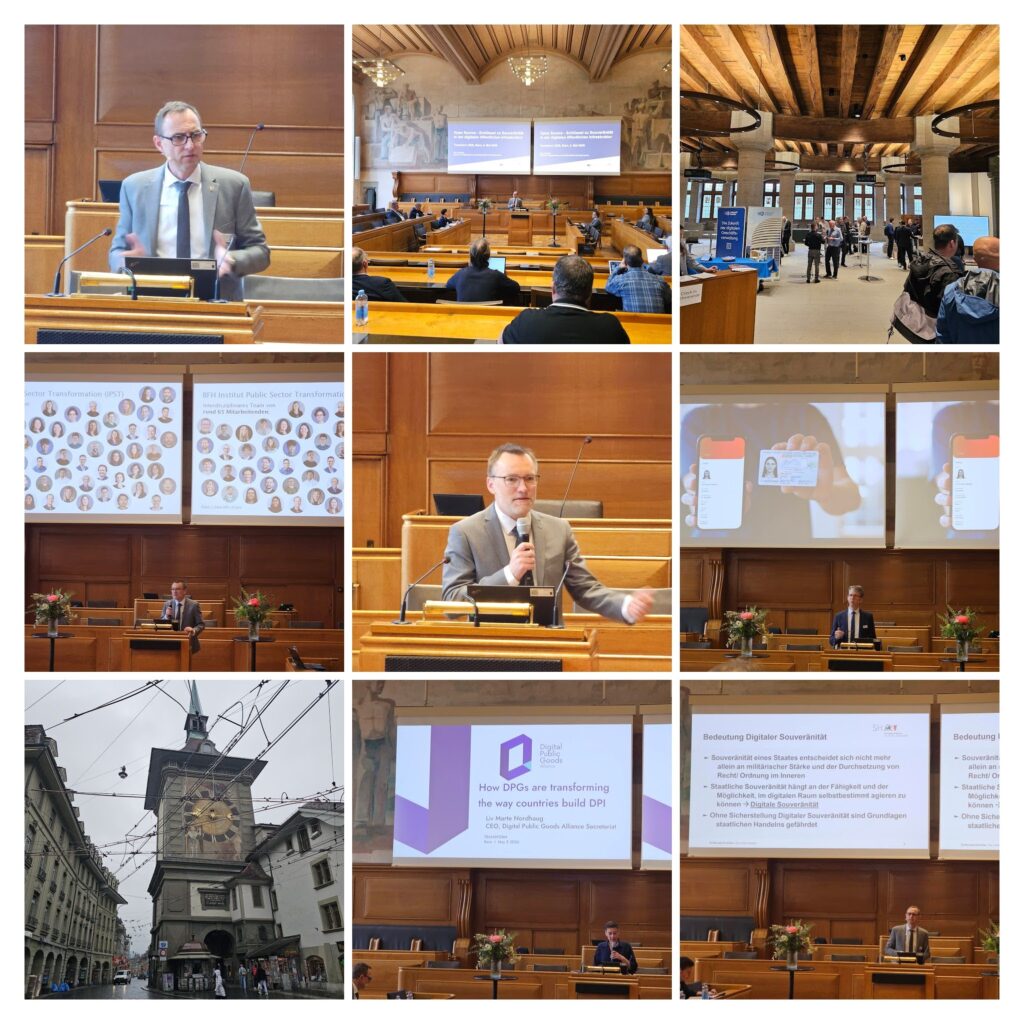
On May 5, 2026, everyone in Switzerland with a stake in digital administration, infrastructure, and sovereignty gathered in Bern. TRANSFORM 2026 brought together experts from politics, public administration, business, and academia at the Bern City Hall – under the theme “Digital Public Infrastructure”.
One thing became very clear: digital sovereignty is no longer an abstract concept. It is becoming real.
From vision to implementation
Over the past years, discussions have often focused on strategies and high-level visions. In Bern, the focus clearly shifted towards implementation. Topics such as e-ID, electronic health records, and mobility data infrastructures show that key building blocks of digital public infrastructure are slowly but visibly taking shape.
At the same time, the core challenge remains: how can federal structures, diverse stakeholders, and existing systems be brought together to create scalable and functional platforms?
Digital public infrastructure as the foundation
A central topic was the role of Digital Public Infrastructure (DPI). These are foundational digital building blocks upon which services can be built – comparable to roads or power grids in the physical world.
This includes identity solutions, data infrastructures, and trust mechanisms. The key question is not just technology, but also governance, openness, and long-term control.
Open source as the anchor of sovereignty
One of the most impactful talks came from Dirk Schrödter.
His key message: digital sovereignty is primarily a technological issue today. It determines whether states can act independently in the digital space – and is therefore a prerequisite for political and economic autonomy.
It also became clear that “Buy European” alone is not enough. Replacing one proprietary dependency with another does not solve the underlying problem.
The real difference lies in openness: open source reduces technological dependencies – and therefore economic ones as well. It creates transparency, control, and long-term independence.
Beyond that, open source was framed as a growth driver: knowledge becomes shareable, innovation accelerates, and collaboration across organizational boundaries becomes possible.
Equally important is the cultural dimension: open source requires a real shift in mindset. Moving away from closed systems and silos towards openness, sharing, transparency, and collaboration. Organizations that embrace this shift build not only better technology, but also more resilient and sustainable structures.
The impact is measurable: a European Commission study (2021) shows that a 10% increase in open source investment could boost EU GDP by 0.4-0.6% and lead to more than 600 additional ICT startups.
And these effects are already visible in practice: Schleswig-Holstein alone saved around EUR 15 million in licensing costs in 2025 – funds that are being reinvested into open source, regional expertise, resilience, and innovation.
Another key takeaway: success requires more than technology – including Open Source Program Offices, strong networks, and active ecosystem development.
Ecosystems over isolated solutions
Another strong theme throughout the event: complex digital challenges cannot be solved in isolation.
It is no longer about individual tools or platforms, but about building functioning ecosystems – connecting public administration, private sector, and communities in a meaningful way.
Digital sovereignty is not only a result of technology choices, but also of how collaboration and marketplaces are structured. This is exactly where platforms like Servala come in – as a sovereign app store connecting providers, technologies, and organizations in an open ecosystem, enabling real choice.
What this means for VSHN
For us at VSHN, TRANSFORM 2026 confirms much of what we have been working on for years.
We build on open source, open standards, and cloud-native platforms. With solutions like APPUiO – Expert Hosting, Servala – Sovereign App Store and Codey – European Code Collaboration, we aim to make digital sovereignty practical while enabling strong ecosystems.
We also actively contribute to open source: projects like k8up (a Kubernetes backup operator for automated backup and restore processes, now a CNCF Sandbox Project), Project Syn (tooling for managing large-scale Kubernetes cluster fleets using GitOps and centralized configuration), and most recently Espejote (a Kubernetes operator for managing arbitrary resources in-cluster, combining GitOps principles and leveraging Server-Side Apply and Jsonnet).
Because in the end, digital sovereignty is not achieved through isolation, but through strong, open, and well-connected systems.
Conclusion
TRANSFORM 2026 showed that Switzerland is moving in the right direction. Maybe not as fast as some would hope – but with a clear trajectory.
Digital sovereignty is becoming tangible – and open source plays a central role.
Now it is time to turn these insights into action.

Markus Speth
Marketing, Communications, People