Digital sovereignty – perspectives from the ecosystem


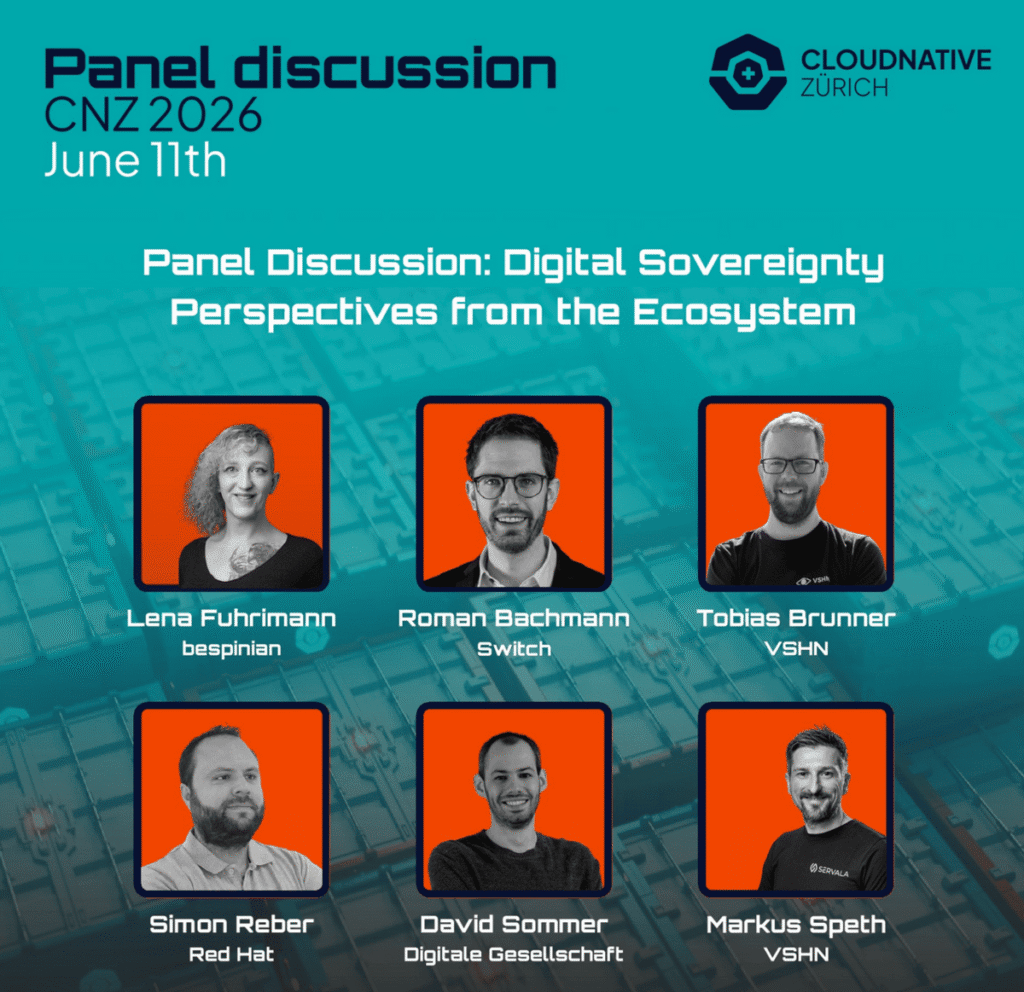
Yesterday at Cloud Native Zürich 2026, we had the chance to moderate a panel discussion in the Sovereignty Track titled “Digital Sovereignty – Perspectives from the Ecosystem.” Five panelists, five very different angles on the same topic – and a room full of people who were interested in Digital Sovereignty.
Setting the scene
The panel didn’t happen in isolation. It came at the end of a morning packed with sovereignty content: David Sterz opened the track making the case that Europe’s cloud future should be distributed by design rather than mirroring the centralized hyperscaler model. Our own Tobias Brunner followed with a talk that connected Swiss sausages (“Cervelat”) to sovereignty – and made a convincing case for why “it’s all open source anyway” is not the same as sovereignty. Pascal Stöckli then introduced Zentrum SDS, the new “Souveräne Digitale Schweiz” initiative bringing together 32 founding organizations from federal authorities, cantons, and Swiss IT companies.
By the time the panel started, the room had already heard that digital sovereignty is distributed, political, operational, and – apparently – has something to do with Cervelat. The panel’s job was to pull these threads together from the perspective of the people actually building, running, and governing this ecosystem.
Five seats, five perspectives
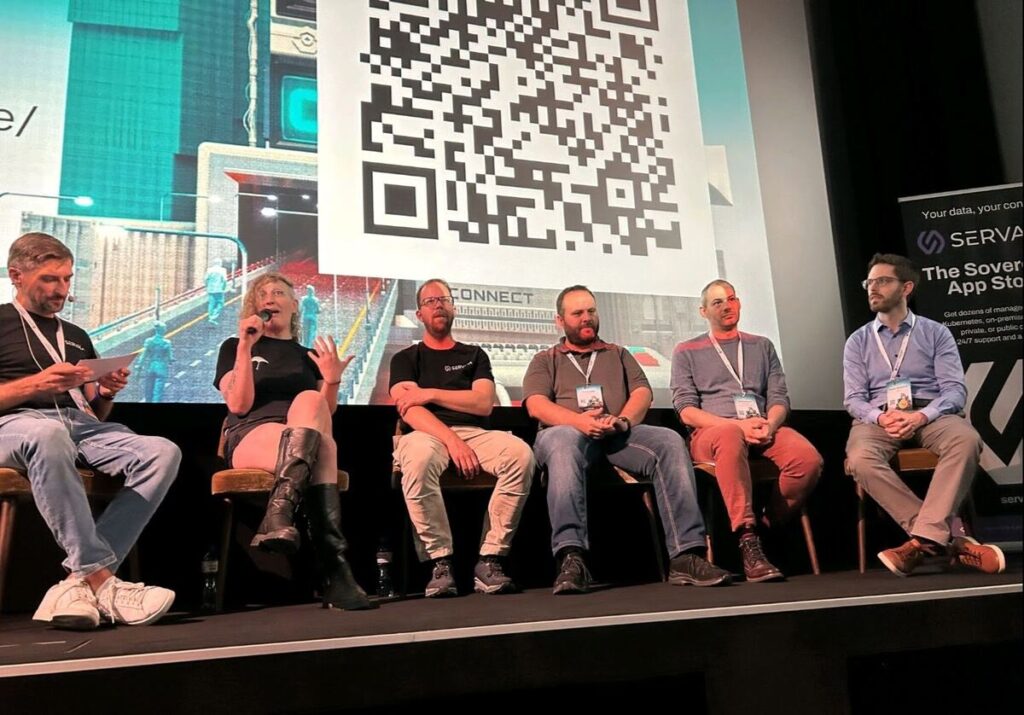
We deliberately put together a panel that covered the ecosystem end to end:
- Lena Fuhrimann (bespinian) – the implementation partner’s perspective, working directly with organizations migrating to cloud native technologies and helping them balance innovation, agility, and control.
- Roman Bachmann (Switch) – the cloud provider’s perspective. Switch operates digital infrastructure for Swiss universities and research institutions and is itself owned by the institutions it serves – sovereignty by design, in a sense.
- Tobias Brunner (VSHN) – the managed service provider’s perspective, on what it actually takes to make digital sovereignty operational: running production systems around the clock, not just writing about it.
- Simon Reber (Red Hat) – the software vendor’s perspective, on how open source contributes to flexibility, interoperability, and sovereignty – and where the limits of that argument are.
- David Sommer (Digitale Gesellschaft) – the civil society perspective, broadening the conversation from technology toward democratic rights, political will, and a digital society that works for everyone.
- Markus Speth (VSHN) – moderator
What we explored
Before diving into the discussion, we asked the audience a simple question: how many of you have used the term “digital sovereignty” in the past six months? Not surprisingly, almost every hand went up.
From there, we asked each panelist for their own definition – and got five genuinely different answers, ranging from technical and operational framings to questions of control, resilience, and democratic values. No single definition won, which was rather the point.
The discussion then moved into more concrete territory: how sovereignty shows up in day-to-day project work working with customers, what it means for a cloud provider to be “sovereign by design”, what it takes to run sovereign infrastructure in production 24/7 rather than on a slide, whether open source is sufficient on its own or just one part of the equation, and where the real blockers sit – in technology, in budgets, or in how organizations make decisions.
We also didn’t shy away from some of the harder numbers floating around this debate: the gap between what European IT leaders say they want to spend on local cloud alternatives and what they actually spend, and the sheer scale difference between hyperscaler investment and the European alternatives currently on the table.
A few things that stuck with us
Reflecting on the discussion afterwards, a few themes stood out:
Digital sovereignty is not a binary state. There’s no certificate that flips an organization from “not sovereign” to “sovereign” – it’s a spectrum across multiple dimensions, and frameworks like the EU Cloud Framework are starting to emerge specifically to measure that.
It’s also about more than where data physically lives. Control, portability, transparency, skills, governance, and legal jurisdiction all play a role – often a bigger one than location alone.
Complete sovereignty, in the sense of controlling everything end to end, is neither realistic nor desirable. Trace any dependency chain far enough and you eventually hit hardware, raw materials, and global supply chains that no single organization – or country – fully controls. The more useful goal is understanding your dependencies and making conscious choices about them.
And perhaps most importantly: sovereignty isn’t something any single company, vendor, or government can solve alone. It needs the whole ecosystem – providers, vendors, open source communities, public institutions, and civil society – all working together.
Which brings us back to a question we asked at the start: is “sovereignty” even the right word? Maybe what most organizations are really after is resilience, autonomy, or freedom of choice, or simply the ability to make their own decisions without having to ask someone else for permission first.
One phrase from our preparation for this panel stayed with us: “sovereignty is a bridge, not a bunker”. The goal isn’t isolation – it’s the freedom to choose your own path while staying connected to a broader ecosystem.
Unfortunately, our time on stage ran out far too quickly. There were so many more angles we could have explored – and judging by the energy in the room, the audience felt the same way.
We’re already thinking about a follow-up session to dig deeper into some of these threads.
Watch the full discussion
The recording of the full panel discussion will be published soon – we’ll share the link as soon as it’s available, so you can hear all five perspectives directly from the panelists themselves.
A big thank you to Lena, Roman, Tobias, Simon, and David for a genuinely thoughtful discussion.
Thanks to the organizers of Cloud Native Zürich
A big thank you to the organizers for putting together another great edition of Cloud Native Zürich. We were happy to be involved as sponsors again – VSHN as a Silver Sponsor, and Servala sponsoring the Sovereignty Track at Cloud Native Zürich 2026.
As part of the track, our colleague Tobias Brunner also held a talk on Servala earlier in the day – we’ll be publishing that recording soon as well, so stay tuned.
If you’re curious about what Servala is and how sovereign, multi-provider managed services on Kubernetes can look in practice – check out Servala – Sovereign App Store, and feel free to get in touch if you’d like to become part of our growing ecosystem.
Also check out our full Cloud Native Zürich 2026 Recap.

Markus Speth
Marketing, Communications, People