General Open Source Sovereignty

Open Source as State Policy: What the EU Strategy and the Swiss Ständerat Vote Mean for IT Decision-Makers

12. Jun 2026

In the span of a few weeks, two policy signals landed that reinforce each other. The European Commission published a new open-source strategy positioning open source as central to EU technological sovereignty. Days later, the Swiss Ständerat accepted a motion for an impulse program on digital sovereignty by 30 to 7, against the Bundesrat’s recommendation. Both name the same mechanism: open-source technology as infrastructure for sovereign, independent digital states.

For Swiss organizations choosing technology stacks and cloud providers, the direction is now unmistakable.

What the EU strategy says

The Commission’s open-source strategy pursues four goals:

  1. Technological sovereignty through open source: scaling European open alternatives to non-EU proprietary solutions, including in digital identity wallets and public services.
  2. Ecosystem development: supporting startups, establishing stewardship frameworks, creating a maintenance instrument for critical open-source projects, and investing in skills.
  3. Public administration leadership: developing open-source procurement guidelines and strengthening the Commission’s Open Source Programme Office (OSPO).
  4. Standards and international cooperation: integrating open-source communities into EU standardization efforts.

The strategy takes a full lifecycle approach: from research through long-term maintenance. It explicitly names the goal of reducing dependence on non-EU technologies and increasing European control over “critical digital infrastructure, including software and hardware systems.”

This is not an abstract policy paper. It follows the EUR 180 million sovereign cloud procurement in April, where open-source technology was one of eight scored sovereignty dimensions. Open source is moving from “nice to have” to procurement criterion.

What the Ständerat decided

On June 10, the Ständerat accepted motion 22.3221 by Heidi Z’graggen (Die Mitte, Uri) calling for an impulse program to strengthen Swiss digital sovereignty. The motion demands seed funding for pilot projects in four areas:

  • Digital infrastructure
  • Open-source technologies
  • Cybersecurity
  • Artificial intelligence

Z’graggen argued that digital sovereignty is “ein zentraler Pfeiler sowohl staatlicher als auch wirtschaftlicher Handlungsfähigkeit” (a central pillar of state and business capability). She emphasized this is time-limited stimulus, not permanent state expansion: “Investitionen in offene, souveräne Technologien stärken unsere Innovationskraft, reduzieren Abhängigkeiten, schaffen Wertschöpfung” (investments in open, sovereign technologies strengthen innovation, reduce dependencies, create value).

The Parldigi parliamentary group backed the motion, citing the geopolitical situation and open source’s cost-saving potential.

Federal President Guy Parmelin recommended rejection, arguing existing strategies and funding instruments (including the “Digitale Schweiz 2026” program) already address digital sovereignty. The Ständerat disagreed, 30 to 7.

The motion now goes to the Nationalrat.

Switzerland already has the legal foundation

What makes the Ständerat vote notable is that Switzerland already has open-source legislation. The EMBAG (Bundesgesetz über den Einsatz elektronischer Mittel zur Erfüllung von Behördenaufgaben), in force since January 1, 2024, establishes:

  • Open Source by default: the federal administration must release self-developed software as open source.
  • Open Government Data: administrative data must be made accessible for free use.
  • Interoperability and open standards: interfaces must be documented and standards can be made binding.

The EMBAG was championed by National Council members Gerhard Andrey and Andri Silberschmidt, and Ständerat member Matthias Michel. When it passed, Switzerland became one of the first countries worldwide to mandate open-source publication of government software.

But a law that mandates release of government-built software is not the same as a program that funds new sovereign infrastructure. The EMBAG says “publish what you build.” The Z’graggen motion says “invest in building more.” The two are complementary: the legal framework exists, but the Ständerat believes implementation needs an impulse.

Two signals, one direction

Read together, the EU strategy and the Swiss vote point to the same conclusion:

EU Open Source StrategySwiss Ständerat Motion
ScopeEU-wide policy frameworkSwiss federal impulse program
MechanismProcurement criteria, OSPOs, maintenance fundingSeed funding for pilot projects
Open source roleCore sovereignty instrumentOne of four priority areas
StatusPublished strategyAccepted by Ständerat (30:7), Nationalrat pending
Legal basisBuilds on Cyber Resilience Act, Interoperable Europe ActBuilds on EMBAG (in force since 2024)

The convergence is not coincidental. Both respond to the same pressures: dependence on US hyperscalers, the CLOUD Act, supply chain risks exposed by geopolitical shifts, and the realization that digital sovereignty requires more than data residency. It requires control over the software stack.

What this means for Swiss organizations

Open source is becoming a compliance expectation, not just a technical preference. The EU scores it in cloud procurement. Switzerland mandates it in government software. Both are moving toward procurement frameworks that favor open, auditable technology over proprietary lock-in.

Public sector demand will grow. If the Nationalrat passes the Z’graggen motion, federal funding for open-source pilot projects will follow. Organizations positioned to deliver sovereign, open-source infrastructure, and to help public sector clients adopt it, have a structural advantage.

The EMBAG creates upstream supply. As the federal administration releases more open-source software, the ecosystem of Swiss-built, Swiss-maintained open-source components grows. This benefits private sector organizations that build on the same stack.

Geopolitical risk is now a board-level topic. Z’graggen’s core argument (dependence on foreign technology providers endangers long-term competitiveness) is the same argument regulated industries have been making for two years. The Ständerat vote gives it political legitimacy beyond the compliance department.

Where VSHN fits

VSHN has operated on the thesis that open source and sovereignty are inseparable since its founding. Every service in the VSHN Application Catalog runs on open-source software (PostgreSQL, MariaDB, Redis, Keycloak, GitLab, OpenBao, Forgejo), operated by a Swiss team on Swiss infrastructure.

The policy direction confirmed by both Brussels and Bern validates this approach:

  • Technology sovereignty: 100% open-source stack, active contributor to CNCF projects (K8up, Crossplane providers), Project Syn, and APPUiO.
  • EMBAG alignment: VSHN’s entire toolchain is open source and auditable. Government clients adopting VSHN services remain EMBAG-compliant without additional effort.
  • Operational sovereignty: Swiss 24/7 operations team, infrastructure-agnostic deployment (customer chooses provider), no foreign vendor dependency.

For organizations evaluating their technology stack against the direction set by EU and Swiss policy, the question is: does your infrastructure depend on a foreign vendor’s proprietary platform, or is it built on open, sovereign technology that you control?

Sources

Aarno Aukia

Aarno is Co-Founder of VSHN AG and provides technical enthusiasm as a Service as CTO.

Contact us

Our team of experts is available for you. In case of emergency also 24/7.

Contact us
General Sovereignty

Digital sovereignty – perspectives from the ecosystem

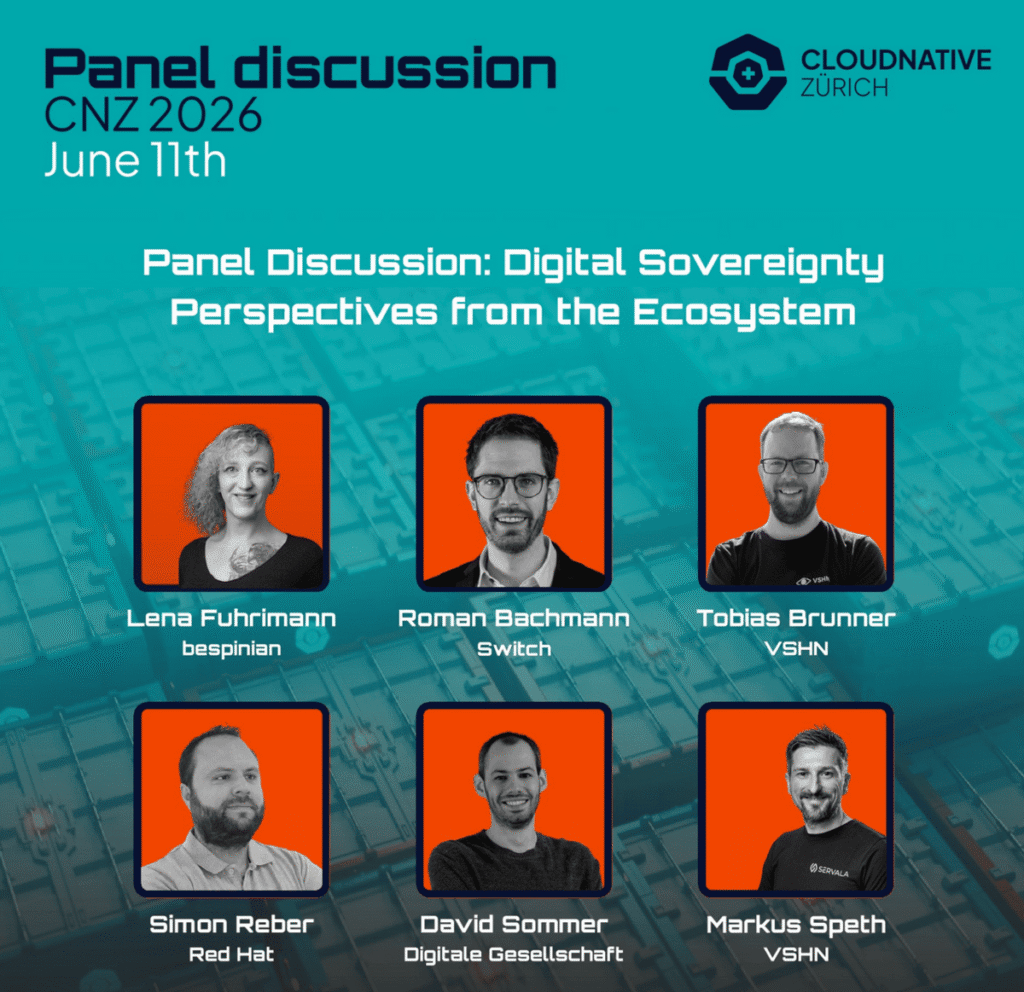
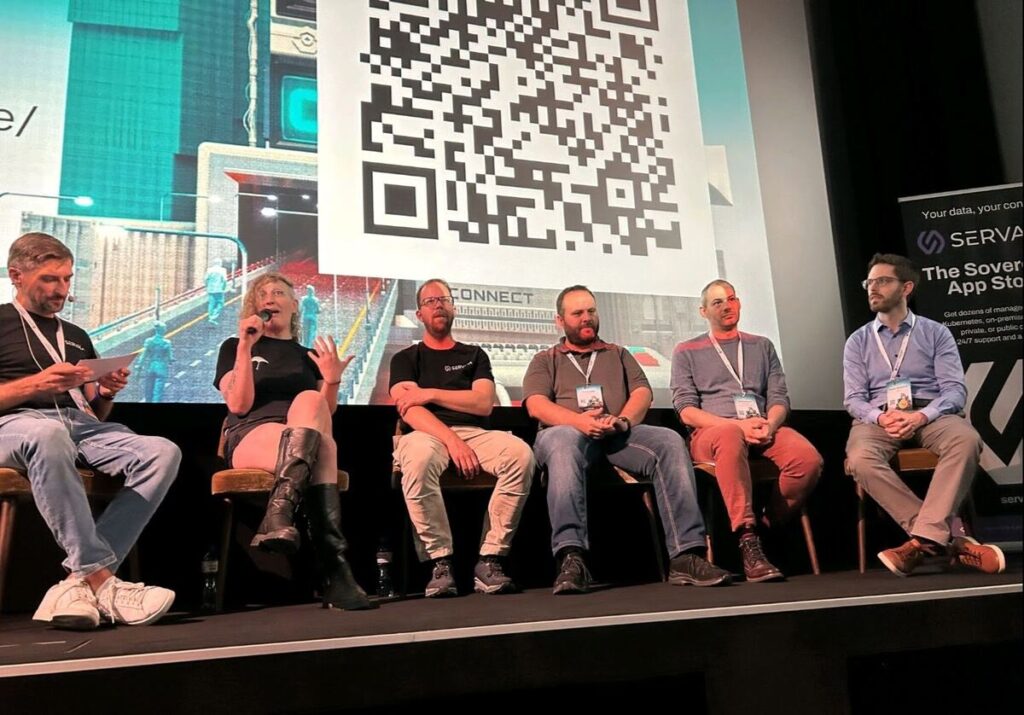
Yesterday at Cloud Native Zürich 2026, we had the chance to moderate a panel discussion in the Sovereignty Track titled “Digital Sovereignty – Perspectives from the Ecosystem.” Five panelists, five very different angles on the same topic – and a room full of people who were interested in Digital Sovereignty.

Setting the scene

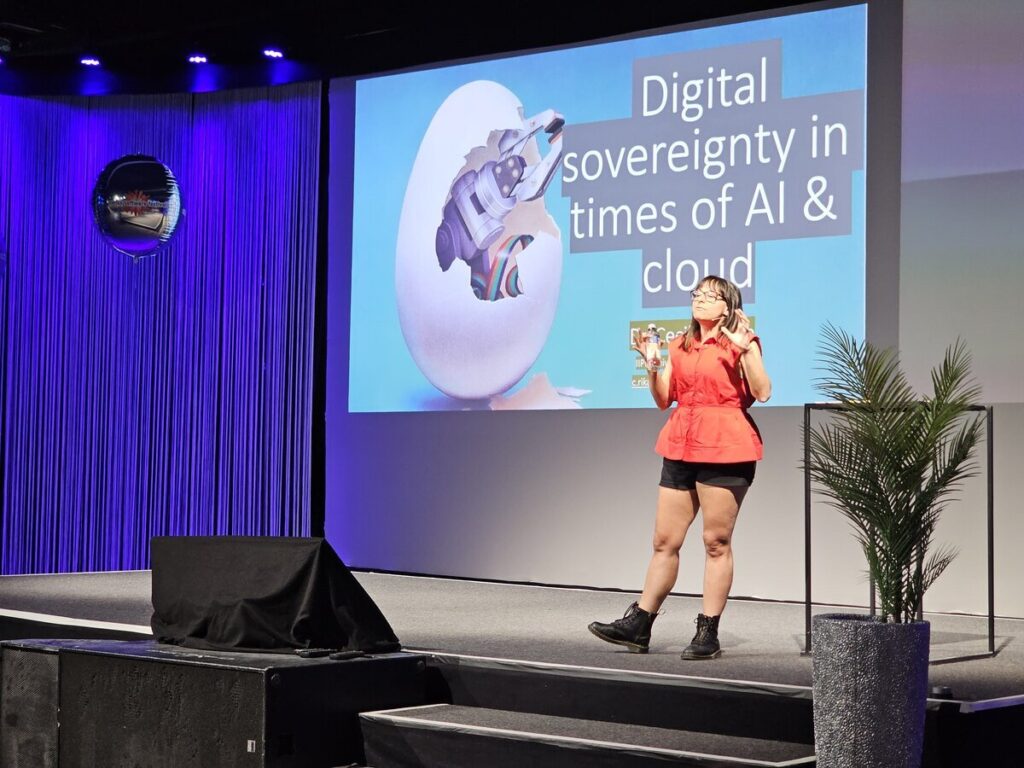
The panel didn’t happen in isolation. It came at the end of a morning packed with sovereignty content: David Sterz opened the track making the case that Europe’s cloud future should be distributed by design rather than mirroring the centralized hyperscaler model. Our own Tobias Brunner followed with a talk that connected Swiss sausages (“Cervelat”) to sovereignty – and made a convincing case for why “it’s all open source anyway” is not the same as sovereignty. Pascal Stöckli then introduced Zentrum SDS, the new “Souveräne Digitale Schweiz” initiative bringing together 32 founding organizations from federal authorities, cantons, and Swiss IT companies.

By the time the panel started, the room had already heard that digital sovereignty is distributed, political, operational, and – apparently – has something to do with Cervelat. The panel’s job was to pull these threads together from the perspective of the people actually building, running, and governing this ecosystem.

Five seats, five perspectives

We deliberately put together a panel that covered the ecosystem end to end:

  • Lena Fuhrimann (bespinian) – the implementation partner’s perspective, working directly with organizations migrating to cloud native technologies and helping them balance innovation, agility, and control.
  • Roman Bachmann (Switch) – the cloud provider’s perspective. Switch operates digital infrastructure for Swiss universities and research institutions and is itself owned by the institutions it serves – sovereignty by design, in a sense.
  • Tobias Brunner (VSHN) – the managed service provider’s perspective, on what it actually takes to make digital sovereignty operational: running production systems around the clock, not just writing about it.
  • Simon Reber (Red Hat) – the software vendor’s perspective, on how open source contributes to flexibility, interoperability, and sovereignty – and where the limits of that argument are.
  • David Sommer (Digitale Gesellschaft) – the civil society perspective, broadening the conversation from technology toward democratic rights, political will, and a digital society that works for everyone.
  • Markus Speth (VSHN) – moderator

What we explored

Before diving into the discussion, we asked the audience a simple question: how many of you have used the term “digital sovereignty” in the past six months? Not surprisingly, almost every hand went up.

From there, we asked each panelist for their own definition – and got five genuinely different answers, ranging from technical and operational framings to questions of control, resilience, and democratic values. No single definition won, which was rather the point.

The discussion then moved into more concrete territory: how sovereignty shows up in day-to-day project work working with customers, what it means for a cloud provider to be “sovereign by design”, what it takes to run sovereign infrastructure in production 24/7 rather than on a slide, whether open source is sufficient on its own or just one part of the equation, and where the real blockers sit – in technology, in budgets, or in how organizations make decisions.

We also didn’t shy away from some of the harder numbers floating around this debate: the gap between what European IT leaders say they want to spend on local cloud alternatives and what they actually spend, and the sheer scale difference between hyperscaler investment and the European alternatives currently on the table.

A few things that stuck with us

Reflecting on the discussion afterwards, a few themes stood out:

Digital sovereignty is not a binary state. There’s no certificate that flips an organization from “not sovereign” to “sovereign” – it’s a spectrum across multiple dimensions, and frameworks like the EU Cloud Framework are starting to emerge specifically to measure that.

It’s also about more than where data physically lives. Control, portability, transparency, skills, governance, and legal jurisdiction all play a role – often a bigger one than location alone.

Complete sovereignty, in the sense of controlling everything end to end, is neither realistic nor desirable. Trace any dependency chain far enough and you eventually hit hardware, raw materials, and global supply chains that no single organization – or country – fully controls. The more useful goal is understanding your dependencies and making conscious choices about them.

And perhaps most importantly: sovereignty isn’t something any single company, vendor, or government can solve alone. It needs the whole ecosystem – providers, vendors, open source communities, public institutions, and civil society – all working together.

Which brings us back to a question we asked at the start: is “sovereignty” even the right word? Maybe what most organizations are really after is resilience, autonomy, or freedom of choice, or simply the ability to make their own decisions without having to ask someone else for permission first.

One phrase from our preparation for this panel stayed with us: “sovereignty is a bridge, not a bunker”. The goal isn’t isolation – it’s the freedom to choose your own path while staying connected to a broader ecosystem.

Unfortunately, our time on stage ran out far too quickly. There were so many more angles we could have explored – and judging by the energy in the room, the audience felt the same way.

We’re already thinking about a follow-up session to dig deeper into some of these threads.

Watch the full discussion

The recording of the full panel discussion will be published soon – we’ll share the link as soon as it’s available, so you can hear all five perspectives directly from the panelists themselves.

A big thank you to Lena, Roman, Tobias, Simon, and David for a genuinely thoughtful discussion.

Thanks to the organizers of Cloud Native Zürich

A big thank you to the organizers for putting together another great edition of Cloud Native Zürich. We were happy to be involved as sponsors again – VSHN as a Silver Sponsor, and Servala sponsoring the Sovereignty Track at Cloud Native Zürich 2026.

As part of the track, our colleague Tobias Brunner also held a talk on Servala earlier in the day – we’ll be publishing that recording soon as well, so stay tuned.

If you’re curious about what Servala is and how sovereign, multi-provider managed services on Kubernetes can look in practice – check out Servala – Sovereign App Store, and feel free to get in touch if you’d like to become part of our growing ecosystem.

Also check out our full Cloud Native Zürich 2026 Recap.

Markus Speth

Marketing, Communications, People

Contact us

Our team of experts is available for you. In case of emergency also 24/7.

Contact us
General Press Servala Sovereignty

Switch joins Servala as Cloud Service Provider to strengthen Switzerland’s digital sovereignty

10. Jun 2026

Switch joins Servala as Cloud Service Provider to strengthen Switzerland’s digital sovereignty

Press release: Zurich, Switzerland – June 10th, 2026

VSHN and Switch are pleased to announce a new partnership: Switch is joining Servala as a Cloud Service Provider (CSP), expanding its ecosystem of sovereign managed services in Switzerland.

The Switch foundation is a key pillar of Switzerland’s digital sovereignty. As the operator of the Swiss National Research and Education Network (NREN), Switch connects universities, and research institutions nationwide and beyond. In addition to its network backbone, Switch provides digital identity solutions, cyber security, cloud services, procurement and collaboration services to research and education institutions – forming a cornerstone of digital innovation in academia.

With around 180 employees and decades of experience, Switch plays a central role in providing secure, reliable, and high-performance digital platforms and critical infrastructure for the Swiss education and research community.

By joining Servala, Switch is extending its portfolio of cloud services to include access to a growing ecosystem of cloud-native managed services. These services can be deployed and operated in a standardised, automated, and production-ready way – aligned with the needs of universities and research institutions that require reliability, scalability, compliance, and long-term sustainability.

ROMAN BACHMANN, Head of Cloud & IT, ad interim, Switch: “By integrating Servala, we are responding to our customers’ frequent requests to be able to provision a managed database, cache or queue at the touch of a button. This way, we are expanding our Switch Cloud service portfolio with key services that are indispensable in modern software development.”

The partnership comes at a time of increasing demand for sovereign digital infrastructure in Switzerland. Organisations are looking for alternatives that combine modern cloud capabilities, providing local control, transparency, and independence from global hyperscalers at the same time.

This is where Servala comes in.

Servala connects Swiss cloud providers, software vendors, and service operators into a collaborative ecosystem. This model allows for greater flexibility, resilience, and innovation – while keeping data and operations under local control.

Servala creates shared value across the entire community:

  • Universities and research institutions gain access to modern, production-ready services tailored to their needs
  • Organisations retain freedom of choice and avoid vendor lock-in
  • Swiss providers collaborate and combine their expertise instead of operating in isolation
  • The Swiss education area is strengthened through local innovation and trusted partnerships

TOBIAS BRUNNER, Product Manager & Partner, VSHN: “What excites me most about this partnership is the shared values. Switch and VSHN have both built their reputation on trust, reliability, and a long-term perspective – not on lock-in. By joining Servala, Switch helps us demonstrate that Swiss providers can collaborate and innovate together, for the benefit of the entire ecosystem.”

For Switch, this partnership marks a step towards evolving its service offering to include cloud-native platforms and managed services. For VSHN and the broader Servala ecosystem, Switch is a strong new partner deeply rooted in the Swiss education and research sector.

Both organisations have already started working on an initial Servala minimum viable product (MVP) tailored to the Switch community. Early interest from universities and research institutions highlights the demand for sovereign, easy-to-access services.

About Servala
Servala is the sovereign application platform connecting cloud providers, software vendors, managed service providers and implementation partners to deliver cloud-native services without vendor lock-in. Built on open standards and designed for interoperability, Servala enables organizations to deploy and operate applications across multiple clouds and on-premises environments in a consistent and automated way.

At its core, Servala is not a single provider, but an ecosystem. It brings together Swiss and European partners who combine their infrastructure, software and operational expertise to deliver fully managed services. This collaborative model ensures transparency, flexibility and long-term independence for customers.

With a strong focus on digital sovereignty, Servala allows organizations to retain full control over their data, workloads and technology choices while benefiting from modern platform engineering practices, automation and scalable operations.

Servala was initiated by VSHN and is developed in close collaboration with ecosystem partners. The platform brings together services operated by multiple providers, including VSHN and other independent partners.

About Switch
Switch is the digitalisation partner for Swiss universities. The foundation collaborates with educational and research institutions to develop secure and future-oriented digital platforms and critical infrastructure. Its activities are focused on strengthening cyber security, the universal use of digital identities and sovereign cloud solutions. Switch has also operated and protected domain names ending in .ch and .li since the early days of the Internet. The non-profit foundation employs around 180 people in Zurich and Lausanne.

About VSHN
VSHN – The DevOps Company – transforms software into reliable online services by automating and operating application workloads. As Switzerland’s leading Managed Service Provider, VSHN specializes in DevOps, Kubernetes, OpenShift, and cloud-native operations, enabling organizations to run business-critical applications reliably, securely, and at scale.

VSHN provides platform engineering, 24/7 operations, and fully managed services across public cloud, private cloud, and on-premises environments – without operating its own infrastructure. Through solutions like Managed OpenShift, APPUiO, Application Catalog, and Servala, VSHN helps organizations simplify operations, avoid vendor lock-in, and retain full control over their workloads.

Founded in 2014 and 100% self-owned, VSHN serves over 350 customers and partners across 16 cloud platforms worldwide. With ISO 27001 certification, FINMA-aligned operations, and ISAE 3402 Type 2 audits, VSHN ensures the highest security and compliance standards.

Markus Speth

Marketing, Communications, People

Contact us

Our team of experts is available for you. In case of emergency also 24/7.

Contact us
General OpenShift Press Sovereignty

Digital Sovereignty Made in Switzerland: HIN Becomes a Global Red Hat Success Story

12. May 2026

A Swiss Success Story with Global Impact

When we originally published the HIN (Health Info Net) success story at VSHN, we already knew this project was something special.

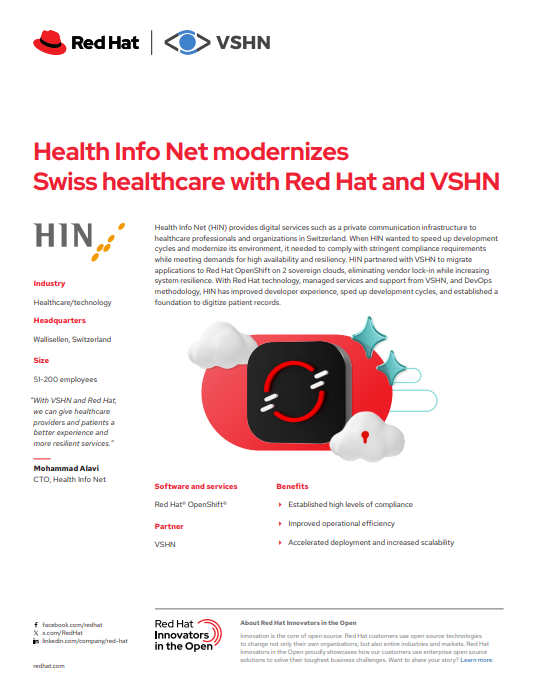
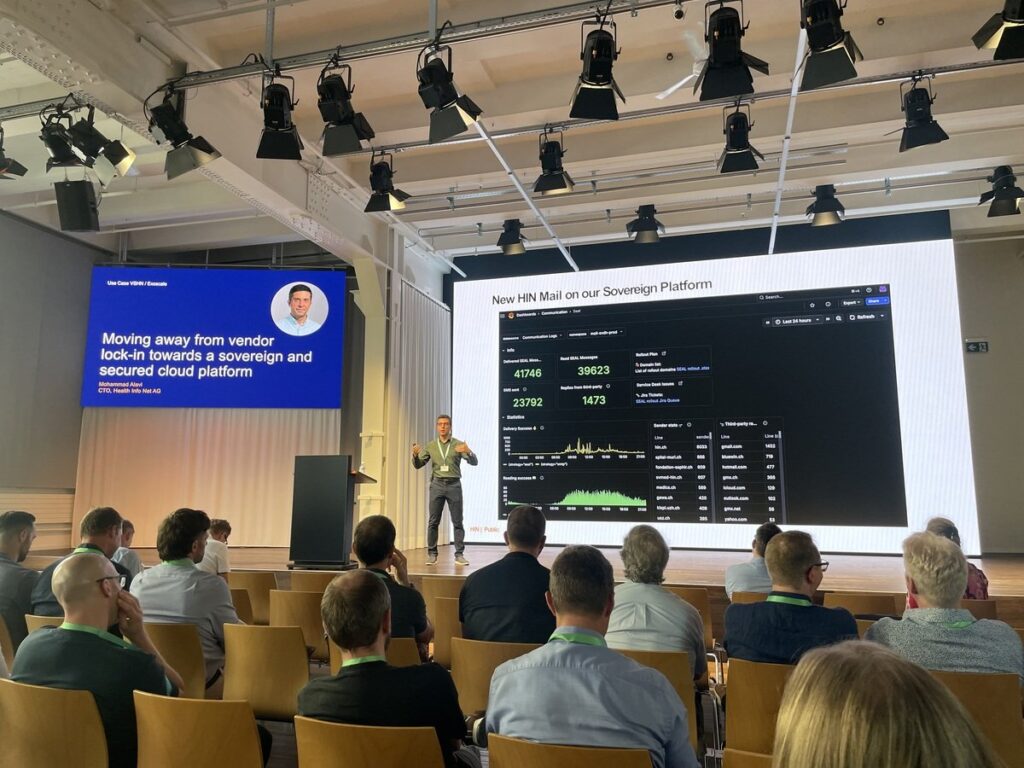
Now, the story has reached a global stage: Red Hat officially published the modernization of HIN as a global customer success story and announced it during Red Hat Summit 2026 in Atlanta on May 11, 2026.

For us, this is far more than just another reference project. It is a strong validation that sovereign, open, cloud-native infrastructure is no longer a niche topic – it is becoming a strategic requirement for critical industries such as healthcare.

And it also highlights something important: Switzerland is no longer only discussing digital sovereignty in theory. It is actively building it.

Why HIN (Health Info Net) Matters

HIN is one of the most important digital healthcare platforms in Switzerland.

More than 50,000 healthcare professionals use HIN services, and over 90% of relevant actors in the Swiss healthcare ecosystem are connected through the platform. Secure communication, digital identities, and trust are at the core of the Swiss healthcare ecosystem – and HIN plays a central role in enabling this infrastructure.

This makes HIN far more than a typical IT platform. It is part of Switzerland’s critical digital infrastructure.

Modernizing such a platform is therefore not simply about upgrading technology. It is about resilience, security, operational flexibility, long-term independence, and trust.

From Legacy Infrastructure to a Sovereign Cloud-Native Platform

Like many established organizations, HIN faced the challenge of evolving a proven and highly trusted platform while preparing it for future requirements.

The goal was not change for the sake of change. The objective was to build a modern operating model that increases flexibility, automation, scalability, and security – without compromising stability and reliability.

Together with Red Hat and VSHN, HIN modernized its platform using Red Hat OpenShift and cloud-native technologies.

The result:

  • A more flexible and scalable platform architecture
  • Increased automation and operational efficiency
  • Stronger security segmentation and Zero Trust principles
  • Kubernetes Gateway API-based protection for web applications and APIs
  • Greater portability and long-term independence
  • A modern foundation for future healthcare services

One particularly important aspect was avoiding unnecessary vendor lock-in.

Digital sovereignty does not mean isolation. It means maintaining strategic control over critical infrastructure, data, operations, and future decisions. Open standards, Kubernetes, and Open Source technologies are key building blocks for achieving this.

Security and Sovereignty Go Hand in Hand

Healthcare platforms are among the most demanding environments when it comes to security and compliance.

The HIN platform therefore consistently applies Defense in Depth and Zero Trust concepts – including network microsegmentation, clear workload segmentation, and modern authentication mechanisms.

As part of this cloud-native security approach, HIN also uses Airlock Microgateway to protect applications and APIs directly within the OpenShift environment. This adds Kubernetes-native Web Application and API Protection close to the workloads and fits naturally into an automated, container-based operating model.

This is an important point that is often overlooked in sovereignty discussions:
Open infrastructure and digital sovereignty are not in conflict with security – they can significantly strengthen it.

Cloud-native architectures enable highly automated, resilient, and observable systems while still maintaining strong control over where and how workloads operate.

Recognition Beyond Switzerland

This project has now received recognition on multiple levels.

Earlier this year, VSHN received the Red Hat Partner Award 2025 for Platform Modernization for the joint success with HIN.

Now, Red Hat has further elevated the story through an official global success story announcement during Red Hat Summit 2026 in Atlanta.

For us, this recognition is not only about VSHN. It highlights the growing importance of sovereign digital infrastructure across Europe and Switzerland.

And it shows that Open Source, Kubernetes, and cloud-native operating models are no longer purely technical topics. They are increasingly becoming strategic foundations for critical industries and public trust.

A Blueprint for Sovereign Digital Infrastructure

We believe the HIN story represents far more than a single modernization project.

Organizations across Europe are currently rethinking:

  • dependencies on hyperscalers
  • operational resilience
  • data sovereignty
  • supply chain risks
  • long-term platform strategies
  • digital sovereignty requirements

In healthcare, these challenges become especially tangible.

HIN demonstrates that modern sovereign infrastructure is already possible today – with Open Source, strong ecosystem partnerships, and cloud-native operating models.

And perhaps most importantly: digital sovereignty can be practical, operationalized, and production-ready.

Not as a future vision.
But as infrastructure already running today.

Projects like this are not built by technology alone. A huge thank you to the entire HIN team for the excellent collaboration and trust – and to all VSHNeers whose incredible dedication made this project possible.

Download the Case Study

Health Info Net is modernizing healthcare with Red Hat and VSHN.

Learn More

👉 Red Hat Success Story

👉 Red Hat Case Study

👉 VSHN HIN Success Story

👉 Red Hat Partner Award Announcement

Markus Speth

Marketing, Communications, People
Contact us

Our team of experts is available for you. In case of emergency also 24/7.

Contact us
General Sovereignty

TRANSFORM 2026 – Why Open Source Makes Digital Sovereignty Real

5. May 2026

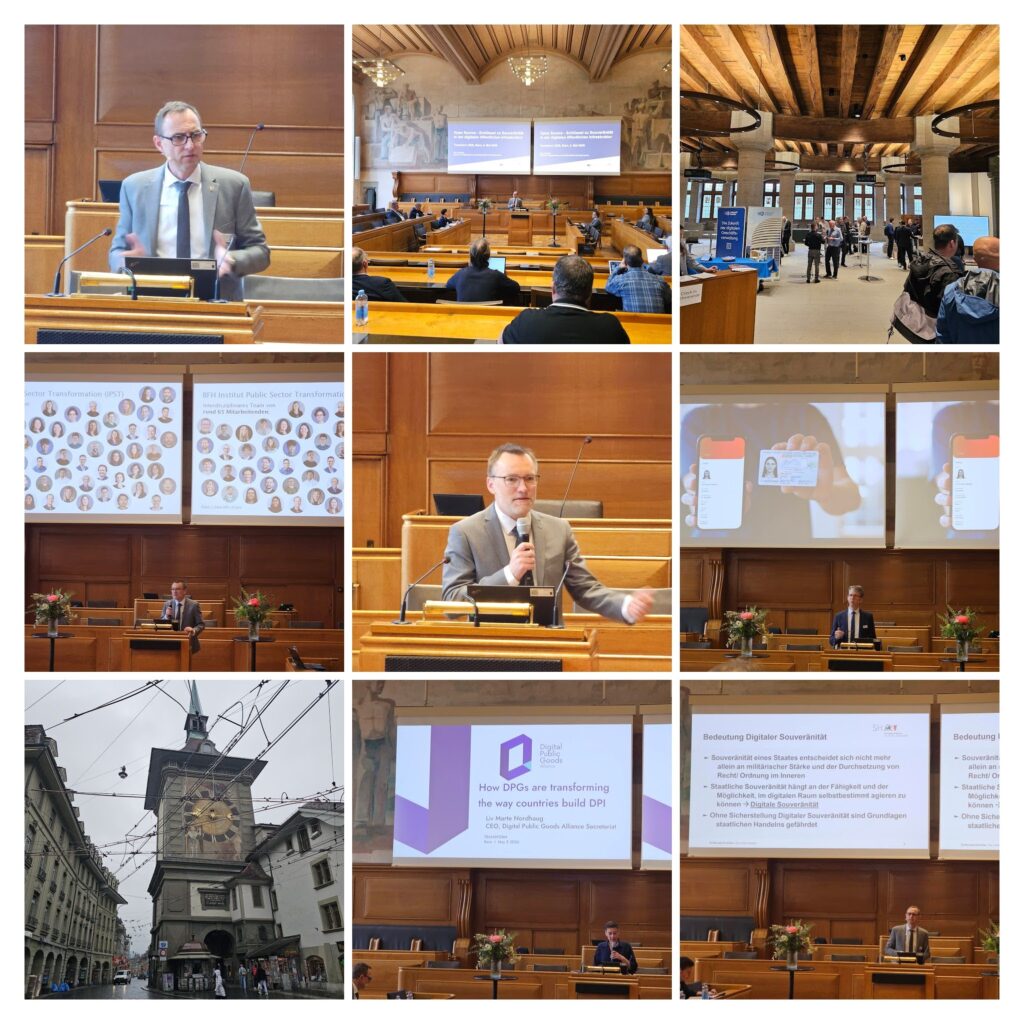
On May 5, 2026, everyone in Switzerland with a stake in digital administration, infrastructure, and sovereignty gathered in Bern. TRANSFORM 2026 brought together experts from politics, public administration, business, and academia at the Bern City Hall – under the theme “Digital Public Infrastructure”.

One thing became very clear: digital sovereignty is no longer an abstract concept. It is becoming real.

From vision to implementation

Over the past years, discussions have often focused on strategies and high-level visions. In Bern, the focus clearly shifted towards implementation. Topics such as e-ID, electronic health records, and mobility data infrastructures show that key building blocks of digital public infrastructure are slowly but visibly taking shape.

At the same time, the core challenge remains: how can federal structures, diverse stakeholders, and existing systems be brought together to create scalable and functional platforms?

Digital public infrastructure as the foundation

A central topic was the role of Digital Public Infrastructure (DPI). These are foundational digital building blocks upon which services can be built – comparable to roads or power grids in the physical world.

This includes identity solutions, data infrastructures, and trust mechanisms. The key question is not just technology, but also governance, openness, and long-term control.

Open source as the anchor of sovereignty

One of the most impactful talks came from Dirk Schrödter.

His key message: digital sovereignty is primarily a technological issue today. It determines whether states can act independently in the digital space – and is therefore a prerequisite for political and economic autonomy.

It also became clear that “Buy European” alone is not enough. Replacing one proprietary dependency with another does not solve the underlying problem.

The real difference lies in openness: open source reduces technological dependencies – and therefore economic ones as well. It creates transparency, control, and long-term independence.

Beyond that, open source was framed as a growth driver: knowledge becomes shareable, innovation accelerates, and collaboration across organizational boundaries becomes possible.

Equally important is the cultural dimension: open source requires a real shift in mindset. Moving away from closed systems and silos towards openness, sharing, transparency, and collaboration. Organizations that embrace this shift build not only better technology, but also more resilient and sustainable structures.

The impact is measurable: a European Commission study (2021) shows that a 10% increase in open source investment could boost EU GDP by 0.4-0.6% and lead to more than 600 additional ICT startups.

And these effects are already visible in practice: Schleswig-Holstein alone saved around EUR 15 million in licensing costs in 2025 – funds that are being reinvested into open source, regional expertise, resilience, and innovation.

Another key takeaway: success requires more than technology – including Open Source Program Offices, strong networks, and active ecosystem development.

Ecosystems over isolated solutions

Another strong theme throughout the event: complex digital challenges cannot be solved in isolation.

It is no longer about individual tools or platforms, but about building functioning ecosystems – connecting public administration, private sector, and communities in a meaningful way.

Digital sovereignty is not only a result of technology choices, but also of how collaboration and marketplaces are structured. This is exactly where platforms like Servala come in – as a sovereign app store connecting providers, technologies, and organizations in an open ecosystem, enabling real choice.

What this means for VSHN

For us at VSHN, TRANSFORM 2026 confirms much of what we have been working on for years.

We build on open source, open standards, and cloud-native platforms. With solutions like APPUiO – Expert Hosting, Servala – Sovereign App Store and Codey – European Code Collaboration, we aim to make digital sovereignty practical while enabling strong ecosystems.

We also actively contribute to open source: projects like k8up (a Kubernetes backup operator for automated backup and restore processes, now a CNCF Sandbox Project), Project Syn (tooling for managing large-scale Kubernetes cluster fleets using GitOps and centralized configuration), and most recently Espejote (a Kubernetes operator for managing arbitrary resources in-cluster, combining GitOps principles and leveraging Server-Side Apply and Jsonnet).

Because in the end, digital sovereignty is not achieved through isolation, but through strong, open, and well-connected systems.

Conclusion

TRANSFORM 2026 showed that Switzerland is moving in the right direction. Maybe not as fast as some would hope – but with a clear trajectory.

Digital sovereignty is becoming tangible – and open source plays a central role.

Now it is time to turn these insights into action.

Markus Speth

Marketing, Communications, People
Contact us

Our team of experts is available for you. In case of emergency also 24/7.

Contact us
General Sovereignty

VSHN is a founding member of Zentrum SDS – Souveräne Digitale Schweiz

29. Apr 2026

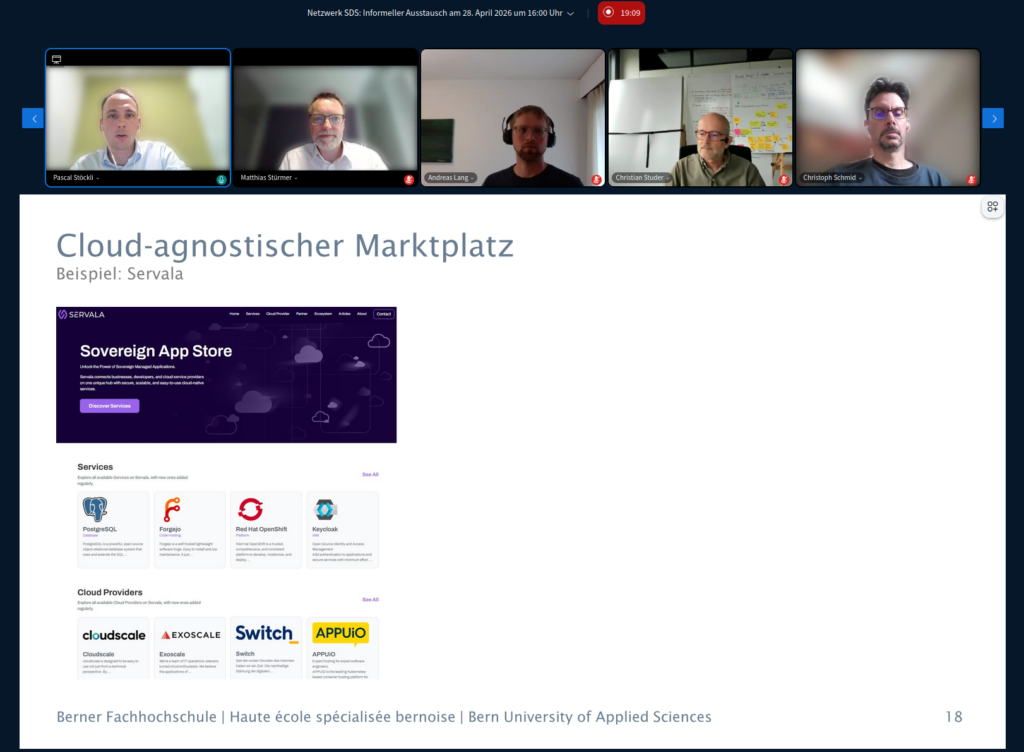
On April 28, 2026, the Zentrum SDS – Souveräne Digitale Schweiz officially launched its activities – and we at VSHN are very happy to be part of the founding members.

Together with 30 other organizations from government, business, and academia, we are sending a clear signal: digital sovereignty in Switzerland is no longer an abstract concept – it is actively being shaped. Participants include institutions such as Kommando Cyber, the Canton of Solothurn, the Office for IT and Organization of the Canton of Bern, the Statistical Office of the Canton of Basel-Stadt, Organization and Informatics (OIZ) of the City of Zurich, the SWITCH foundation, as well as many leading Swiss IT companies.

The announcement can also be read on netzwoche and Inside-IT.

Why the Zentrum SDS matters

Digital sovereignty means maintaining control over data, technologies, and digital infrastructure – and consciously deciding which dependencies to accept. This is exactly where the Zentrum SDS comes in: it brings together key stakeholders to jointly develop solutions, define standards, and drive concrete alternatives forward.

In the coming months, members will collaborate across four key areas:

  • Financing and procurement of Open Source technologies
  • Sovereign workplace solutions such as openDesk
  • Swiss cloud offerings
  • Open Source-based AI platforms

The initiative was launched by the Institut Public Sector Transformation at the Berner Fachhochschule. Thanks to the contributions of its members, the collaboration can be structured effectively and developed sustainably over time.

Open Source as a key to sovereignty

A central pillar is the use of Open Source technologies. They enable transparency, control, and independence – exactly the qualities required for a sovereign digital infrastructure.

The growing international importance of this topic is reflected in the close collaboration with Germany. There is active exchange with the Zentrum für Digitale Souveränität der Öffentlichen Verwaltung (ZenDis), which is involved in the development of openDesk.

A highlight in this context is the TRANSFORM conference 2026 on May 5, 2026 in Bern. There, Dirk Schrödter will demonstrate how Open Source concretely contributes to digital sovereignty. The program is complemented by international perspectives on Digital Public Goods and insights into the role of the state in digital infrastructure.

Servala – Sovereign App Store as a cloud-agnostic marketplace

With Servala, we at VSHN are taking this idea one step further. Servala connects providers, partners, and enterprises through a cloud-agnostic marketplace, making sovereign, standardized services easy to consume. Instead of locking into a single cloud provider early on, Servala enables real choice – based on open standards and interoperable services.

In the context of the Zentrum SDS, we see strong potential here: a shared ecosystem where services are available across different providers strengthens not only sovereignty, but also innovation and collaboration across the entire market.

Our perspective at VSHN

For us, participating in the Zentrum SDS is a natural next step. For years, we have been building on Open Source, open standards, and collaborative ecosystems – whether operating Kubernetes platforms, developing platforms like APPUiO, or driving initiatives like Servala.

Digital sovereignty does not emerge through isolation, but through collaboration on equal footing. This is exactly what the Zentrum SDS enables: a shared foundation on which innovation, security, and independence can grow together.

See also: EUR 180 Million for Sovereign Cloud: What the EU’s First Sovereignty-Scored Procurement Means for Swiss Organisations.

We look forward to actively shaping this journey.

Markus Speth

Marketing, Communications, People
Contact us

Our team of experts is available for you. In case of emergency also 24/7.

Contact us
General Sovereignty

EUR 180 Million for Sovereign Cloud: What the EU’s First Sovereignty-Scored Procurement Means for Swiss Organisations

24. Apr 2026

On April 17, 2026, the European Commission awarded EUR 180 million in cloud contracts to four European providers – Post Telecom Luxembourg, STACKIT, Scaleway, and Proximus. For the first time, providers were scored on sovereignty using a formal framework with eight measurable dimensions. Hyperscaler involvement cost one consortium a lower score. Here is what this means for Swiss organizations choosing cloud providers.

The EU now scores sovereignty

The Commission’s Cloud Sovereignty Framework (v1.2.1, October 2025) defines eight Sovereignty Objectives and five assurance levels (SEAL-0 to SEAL-4). Providers bidding for these contracts were evaluated on:

  • Strategic sovereignty – EU ownership and anchoring, resilience against foreign interference
  • Legal & jurisdictional sovereignty – insulation from extraterritorial laws such as the US CLOUD Act
  • Data & AI sovereignty – where data is stored, who holds encryption keys, independence of AI services
  • Operational sovereignty – can EU-based teams operate the service independently?
  • Supply chain sovereignty – geographic origin of components and sub-suppliers (highest weight: 20%)
  • Technology sovereignty – open source, open standards, no proprietary lock-in
  • Security & compliance sovereignty – certifications, independent patching, EU-based SOC
  • Environmental sustainability – energy efficiency, renewable energy, carbon disclosure

Each objective carries a defined weight. Supply chain sovereignty is the highest at 20%, followed by strategic, operational, and technology sovereignty at 15% each.

What the results tell us

Three of the four winners achieved SEAL-3 (“Digital Resilience”), meaning EU actors exercise meaningful control with only marginal non-EU influence:

ProviderCountryPartnersSEAL Level
Post TelecomLuxembourgCleverCloud, OVHcloudSEAL-3
STACKIT (Schwarz Group)GermanySEAL-3
Scaleway (Iliad Group)FranceSEAL-3
ProximusBelgiumS3NS (Thales/Google Cloud JV), Clarence, MistralSEAL-2

The Proximus consortium – which includes S3NS, a joint venture between Thales and Google Cloud – achieved only SEAL-2 (“Data Sovereignty”), where EU law is enforceable but material non-EU dependencies remain.

The message is clear: involving a US hyperscaler – even through a European joint venture with a defense contractor – measurably reduces your sovereignty score. The framework does not ban hyperscaler partnerships, but it scores them lower.

Why Swiss organizations should pay attention

Although this procurement targets EU institutions, the framework will cascade:

  • EU member states will adopt similar criteria for national cloud procurement, following France’s “Cloud de Confiance” and Germany’s “Souveräner Cloud” strategies that the framework explicitly references.
  • Regulated industries (banking, insurance, healthcare) already face FINMA, DORA, and NIS2 requirements that overlap with these sovereignty objectives – particularly legal jurisdiction, data sovereignty, and security compliance.
  • Swiss public sector procurement increasingly references EU standards. Organizations evaluating cloud providers now have a structured vocabulary to compare sovereignty claims instead of relying on marketing.

Eight dimensions, not just “data stays in Switzerland.”

Most sovereignty marketing stops at data residency. The EU framework goes much further – and so should your evaluation criteria:

DimensionWhat to ask your provider
StrategicWho owns the company? Any foreign investors or parent entities?
LegalWhich law governs your contracts? Are you exposed to the US CLOUD Act?
DataWhere is data stored? Who holds the encryption keys?
OperationalWhere is your operations team? Can you patch and upgrade without any non-EU vendor?
Supply chainWho are your infrastructure sub-suppliers? Can you disclose the full chain?
TechnologyIs the software open source? Can I migrate to another provider?
SecurityWhere is your SOC? Can you apply security patches independently?
EnvironmentalWhat is your energy source? Do you disclose PUE and carbon emissions?

Where VSHN stands: self-assessment against the framework

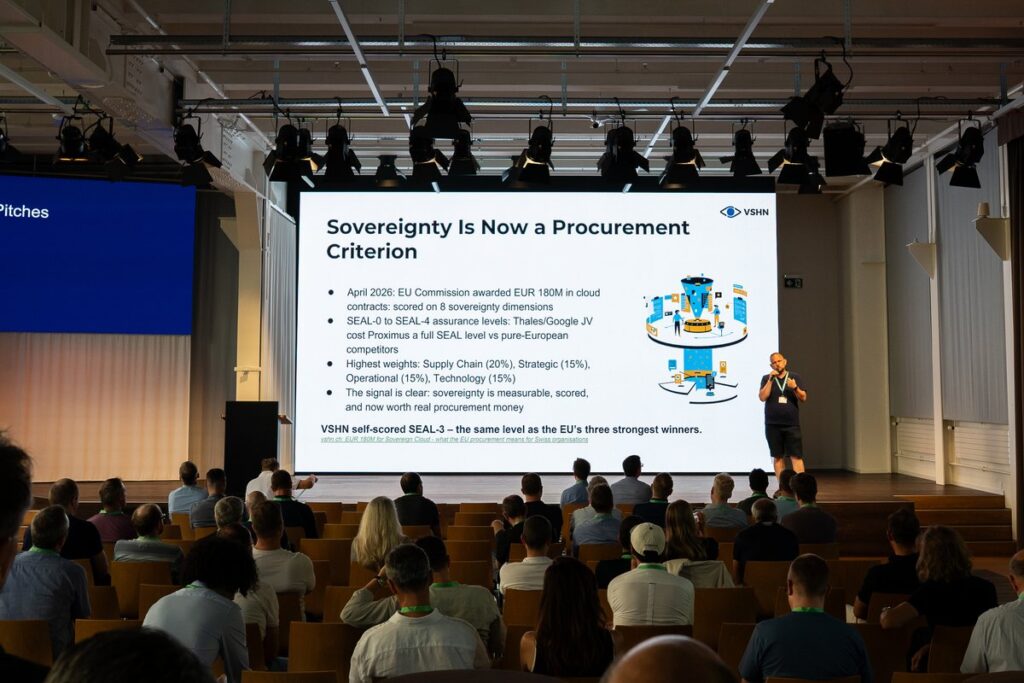
We applied the EU’s eight sovereignty objectives to our own services. This is a self-assessment – VSHN has not been formally scored by the European Commission – but we believe transparency is more useful than vague claims. The full assessment with references is available on request.

#DimensionWeightVSHN assessmentEvidence
SOV-1Strategic15%StrongSwiss AG, no foreign parent company, all shareholders Swiss citizens (Commercial Register)
SOV-2Legal10%StrongSwiss law governs all contracts (GTC), no CLOUD Act exposure, EU adequacy decision for Switzerland
SOV-3Data & AI10%StrongInfrastructure-agnostic: customer chooses provider. Open-source software, fully auditable. Swiss-owned options available (e.g., cloudscale.ch — 100% Swiss-owned)
SOV-4Operational15%StrongSwiss 24/7 ops team, optional Switzerland-only support. All services available on vanilla Kubernetes — no non-Swiss vendor dependency required
SOV-5Supply Chain20%StrongInfrastructure-agnostic: customer chooses provider. Open-source software, fully auditable. Swiss-owned options available (e.g. cloudscale.ch — 100% Swiss-owned)
SOV-6Technology15%Strong100% open-source stack. Active contributor: K8up (CNCF Sandbox), Crossplane providersProject SynAPPUiO
SOV-7Security10%StrongISO 27001, ISAE 3402 Type II (2025), Swiss SOC. Serving FINMA-regulated customers
SOV-8Environmental5%ModerateCloudscale operates in Green Datacenter AG facilities (ISO 22301/27001/27701). Exoscale sustainability with per-customer environmental impact reports. VSHN CSR policy

Overall: SEAL-3 equivalent – the same level achieved by the three strongest providers in the EU’s own tender. No provider achieved SEAL-4.

Why not SEAL-4?

SEAL-4 (“Full Sovereignty”) requires complete EU/EEA control with no non-EU dependencies. No provider achieved it – not even in the EU’s own EUR 180M procurement. The gaps are structural, not provider-specific:

  • Switzerland is not an EU/EEA member but participates in the single market through bilateral agreements, is Schengen-associated, and has an EU adequacy decision for data protection. The gap is formal, not substantive.
  • Hardware supply chains are global: semiconductors, networking equipment, and storage are manufactured in Asia and the US. This applies to every cloud provider, including the SEAL-3 winners.
  • Open-source foundations are US-based: the Linux Foundation, CNCF, and the Apache Foundation are US entities. Open-source licensing mitigates this (code is forkable and auditable), but strict SEAL-4 interpretation could flag it.

VSHN operates at the practical maximum. The remaining gaps in SEAL-4 are shared by every cloud provider worldwide.

Sovereignty is a bridge, not a bunker

It’s tempting to frame sovereignty as a defensive exercise — protecting data, avoiding foreign law, ticking compliance boxes. But that misses the point.

As Stefan van Oirschot argues, infrastructure should be a bridge that enables agility, not a bunker that constrains it. The distinction matters: organizations on proprietary platforms ask their vendor for permission to innovate. Organizations on sovereign, open-source platforms grant themselves permission.

The invisible taxes of lock-in: Proprietary platforms carry two hidden costs that don’t appear on invoices. First, implementation debt: migrating working solutions to a vendor’s proprietary framework burns capital and frustrates engineering talent. Second, compliance reset: regulations like DORA and NIS2 increasingly require credible exit strategies. An infrastructure that can’t be migrated creates audit risk — what van Oirschot calls “regulatory deadlock.”

The sovereignty dividend: Open-source infrastructure — Linux, Kubernetes, PostgreSQL, OpenBao, Crossplane — transfers ownership from vendors to the organizations using it. Vendors become partners, not landlords. When your infrastructure is built on standards rather than rented land, you can change providers, add clouds, or adopt new technology without rebuilding from scratch.

AI readiness requires sovereign infrastructure: The next wave of enterprise technology, agentic AI, RAG pipelines, and private LLM inference demands infrastructure that you control. Running AI workloads on a platform where a foreign vendor holds the keys to your data, your models, and your compute is the opposite of self-determination. Sovereign infrastructure is the prerequisite for sovereign AI. This is why VSHN operates managed LLM inference on customers’ infrastructure, so that organizations deploying AI keep control of their data and their models.

The EU framework scores eight technical dimensions. But the strategic question is simpler: does your infrastructure let you move faster, or does it slow you down?

The bottom line

The EU Cloud Sovereignty Framework confirms what VSHN has built over the past decade: sovereign cloud operations are not just about where data is stored. They require European ownership, independent operational capability, open-source technology, transparent supply chains, and jurisdictional insulation from foreign law.

Sovereignty is not a cost center; it is the foundation for agility, compliance, and AI readiness. Organizations that treat it as a checkbox will find themselves asking their vendor for permission. Organizations that build on sovereign infrastructure will already be shipping.

For Swiss organizations evaluating cloud providers, the question is no longer “Do you host in Switzerland?” but “How do you score across all eight sovereignty dimensions, and does your infrastructure enable or constrain your next move?”

For product-specific sovereignty assessments, see GitLabKeycloakOpenShiftOpenBao, and our full service catalog.

Sources:

Aarno Aukia

Aarno is Co-Founder of VSHN AG and provides technical enthusiasm as a Service as CTO.

Contact us

Our team of experts is available for you. In case of emergency also 24/7.

Contact us
Events General Kubernetes Sovereignty

KubeCon Europe 2026 Recap – Sovereignty, AI Agents and a Strong Community

26. Mar 2026

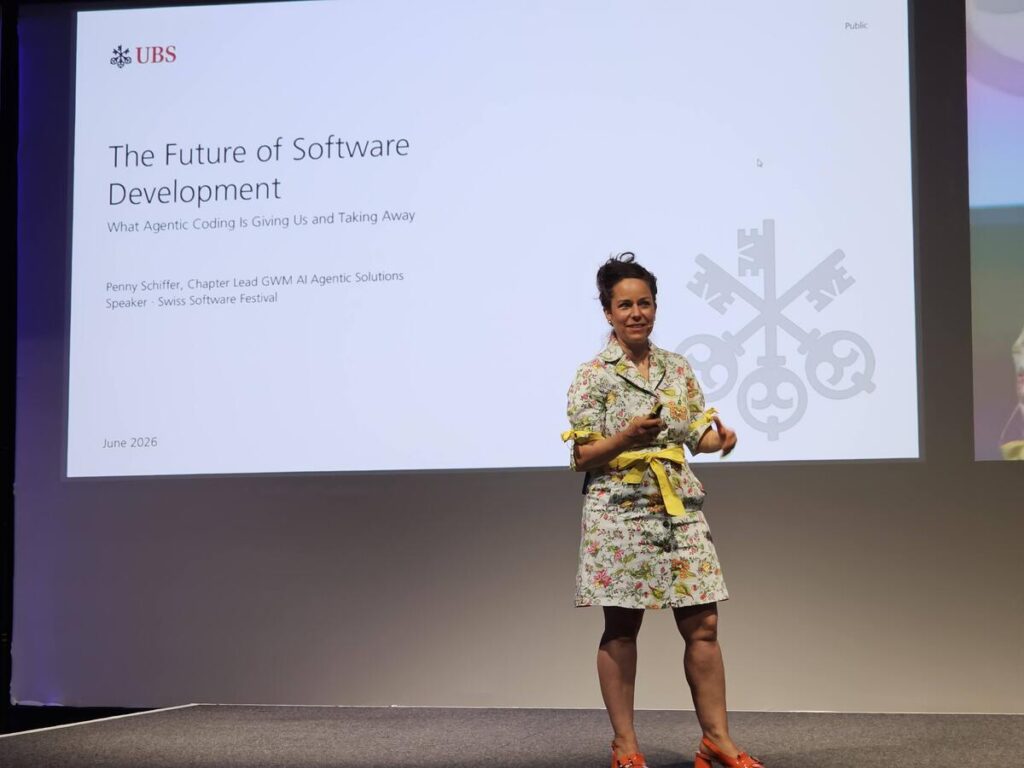
KubeCon + CloudNativeCon Europe 2026 in Amsterdam is coming to an end – and it once again showed why this event remains the beating heart of the cloud native ecosystem.

A Clear Direction: Sovereignty and “Agentic” AI

Two themes were impossible to miss this year.

First: digital sovereignty.
Not as a buzzword, but as a real, practical goal. Across talks and discussions, it became clear that organizations are actively looking for ways to build independent, resilient platforms – based on open standards and open ecosystems.

Second: AI – especially “agentic” systems.
From hallway conversations to keynote stages, the focus has shifted from experimentation to application. The big question is no longer if AI will be integrated into platforms, but how.

K8up: Strong Interest and a Call for Maintainers

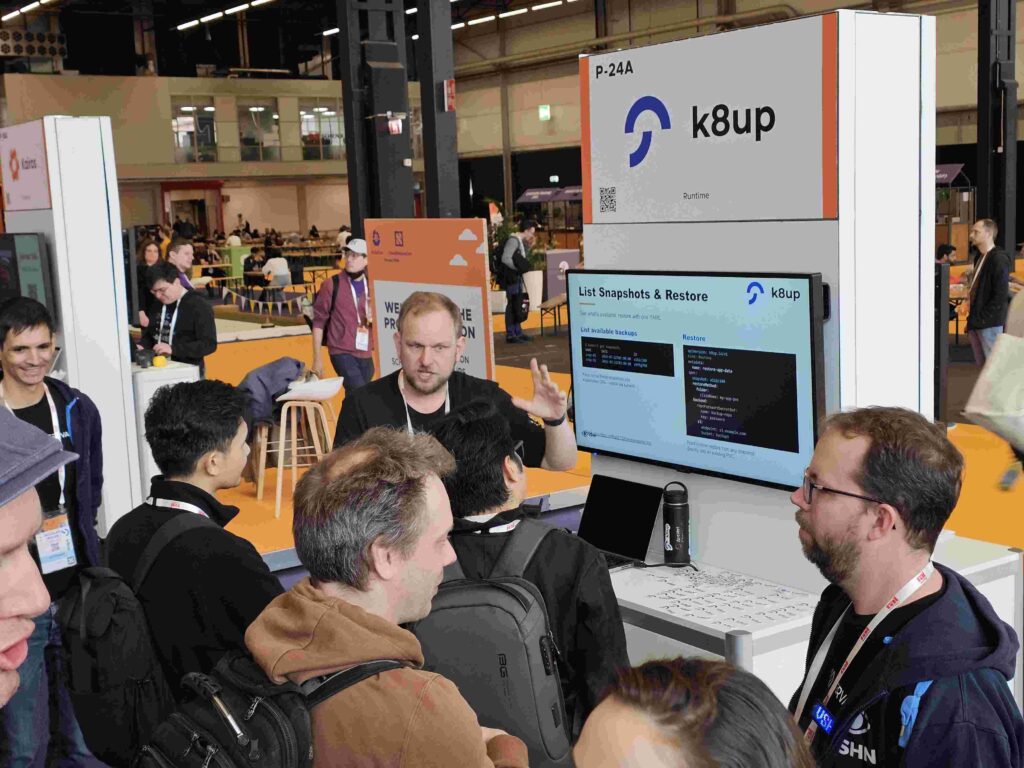
One of the highlights for us was the strong interest in K8up.

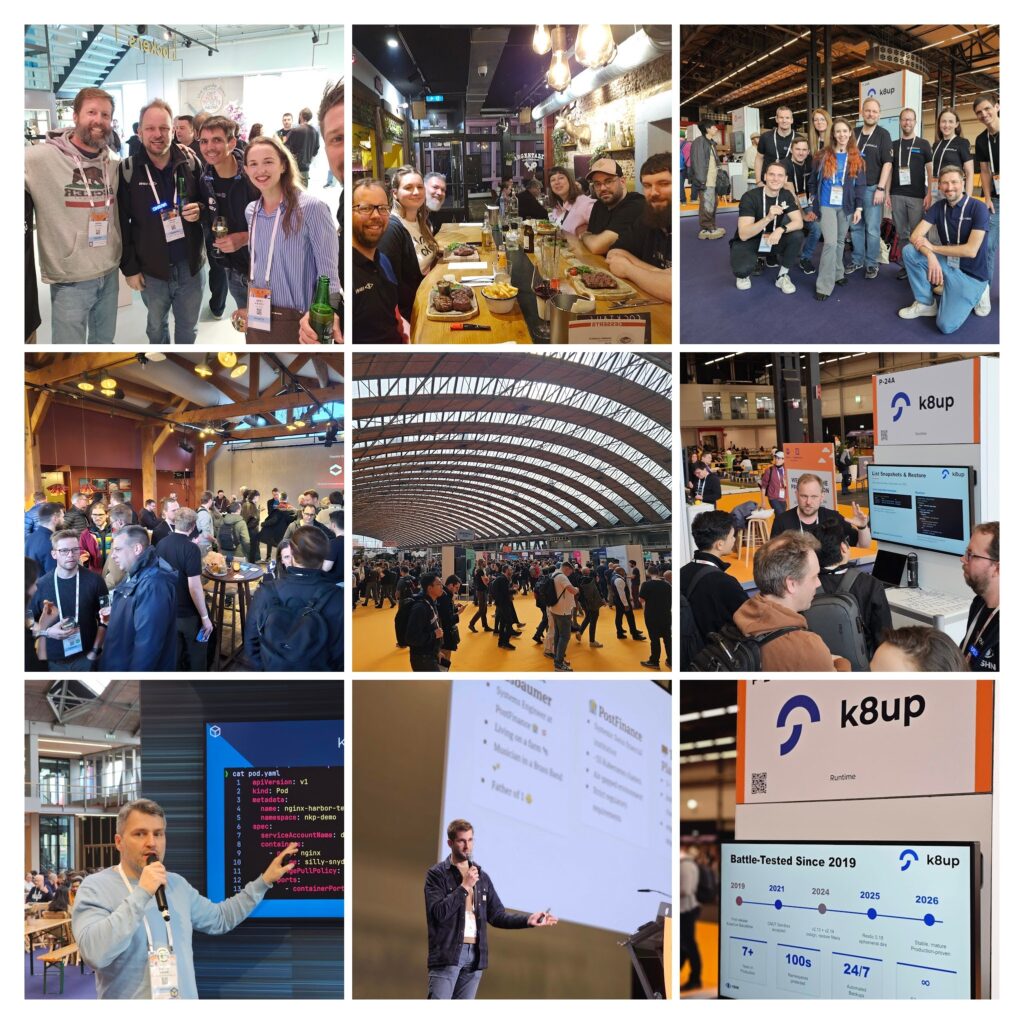
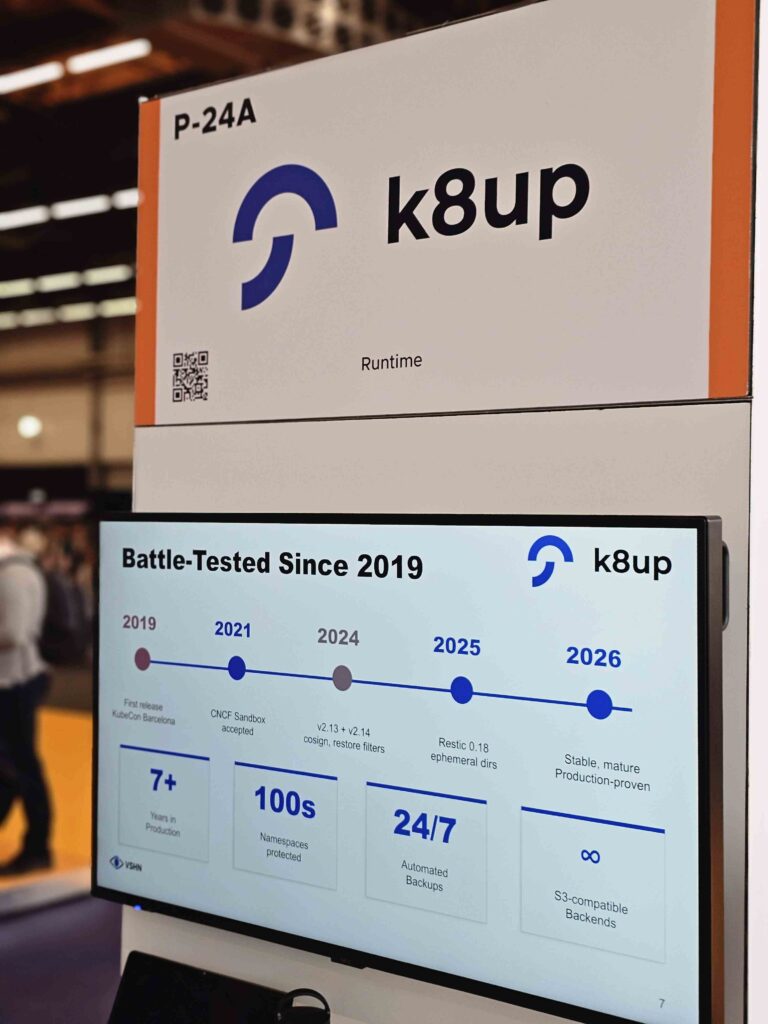
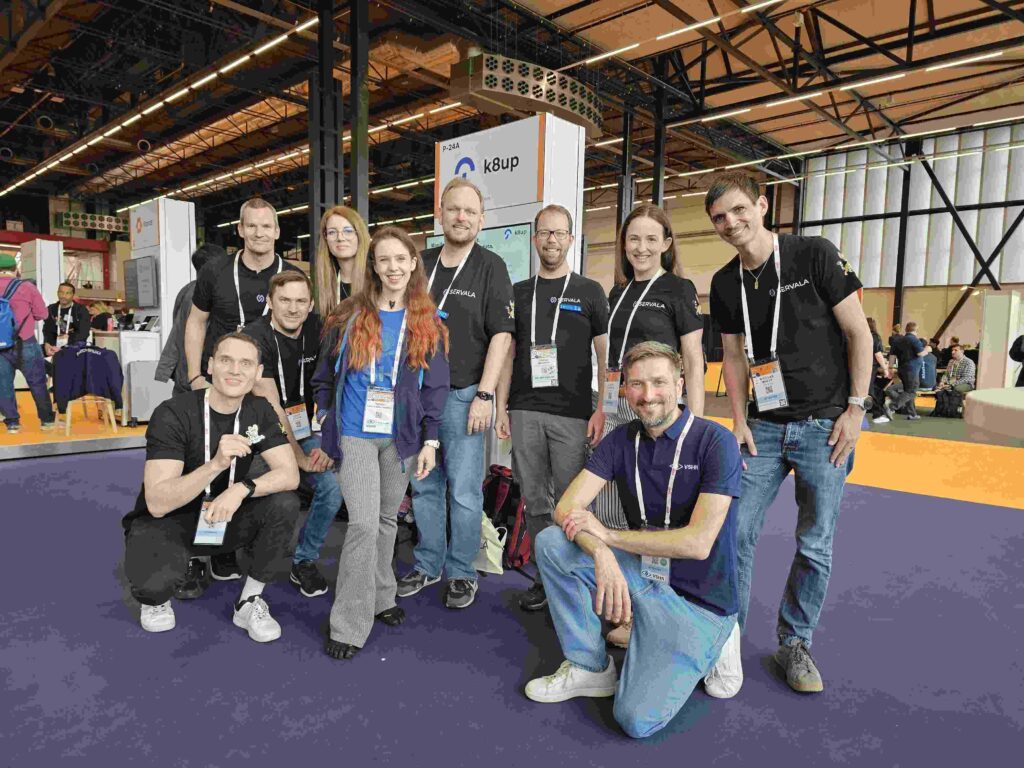
At the K8up kiosk in the Project Pavilion, we had many great conversations with users, contributors, and curious newcomers.

It became clear:
👉 The need for simple, reliable Kubernetes backup solutions is growing
👉 The community around K8up is highly engaged
👉 There is real momentum to push the project forward together

At the same time, we’re actively looking for maintainers and contributors to help shape the future of K8up.

If you’re interested in getting involved, join the discussion here:
https://github.com/k8up-io/k8up/issues/1187

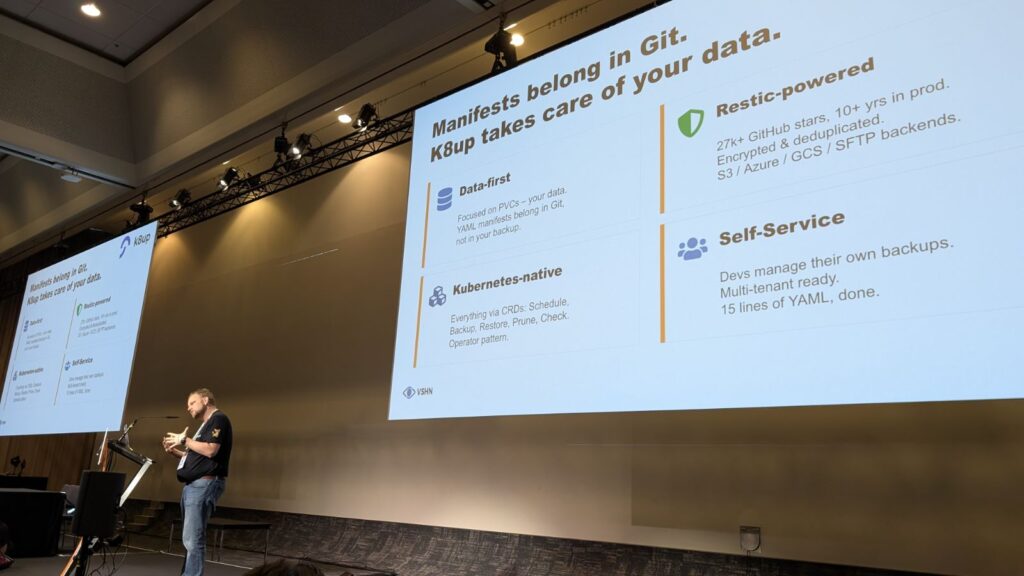
Lightning Talk: Aarno on Stage

A special moment was Aarno Aukia’s lightning talk on K8up.

Short, focused, and right to the point – it sparked great discussions afterwards and brought even more attention to the project.

(And yes – in true Kubernetes fashion, there was even a live moment where an NGINX ingress got archived during a talk. Cloud native never gets boring.)

Servala: From Concept to Real Interest

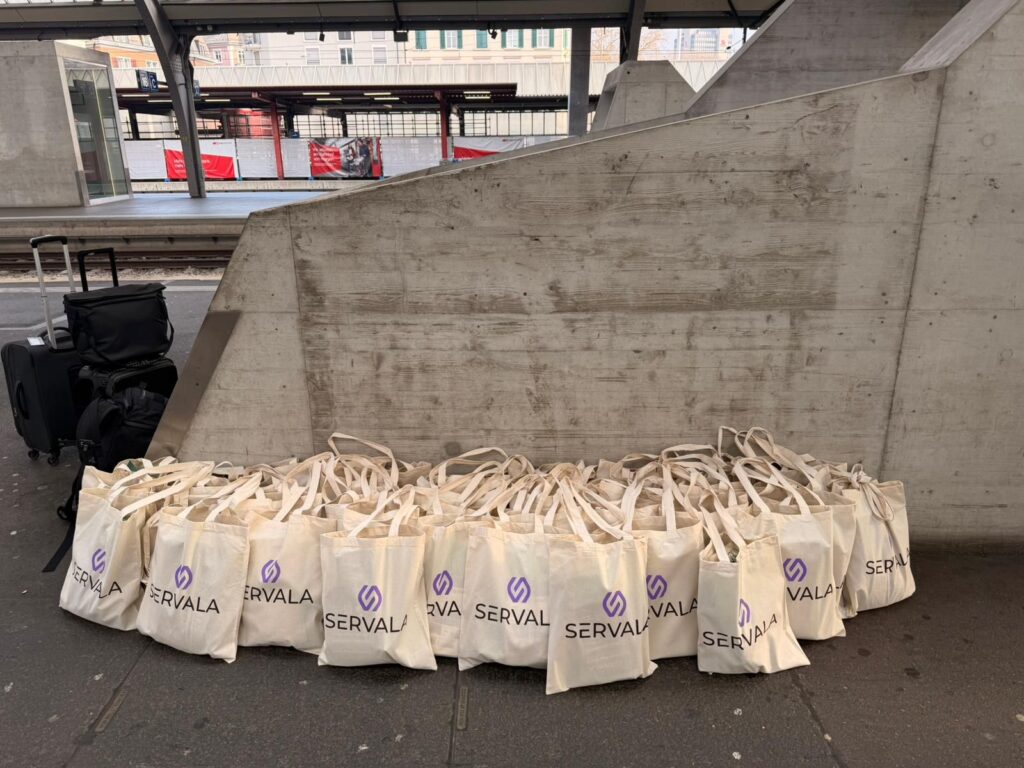
Servala – Sovereign App Store was another big topic throughout the week, not only because of the goodie bags for the KubeTrain attendees:

What stood out most was the level of understanding and curiosity.

The conversations have clearly evolved:

  • From ‘What is Servala?’
  • To ‘How can we participate?’

This reflects a broader shift in the industry – towards ecosystems instead of isolated platforms, and towards practical implementations of sovereignty.

Switzerland Punching Above Its Weight

One thing that stood out clearly this year: Switzerland’s impact on the cloud native ecosystem is disproportionately strong.

Despite its size, Switzerland contributed 3 out of 48 CNCF projects present at KubeCon – roughly 6%.
Projects like Harbor, K8up and Capsule are actively shaping the ecosystem.

And that’s only part of the story.

When including major contributions such as Cilium, the influence of Swiss engineering and open source involvement becomes even more significant.

But it’s not just about projects.

Switzerland was highly visible across the board:

  • Talks and lightning talks
  • Maintainers and contributors
  • Active community participation
  • Strong presence at events and discussions

This combination of engineering quality, open collaboration and community engagement is what makes the Swiss cloud native scene stand out.

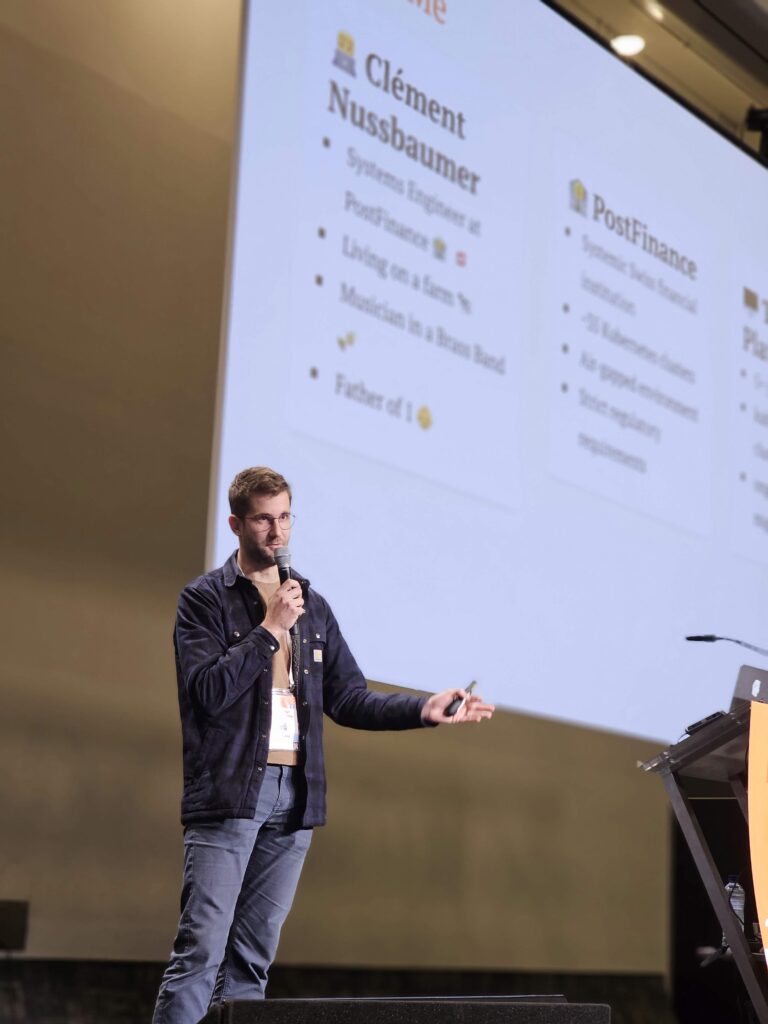
Clément Nussbaumer – PostFinance

A perfect example of what makes this community special:
Open, collaborative, and deeply involved.

Because in the end, the best conversations often happen outside of the actual sessions.

The Swiss Apéro – Community at Its Best

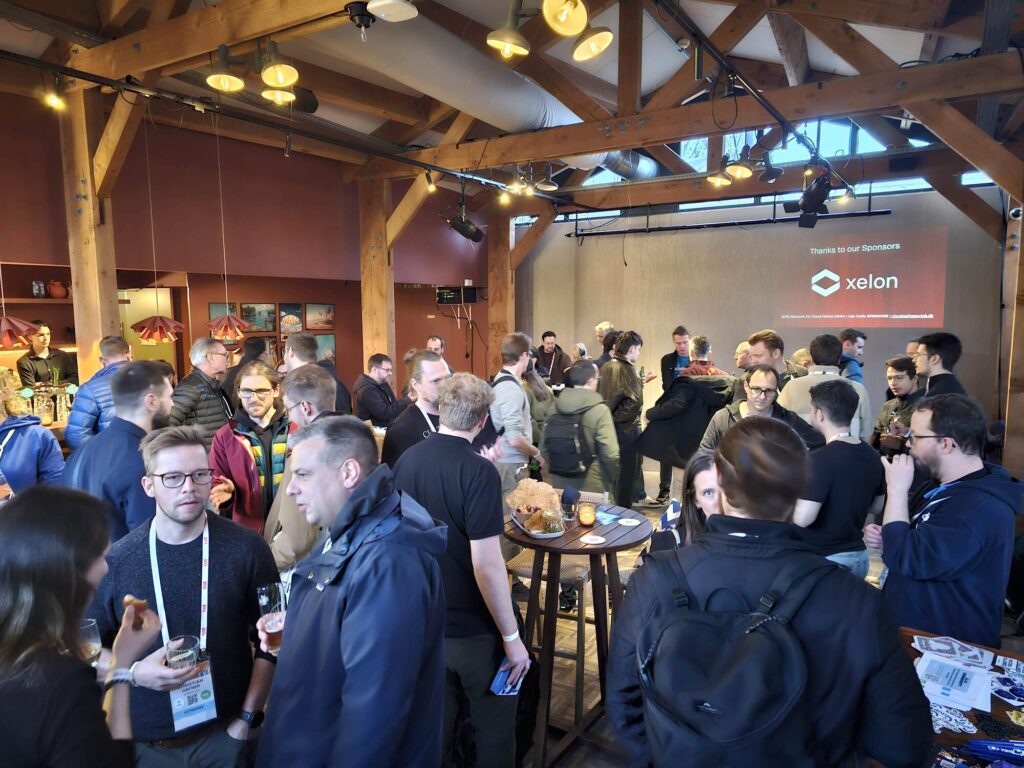
One of the highlights of the week was the KubeCon Swiss Apéro organized by Rocket Engineers.

Around 130 people from the Swiss cloud native community came together in Amsterdam.

More Than Just Talks

Beyond the official program, KubeCon once again delivered a full week of side events and community moments:

  • KubeTrain
  • KubeCon Swiss Apero
  • Upbound, Isovalent and many more community events
  • Countless spontaneous meetups and discussions

These moments are where ideas turn into collaborations.

What We Take Away

KubeCon Europe 2026 confirmed a few key trends:

  • Sovereignty is becoming a real, actionable priority
  • AI is moving into practical, platform-level use cases
  • Open ecosystems are replacing isolated solutions
  • Community remains the driving force behind everything

And maybe most importantly:

👉 The best ideas don’t happen in isolation – they happen when people come together

Thank You, Amsterdam

A big thank you to everyone we met throughout the week – partners, contributors, customers and the broader cloud native community.

We’re heading home with new ideas, new connections, and a lot of momentum.

See you next year in Barcelona!

Markus Speth

Marketing, Communications, People
Contact us

Our team of experts is available for you. In case of emergency also 24/7.

Contact us
Servala Sovereignty

Recap Servala Ecosystem Day 2025 – Sovereignty in Action

2. Dec 2025

Servala Ecosystem Day – Sovereignty in Action

Yesterday we hosted the first Servala Ecosystem Day at the VSHNtower in Zürich – and it marked a key milestone on our journey toward sovereign cloud in Europe. What began two years ago as an idea has now become something collaborative and real.

We welcomed 42 participants from cloud providers, software vendors and consulting partners – all aligned around one belief: Europe needs digital sovereignty, and we can build it together.

Servala is evolving into Servala – The Sovereign App Store – more than a product, it is becoming an ecosystem where roles, standards and collaboration matter.

Our Agenda included

  • Servala vision
  • ecosystem introductions
  • co-creation workshop
  • mulled wine networking

The co-creation workshop focused on defining success, roles, required standards and future collaboration needs. The strongest signal of progress: the first SIGs formed during the event.

Key themes emerged

  • sovereignty should simplify, not complicate
  • interoperability requires shared governance
  • collaboration accelerates adoption

Next steps

  • refine and share workshop outcomes
  • support SIG workstreams
  • plan the next ecosystem touchpoints

A big thank you to everyone who joined and contributed. The momentum is real – and we’re just getting started.

Read the full blog post on Servala.com.

Markus Speth

Marketing, Communications, People

Contact us

Our team of experts is available for you. In case of emergency also 24/7.

Contact us
Events General Sovereignty

DINAcon 2025: Sovereignty Needs Collaboration, Courage, and Real Openness

21. Nov 2025

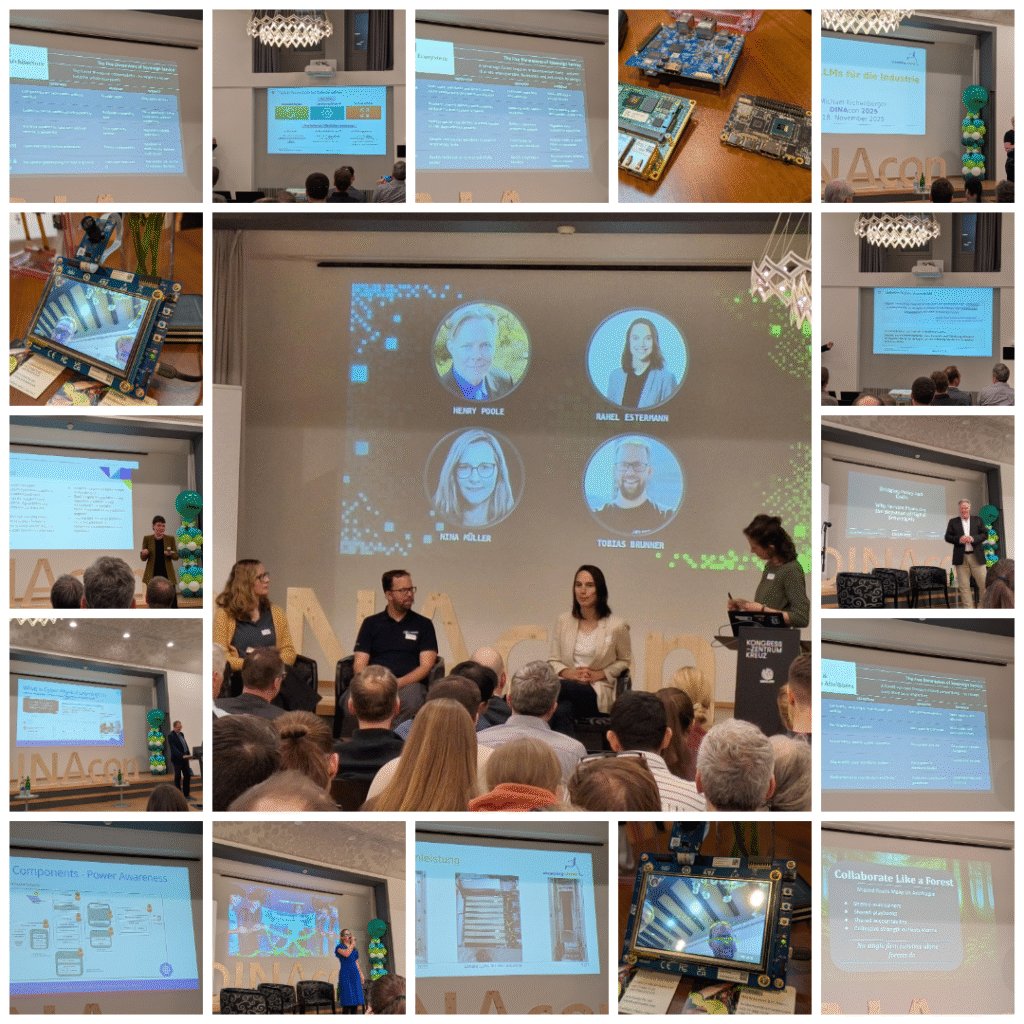
DINAcon 2025 took place on Tuesday, November 18 at the Kongresszentrum Kreuz in Bern, and VSHN was right in the middle of it. Tobias Brunner was invited as a panelist, joining Henry Poole, Nina Müller from Nextcloud, and Rahel Estermann to discuss digital sovereignty. The message was clear: we are moving in the right direction, but we are far from finished.

And the atmosphere? A mix of curiosity, realism, and momentum.

AI is everywhere. But it is not sovereign yet.

A dominant theme across the conference was Artificial Intelligence. Nearly every session, conversation, and coffee break circled back to it. The key realization: AI is already here, but it is not yet sovereign.

One highlight was the demo of MeLODy – Der intelligente Linked Open Data Chatbot, developed for public administration in the City of Zurich and the Canton of St. Gallen. Here, AI is not only being discussed in theory, but actively used in real applications. That is encouraging and shows that progress is not just conceptual, but operational.

Switzerland already has strong foundations: law, infrastructure, and community

There was also positive news. Tobias pointed out during the panel that Switzerland already has several important building blocks in place.

  • EMBAG creates clear legal requirements for the use of open source in public administration
  • GPU capacity for sovereign AI is already available, for example at Stepping Stone, and providers like Exoscale and Cloudscale also offer AI compute
  • With Apertus, a Swiss LLM is emerging. It is not finished yet and not on the level of large foundation models, but it is a start and publicly testable at Public AI Inference Utility

So the foundation exists. Now we need to build on it together.

Ecosystems are forming. Companies are investing.

Another key takeaway from DINAcon was the momentum in the European tech landscape.

  • The Heinlein Group is investing heavily in Open Cloud, a fork of ownCloud and direct competitor to Nextcloud, and is expanding its presence with a new office in Switzerland
  • Open source culture was visible not only in technology, but also creatively. There was even open source music: Music Album Open Up | Open Source | MD Systems GmbH

Solche Entwicklungen zeigen, dass Open Source längst kein Nice-to-have mehr ist, sondern StThese developments show that open source is no longer a nice-to-have. It has become a strategic differentiator.

Panel insights from Tobias Brunner

During the panel, Tobias addressed three key questions.

What was the worst misuse of the term digital sovereignty?

Tobias began with a clear definition of sovereignty, summarised in three pillars:

  • Confidentiality: Who has access to my data and under which jurisdiction?
  • Availability: Do I always have access or is there a technical or legal kill switch?
  • Control: Am I free to move or export my data, or am I locked into proprietary licenses, APIs, or opaque operating models?

Many providers today fulfil only one or two of these pillars, yet still label their solutions as sovereign. Unfortunately, many such offerings already exist and there is even a name for it: Sovereignty Washing.

Ein Beispiel, das er nannte: Ein Anbieter betreibt Infrastruktur in einem Schweizer Rechenzentrum und Tobias shared an example: a provider runs infrastructure in a Swiss data center and advertises Swiss hosting and data portability. Yet the provider is subject to a foreign jurisdiction with extraterritorial access laws. The result: the solution looks sovereign on the surface, but underneath it is not. These grey areas make decision-making extremely difficult for organisations striving for sovereignty.

How can Switzerland take a sovereign role in global software supply chains?

His answer was clear: not by doing everything alone, but by working together. Tobias stressed that historically, Switzerland has always found ways to be part of global value chains, even when production physically happened elsewhere. The same applies to software. To achieve this, three things are needed:

  • open standards instead of proprietary protocols
  • open source software as a shared foundation
  • shared ecosystems and collaboration between cloud providers, developers, and operators

For years, hyperscalers have repeated the narrative that data must move to them. Today, this has led to dangerous centralisation of power and infrastructure. Tobias flipped the logic: why not bring the services to the data?

This idea was the spark for Servala – The Sovereign App Store. An open platform that connects cloud service providers, software vendors, and enterprise clouds while giving customers true freedom of choice.

At the end of the discussion, the panelists were asked for their call to action for organisations and public institutions.

Tobias closed with a simple but clear message:

Understand the value of sovereign software services for your organisation and start using them. It is never too late to become sovereign.

Conclusion

DINAcon 2025 made one thing clear: we have the expertise, the community, the infrastructure, and the legal frameworks. But we need more courage and more collaboration to achieve real digital sovereignty.

Not just marketing terms. Not just buzzwords. But real control over data, infrastructure, and value creation.

At VSHN, we will continue to drive this vision forward. And we look forward to building this sovereign future together.

If you would like to continue the discussion or have questions, get in touch. We are happy to continue the conversation.

Tobias Brunner

Tobias Brunner is working since over 20 years in IT and more than 15 years with Internet technology. New technology has to be tried and written about.

Contact us

Our team of experts is available for you. In case of emergency also 24/7.

Contact us
General Sovereignty

Sovereignty Washing – When ‘Sovereign Cloud’ Isn’t Really Sovereign

10. Nov 2025

In recent months, the word sovereignty has appeared everywhere in the tech world. From ‘sovereign clouds’ to ‘sovereign AI’, every vendor seems to offer something that sounds compliant, secure, and independent. But as with greenwashing or AI washing, we’re starting to see a new phenomenon emerge – sovereignty washing.

What is Sovereignty Washing?

Sovereignty washing happens when companies market their products as sovereign without truly giving users control, autonomy, or independence.
Often, this means a provider hosts data in a local data center, adds a ‘.eu’ to their cloud name, and declares victory. But real digital sovereignty is much more than a ZIP code.

Sovereignty Is Not Just About Data Location

Yes, where your data resides matters. But even more important is who controls the infrastructure, software stack, and decision-making.

If the control plane, billing systems, or support teams still depend on a non-European parent company, then even a ‘local’ cloud can be forced to comply with foreign jurisdiction – whether through the CLOUD Act, extraterritorial export rules, or simply commercial lock-in.

In other words – sovereignty means the ability to make your own decisions, not just store your data in your preferred country or location.

Lessons from Industry – The Nexperia and Microsoft Cases

The recent story around Nexperia, a Dutch chipmaker owned by a Chinese company, and the German automotive industry’s current dependency on critical semiconductor supply already leading to short-time work and production stoppages, shows how strategic autonomy isn’t just a political slogan – it’s a business necessity.

When an entire sector relies on a single supplier, it loses bargaining power, flexibility, and resilience. The same applies to software and cloud platforms:
If your critical systems only run on one hyperscaler, you are not sovereign – no matter how many ‘sovereign’ labels appear on your dashboard.

A recent case involving Microsoft underlines this risk on a global scale. The company blocked access to Outlook email accounts of employees at the International Criminal Court in The Hague, following U.S. sanctions compliance rules. The decision, reported by Heise Online, serves as a wake-up call for digital sovereignty in Europe – showing that control over essential communication infrastructure can be limited by non-European legal frameworks.

How to Spot Sovereignty Washing

So how can you tell if a vendor’s sovereignty claim holds up? Here are some questions worth asking:

  • Control: Who operates the platform and has access to the control plane?
  • Legal independence: Is the provider fully governed under EU or Swiss law, or are there foreign parent companies involved?
  • Open standards: Can I move my workloads to another provider without rewriting everything?
  • Transparency: Is the software stack open source or verifiable, or locked behind proprietary APIs?
  • Interoperability: Does the solution integrate with other vendors and clouds, or create another walled garden?

If the answer to most of these questions is ‘no’, chances are you’re looking at sovereignty washing.

Recent analyses like DNIP Briefing #48 – Dokumentierte Überwachung describe this problem vividly. The section “Cloud ohne Souveränität” points out how cloud providers without full jurisdictional control expose users to surveillance and dependency risks – demonstrating that technical sovereignty is meaningless without legal and operational sovereignty to match.

Why True Sovereignty Matters

For governments, public institutions, and regulated industries, true digital sovereignty is about long-term independence, not short-term convenience.
It ensures continuity, resilience, and the freedom to innovate without being tied to one vendor’s roadmap.

At VSHN, we see sovereignty not as isolation, but as collaboration across open ecosystems – where European cloud providers, software vendors, and enterprises work together on open standards and interoperable solutions.

That’s the vision behind Servala – the Sovereign App Store, connecting vendors and providers and ensuring services can run on any cloud or on-premise, without lock-in.

Because real sovereignty means – choice, transparency, and trust.

📬 Curious to see how sovereignty works in practice?
Join us at the Servala Ecosystem Day on December 1st in Zurich and help shape the future of open, sovereign cloud services.

📖 Want to dive deeper?
Check out the Sovereignty Washing White Paper by ZenDis for deeper insights into what makes true sovereignty.

Markus Speth

Marketing, Communications, People
Contact us

Our team of experts is available for you. In case of emergency also 24/7.

Contact us
Events General Sovereignty

The Path to Digital Sovereignty – Kickoff Event of the SDS Network in Bern

28. Aug 2025

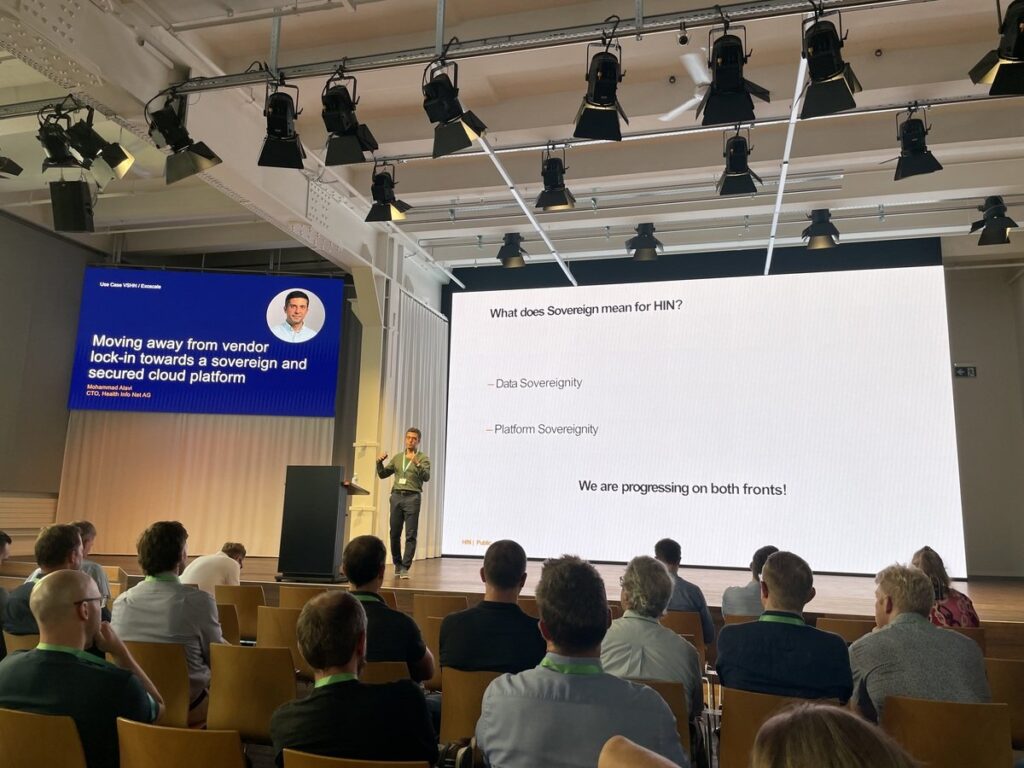
Today, on August 28, 2025, the kickoff event of the SDS Network – Sovereign Digital Switzerland took place at the Bern University of Applied Sciences. Numerous representatives from politics, public administration, and research shared valuable insights into current projects, challenges, and visions on the path toward greater digital sovereignty in Switzerland. Our colleague Tobias Brunner was on site and reported back from an inspiring morning.

Political and Strategic Perspectives

After the welcome by Matthias Stürmer and Pascal Stöckli from the Institute Public Sector Transformation (IPST), Nationalrat Gerhard Andrey presented the political dimension of digital sovereignty. It became clear: the demand for independence, transparency, and control over digital infrastructures is broadly supported and increasingly urgent.

Further contributions came from Matthias Schmutz of the Federal Department of Justice and Police (EJPD), and from Dominika Blonski, Data Protection Officer of the Canton of Zurich, who both emphasized the importance of governance and security architecture. Valentina Sulmoni from the Swiss Federal Office for Cybersecurity (BACS) highlighted the contributions of the National Cybersecurity Strategy to strengthening digital sovereignty.

Practical Examples from Federal and Local Authorities

Particularly interesting were the insights into concrete implementations:

  • Erica Dubach Spiegler from the Federal Chancellery presented the proof-of-concept “Office Automation with Open Source Software” (BOSS), based on open-source office software.
  • Werner Kipfer from the City of Zurich (OIZ) showed how the administration evaluates and pilots open-source solutions to reduce long-term dependency on proprietary systems.

International Impulses from Germany

A highlight of the event was the visit from the German Center for Digital Sovereignty (ZenDiS). Managing Director Alexander Pockrandt, Pamela Krosta-Hartl, and Leonhard Kugler presented the key solutions openDesk and openCode. The focus was not only on software but also on strengthening open-source communities and fostering cross-border cooperation in Europe.

Networking and Exchange

The event concluded with a panel discussion and a networking lunch – a valuable opportunity for participants to ask questions and make new connections. Tobias reported on an inspiring atmosphere and a clear message: digital sovereignty in Switzerland is moving from vision to practical implementation.

Official Review by the SDS Network

The SDS Network itself draws a very positive conclusion: more than 200 participants attended the kickoff event in Bern and online. A key outcome was the signing of a Letter of Intent between the Bern University of Applied Sciences (IPST) and the German ZenDiS. The two institutions plan to cooperate closely in the future on openDesk, the OSS Directory, and the planned Sovereignty Check.

All presentations, the event recording, and additional media coverage are publicly available. You can find the detailed review here: 👉 SDS Network Kickoff Event Recap

What does SDS mean?

The official definition of the SDS Network – Sovereign Digital Switzerland is as follows:
“Digital sovereignty of a state or an organization necessarily includes full control over stored and processed data, as well as the independent decision about who may access it. It also encompasses the ability to independently develop, modify, control, and complement technological components and systems with other components.”

VSHN and Servala – The Sovereign App Store

For VSHN, digital sovereignty has been a key topic for many years. With Servala, our Sovereign App Store, we provide a platform where enterprises and public institutions can instantly and securely consume dozens of open-source services as managed services – with full control over data, infrastructure, and compliance. Servala combines the principles of digital sovereignty with the flexibility of modern cloud and DevOps technologies, making open source easy to use.

👉 Learn more about Servala here: www.servala.com

Markus Speth

Marketing, Communications, People
Contact us

Our team of experts is available for you. In case of emergency also 24/7.

Contact us
General Press Sovereignty

VSHN Joins the ‘Sovereign Digital Switzerland (SDS)’ Network

17. Jul 2025

SDS Network – The Network for a Sovereign Digital Switzerland

Zurich, July 17, 2025 – VSHN is proud to announce its membership in the SDS – Sovereign Digital Switzerland – network. As a company committed to openness, transparency, and digital self-determination since day one, we’re excited to further strengthen this mission alongside other forward-thinking organizations in the SDS community.

For us, digital sovereignty means having the freedom to decide where data is stored, how software is operated, and which technologies are used – without lock-in, and without relying on proprietary ecosystems. Achieving this requires open standards, interoperable systems, and a trusted ecosystem built on collaboration. These principles are at the core of everything we build:

  • Servala, our open cloud service hub
  • APPUiO, Switzerland’s leading container platform
  • and our open source projects K8up (Kubernetes backup) and Project Syn (DevOps automation).

Joining the SDS network is a natural next step. We believe that ensuring digital sovereignty can’t be done alone – it requires strong partnerships between the private sector, public institutions, academia, and civil society. The SDS network offers a unique platform to exchange ideas, develop joint solutions, and promote independent alternatives.

At VSHN, we embrace Open Source because we believe openness is the foundation of trust, innovation, and long-term independence. Through our involvement in SDS, we want to actively contribute to shaping a sovereign digital future for Switzerland – pragmatic, open, and responsible.

📬 More about the SDS network: https://netzwerksds.ch

Let’s stay in touch

📬 Contact us if you want to learn more about our solutions
📸 Follow us on LinkedIn or other social media channels, subscribe to our YouTube-Channel.
📧 Subscribe to our newsletters

Markus Speth

Marketing, Communications, People
Contact us

Our team of experts is available for you. In case of emergency also 24/7.

Contact us