
DINAcon 2026 Recap: Two VSHNeer Talks and the Launch of OpenSovereign


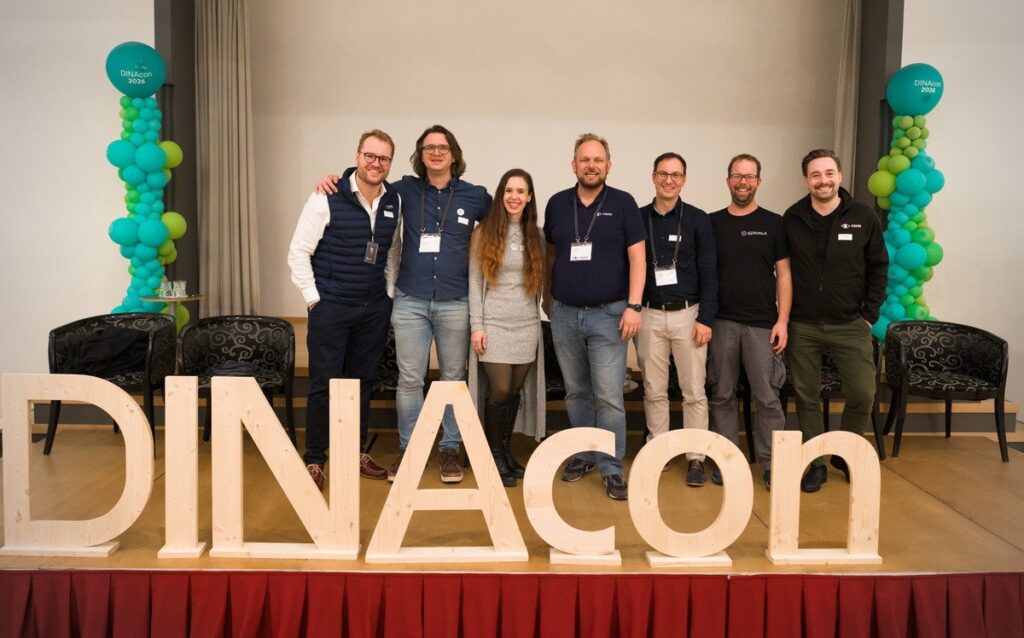
DINAcon 2026 took place on November 18th at the Kongresszentrum Bern. For us, this year’s edition was a very special one. VSHN gave two talks on digital sovereignty, and the same day OpenSovereign launched: the new Swiss alliance for digital independence that VSHN co-founded with Puzzle ITC, Adfinis, cloudscale and Cyberlink.
We came home with lots of impressions and plans for a new partnership.
Here’s a look back at our day in Bern.
Two talks, back to back
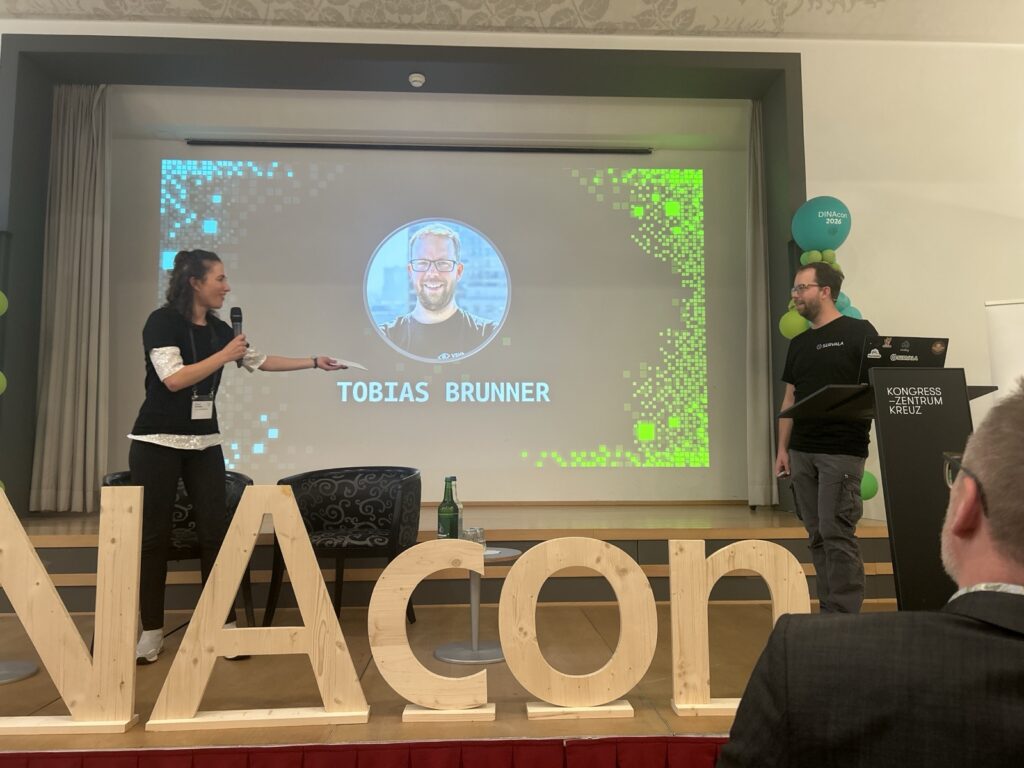
As announced, our partners and co-founders Tobias Brunner and Aarno Aukia spoke one after the other in the Souveränität track. The two talks were planned as a pair: Tobias showed why the sovereignty gap exists, and Aarno how to measure it and close it.
Tobias Brunner – “Furniture, Not Lumber: What Sausages, Furniture and Airplanes Have to Do with Digital Sovereignty”
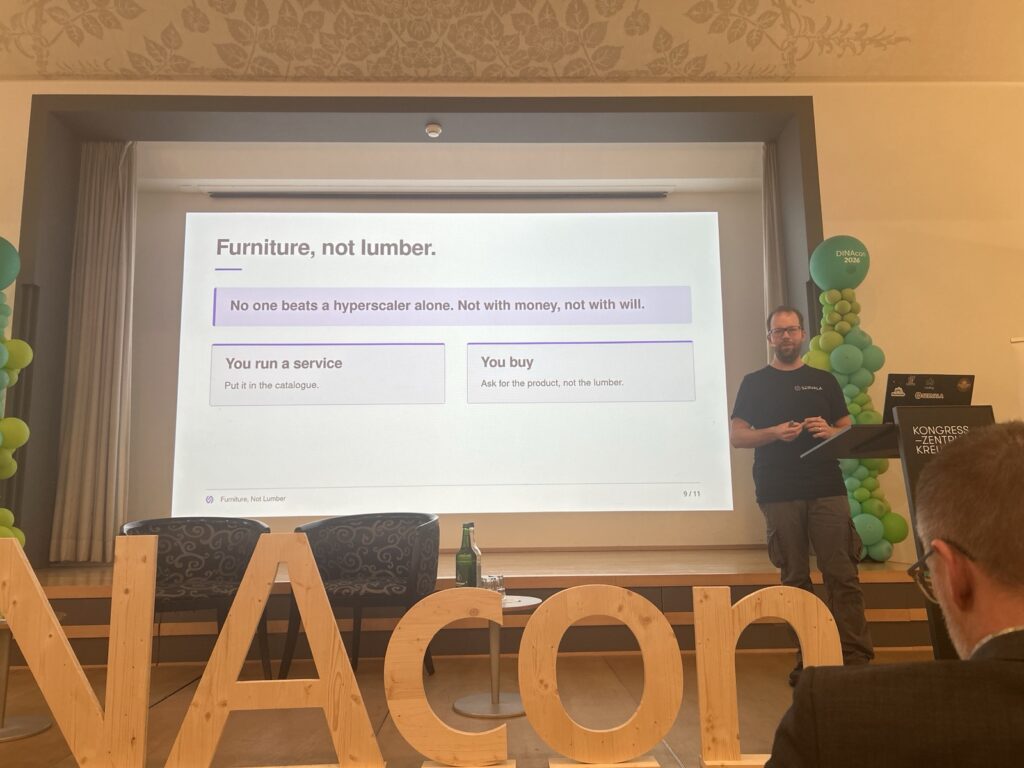
Tobias started with three everyday products: furniture, airplanes and sausages. All three are finished products, and nobody buys the parts. Digital services today are different. You order a database, and what you get is a VM, an empty Kubernetes cluster, a storage class and a link to the install guide. You wanted a database, and you got a platform project.
Next, Tobias looked at how we buy furniture. You can go to a carpenter, who builds everything piece by piece, just the way you like it. But that’s slow, expensive and doesn’t scale. You can order from a catalogue. Or you can go to a store or a marketplace. IKEA builds everything itself, and you can’t just build a new IKEA on a green field. Galaxus combines its own warehouse with goods from other sellers, and its range grows with every partner.
Airplanes show how Europe has solved this kind of problem before. In the 1970s, Boeing and McDonnell Douglas dominated the market, and no single European country could have kept up alone. The answer was pooled work, one brand and one final assembly line.
According to Tobias, the parts for digital sovereignty already exist today. Europe and Switzerland have good cloud providers, brilliant minds and open source for almost every need. But open source on its own is just lumber. What’s missing is the store. Or as Tobias put it: digital sovereignty is not a product, it’s a shape of the market.
This is exactly where Servala comes in: a marketplace for sovereign managed services, a “federated hyperscaler”. Cloud providers bring the infrastructure, software vendors and open source communities bring the software, and managed service providers run it all, carry the SLA and answer the phone at night. Customers find and order everything in one place and get a single bill. The service goes to the data, not the data to the service.
His conclusion: no one beats a hyperscaler alone, not with money and not with will. If you run a service, put it in the catalogue. If you buy, ask for the finished product, not the lumber.
Let’s build the store together!
Aarno Aukia – “Sovereignty Is More Than Data Residency: Eight Dimensions for Sustainable Digital Infrastructure”
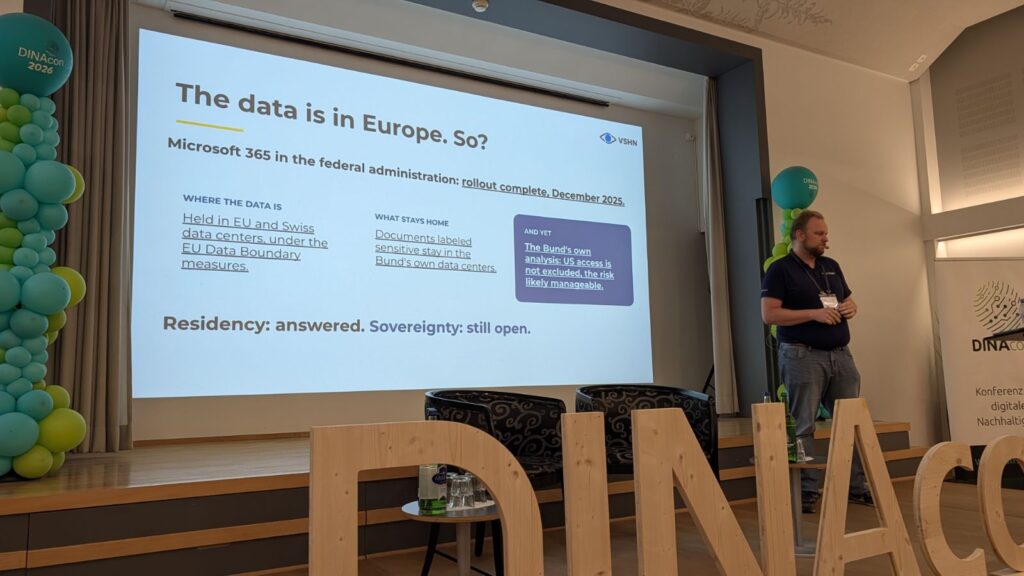
Aarno picked up right where Tobias left off. His starting point was Microsoft 365 in the Swiss federal administration, where the rollout was completed in December 2025. The data sits in data centers in the EU and Switzerland, and documents classified as sensitive stay in the federal administration’s own data centers. And yet the federal administration’s own analysis states that access by US authorities is not excluded and that the risk is likely manageable. So the question of where the data is stored is answered, but the question of sovereignty is still open.
To answer it, Aarno turned to the EU Cloud Sovereignty Framework. In April 2026, the EU awarded EUR 180 million in cloud contracts that were scored for the first time on eight weighted dimensions of this framework: strategic, legal, data and AI, operational, supply chain, technology, security and environmental. Each dimension becomes a question you can ask of any system.
Aarno asked these eight questions of two cases from the federal administration itself. Microsoft 365 is the solution it bought. openDesk, the open source workplace suite from ZenDiS, is the one it built: the Federal Office of Information Technology (BIT) ran it on its own OpenShift in the BOSS proof of concept, with 172 testers.
The comparison shows that neither option gives you sovereignty for free. With the bought solution, the answers are a promise, checked in audit reports: contracts, vendor reports and a risk the federal administration has consciously decided to accept. With the built solution, the answers are a cost, counted in days: about 100 container images, an upgrade that lost data and three days a month for updates.
Aarno also brought the furniture back. He boiled the eight questions down to three tests you can apply to any store, Tobias’ marketplace included: Can you replace where it runs? Can you replace who runs it? Can you replace who makes it?
The federal administration’s own answer is “a bridge, not a bunker”. The federal administration isn’t replacing Microsoft 365. Instead, it plans to run a sovereign workplace alongside it for about 3,000 staff from the end of 2027, with about CHF 9 million for the first phase.
Aarno closed with one thought for everyone currently working on their next evaluation: “The question isn’t which cloud you choose, but whether your architecture still gives you a choice tomorrow.”
The first-ever OpenSovereign slide
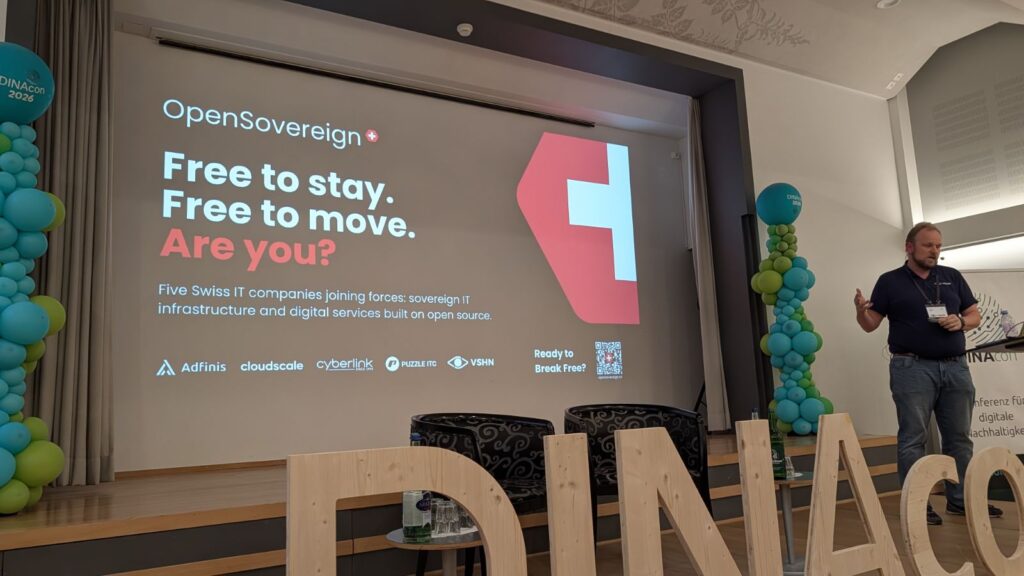
Aarno’s talk ended with a premiere: the very first public slide about OpenSovereign. The alliance had launched that same morning, and Aarno’s talk was the perfect setting for it. OpenSovereign answers exactly the three tests from his talk: where it runs, who runs it and who makes it.
OpenSovereign brings together five independent Swiss IT companies: VSHN, Puzzle ITC, Adfinis, cloudscale and Cyberlink. None of us covers the entire stack alone, but together we do, from cloud infrastructure and connectivity to platforms, managed services and applications, all the way to secure collaboration and AI. The five companies stay independent and are organized as members of OpenSovereign, a Swiss association (Verein).
The idea behind it is simple: organizations should be free to choose, free to stay and free to move, without lock-in.
Free to stay. Free to move. Are you?
👉 Read the full announcement on our blog: New Alliance for Digital Independence: Five Swiss IT Companies Launch OpenSovereign
👉 Visit opensovereign.ch and follow OpenSovereign on LinkedIn and Mastodon
A reunion and plans for a new partnership
At DINAcon you meet people, and sometimes old friends too. Tobias ran into Peer Heinlein, CEO of the Heinlein Group. The two first worked together about 15 years ago, when Heinlein’s consulting team helped Tobias with mail questions. In Bern they met again and started planning a partnership. As soon as there’s news, you’ll read it here.
Fittingly, Peer spoke in the Souveränität track right before Tobias, with “Digitale Souveränität und Nationale Sicherheit: Nur mit Open Source?”. That made it three sovereignty talks in a row.
Cheers at the apéro
As this year’s Apéro Sponsor, we covered the drinks in the evening. A big thank you to everyone who came by for a chat. Those conversations are a big part of why we keep coming back to DINAcon.
Thank you, DINAcon
Thanks to CH Open and the whole DINAcon team for another great conference, and to all the speakers and attendees who made the day what it was. We’re already looking forward to next year. 🇨🇭

Markus Speth
Marketing, Communications, People