Codey General

Codey is Live: New Features & Lock In Your Price Until April 30th

22. Apr 2026

When we quietly put Codey – European Code Collaboration Platform online a few months ago, we weren’t ready to make a big deal of it. We had early customers, a working service, and a soft launch page on vshn.ch but no fanfare. That changes today.

Codey now has a proper home at codey.ch, and with it comes a real launch: new features on the roadmap, a cleaner onboarding experience through the Servala portal, and a pricing offer worth paying attention to.

What Is Codey, For Those Who Missed the Soft Launch

Codey is VSHN’s managed Forgejo platform. You get your own dedicated, isolated Forgejo instance – not a shared multi-tenant setup – hosted on European cloud infrastructure, fully managed by us. That means updates, backups, monitoring, and security patches are handled. Your team just uses it.

Forgejo itself is a community-driven, 100% free software Git forge, governed by the non-profit Codeberg e.V. It covers everything a development team needs: Git hosting, pull requests, CI/CD via Forgejo Actions (compatible with GitHub Actions workflows), package hosting, Kanban boards, issue tracking, and more – with no feature gating behind an enterprise tier.

Codey adds Renovate integration on top, keeps your instance on the latest stable release, and handles the operational overhead you’d rather not think about.

What’s New

Two features have been on top of our customer wishlist and are now on their way:

  • SSH access – until now, Git operations over HTTPS with personal access tokens was the supported workflow. SSH support is coming, so you can add your public keys and work the way you’re used to.
  • Self-service via the Servala portal – Codey instances are ordered through Servala, VSHN’s Sovereign App Store. We’re expanding what you can manage yourself directly in the portal, so you don’t need to go through us for routine changes to sizing, storage, or Forgejo configurations of your instance

For existing customers, we’ll be in touch individually to coordinate the migration to the new infrastructure that enables these features.

Lock In Your Price – Until April 30th

We’re introducing updated pricing alongside the new platform. But here’s the deal: if you’re already a Codey customer, or if you order or upgrade before April 30th, 2026, your current plan price is locked in permanently. Whatever we charge going forward, your rate doesn’t change – ever.

It’s our way of rewarding early adopters and giving anyone on the fence a concrete reason to decide now.

👉 Get Started at portal.servala.com

Why We Built Codey

GitHub and GitLab are excellent platforms run by large corporations with their own pricing roadmaps, data handling policies, and strategic interests. For many teams that’s fine. For teams who care about data sovereignty, vendor independence, or just want their code to stay in Europe on infrastructure they can trust – the choice looks different.

Codey is built on free software with no enterprise paywall. Every Forgejo feature is available to every customer. And because it’s Forgejo, there’s no lock-in: you can export everything and self-host at any time if you ever want to.

We’ve been running open-source infrastructure for over 10 years at VSHN. Codey is what we’re using to develop portal.servala.com ourselves.

Check Out codey.ch →

Markus Speth

Marketing, Communications, People

Contact us

Our team of experts is available for you. In case of emergency also 24/7.

Contact us
Events General

Meet VSHN at DevOpsDays Zurich 2026

20. Apr 2026

DevOpsDays Zurich is back – and of course we’re joining again. We’re happy to announce that VSHN is once again Gold Sponsor of DevOpsDays Zurich 2026, taking place on May 6 and 7, 2026 at the Alte Kaserne in Winterthur.

Two Days of DevOps, Community, and Good Conversations

DevOpsDays Zurich is one of our favourite events of the year – and for good reason. This is where the Swiss DevOps community comes together for two days of talks, open spaces, workshops, and the hallway conversations that sometimes move things more than any presentation. If you care about software delivery, infrastructure, platform engineering, or simply building better teams, this is the place to be.

Come Find Us at the Booth

Come by, ask us anything, and find out how we at VSHN help teams run their applications on Kubernetes and OpenShift – reliably, securely, and with a great developer experience.

Whether you want to learn more about what we offer, geek out on specific topics, or just say hi – we’d love to see you.

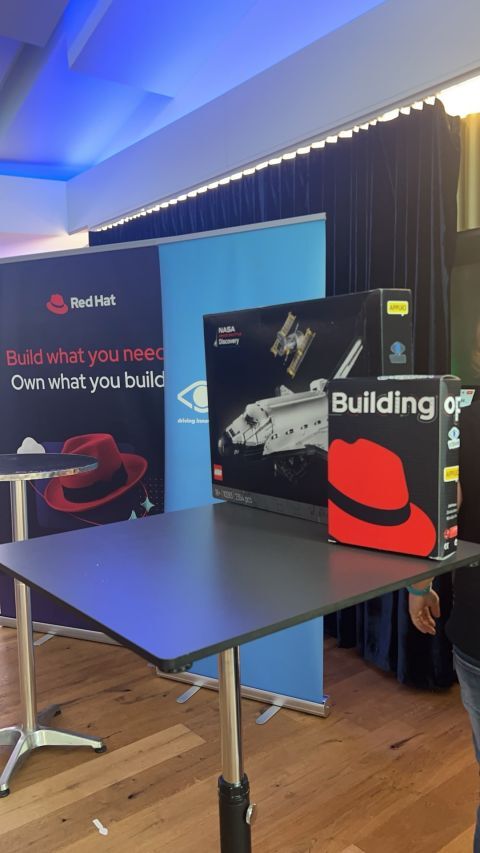
Win a Lego – Yes, Really

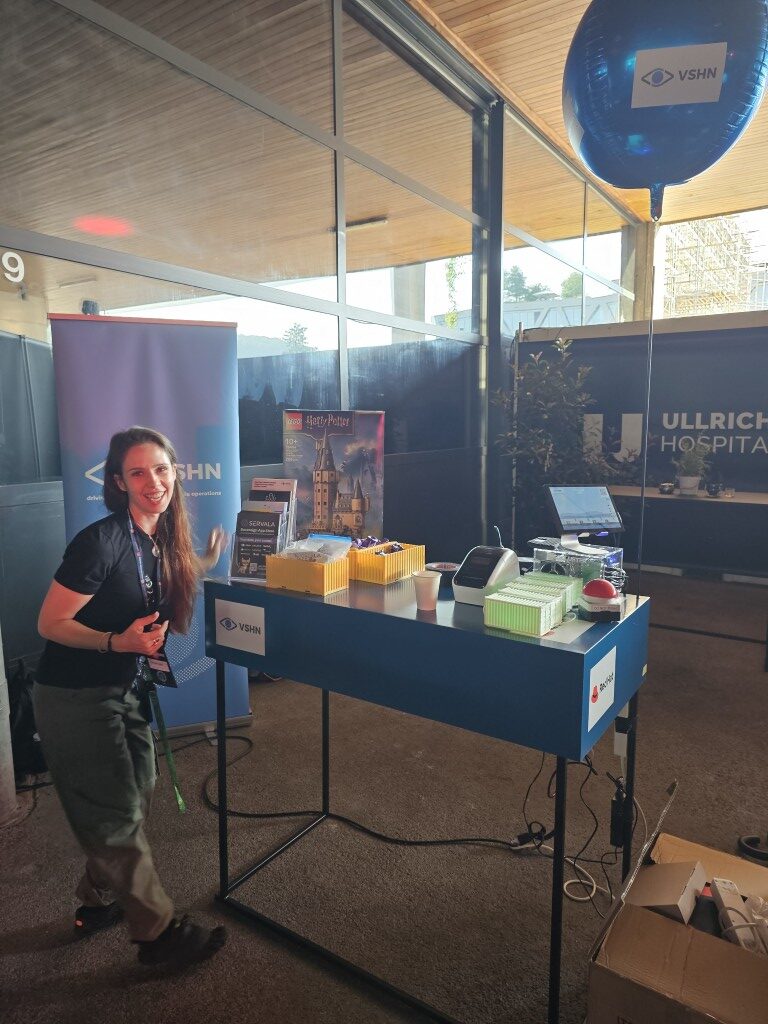
A VSHN booth without a Lego raffle? Unthinkable. Stop by, enter the draw, and maybe you’ll walk away with something to keep you busy for a while. It’s become a little event tradition of ours – and we’re keeping it going, of course. 🙂

See You in Winterthur!

You can find the full programme at devopsdays.ch. We’re looking forward to great conversations, good coffee – and of course finding out who takes home the Lego this year.

Markus Speth

Marketing, Communications, People

Contact us

Our team of experts is available for you. In case of emergency also 24/7.

Contact us
General Tech

Espejote: A GitOps journey

14. Apr 2026

Espejote (big mirror in Spanish) manages arbitrary resources in a Kubernetes cluster. Built from the ground up to take advantage of Server-Side Apply and Jsonnet templating.

VSHN manages a large fleet of Kubernetes clusters for our customers, and we try to automate as much as possible to keep our operations efficient and sustainable. We use GitOps principles, but sometimes external state needs to be merged into the desired state defined in Git. This GitOps journey took us from Ansible playbooks directly applying YAML, to various operators, to bash “reconcilers”, and finally to Espejote, our shiny new GitOps operator.

Chapter 1: The Ansible era and first operator attempts

In the beginning, we used Ansible playbooks and custom roles to manage our OpenShift 3 Kubernetes clusters. We had a set of YAML files that defined the desired state of our clusters, and we would run Ansible playbooks to apply those YAML files to the clusters. This worked, but it was not very efficient. We had to run the playbooks manually, and if we forgot to run them, the clusters would drift from the desired state.

The collection of roles was nicknamed “mungg”, the Swiss German word for “marmot”. Nobody seems to know why, but it stuck.

We were just getting into writing operators and developed espejo to quickly sync resources between namespaces. It was the very early days of our operator journey.

Chapter 2: The sea of operators and tears

To solve the problem of manual intervention (and because we migrated to OpenShift 4, where the install procedure doesn’t use Ansible anymore), we started looking into Kubernetes operators.
It can’t be that hard to patch a Kubernetes manifest. Right? Wrong.
Some of the operators were buggy, some of them were not flexible enough, some of them loved to randomly go into reconcile loops, and most of them used too many resources. Some of them crashed our API servers. We started with resource-locker-operator, migrated to patch-operator, generated outages with Kyverno, and tested all other policy engines we could find. Kubewarden was the only one we really liked, but the cluster context API was not yet flexible enough for our use cases.

Espejo had been a good start, but we did not yet have the experience to build well-designed operators.
It showed. Every event triggered a full reconciliation of every resource, so syncing slowed down dramatically on larger clusters. We missed a lot of flexibility.

Chapter 3: Getting desperate for safe landings

We were fed up with the constant bugs and breaking changes in Kyverno, and patch-operator was barely maintained. Espejo was at its limits.

Desperate times called for desperate measures, so we started using an amalgamation of bash “reconcilers” – hacks with cron jobs, tiny custom controllers, and pre-processing resources in Project Syn.

We were using Jsonnet more and more. Project Syn components primarily use Jsonnet. We use Jsonnet for our cloudscale machine-api provider, for our SSO solution, and many other projects.

A growing issue were our heavily patched OpenShift alerting rules. We curate upstream rules and only enable the ones we need. Some are heavily patched. Every OpenShift release the upstream definitions are moved around and are sometimes only available embedded into Go code. We needed something that was able to patch rules already deployed in the cluster, as this was the only stable interface we had.

Chapter 4: Espejote, the shiny new GitOps operator

Bolstered by our growing operator experience and our love for Jsonnet, we decided to build our own operator to rule them all. We wanted something that was flexible, efficient, and easy to use. We wanted something that could handle all our use cases, from syncing resources between namespaces to patching OpenShift alerting rules.

Espejote is the result of that journey. It merges cluster state with GitOps principles, using Jsonnet to define the desired state of our clusters. It efficiently caches cluster state, and the reconcile trigger logic is explicitly defined. Sane controller-runtime rate limits apply. Jsonnet allows a huge amount of flexibility, and native server-side apply makes adding and removing keys a breeze. Every Espejote “resource manager” – the dynamic controller spawned for a config unit – uses its own ServiceAccount for least privilege.

Espejote is the operator we always wanted, and we are excited to share it with the world.

What is Espejote?

Espejote is a Kubernetes operator allowing you to manage arbitrary resources in a Kubernetes cluster.
It can mix GitOps principles with in-cluster state.

Why Espejote?

There are plenty of similar tools (and policy engines), but Espejote sets itself apart by focusing on three core pillars:

1. Powered by Jsonnet

Espejote uses Jsonnet as its templating engine. Unlike YAML combined with Go templates, Jsonnet treats the configuration as a data structure. It understands objects, arrays, and strings. It can’t accidentally generate broken YAML because Jsonnet ensures the internal data structure is valid before it ever exports the final file.

2. Native Server-Side Apply

Espejote is built from the ground up to leverage server-side apply (SSA). This means Espejote plays nicely with other controllers and operators. It can manage a single annotation or an entire resource; SSA ensures that the changes are merged without stomping on other tools.

3. Reliability

Reliability isn’t an afterthought. Espejote was born out of the frustration of watching operators enter infinite reconcile loops or crash clusters. It features:
  • Sane rate limiting and backoff strategies.
  • Every configuration unit or “resource manager” runs its own dynamically spawned controller, so a misbehaving unit won’t affect others.
  • Least privilege: Every resource manager runs with its own ServiceAccount.
  • Explicit control: There are no implicit watches or “magic” triggers. You have complete control over what gets reconciled and when.

Real-World Use Cases

What can you actually do with Espejote? Here are a few ways VSHN is using it in production:

  • Secret Syncing: Automatically replicate specific secrets (like image pull secrets or certificates) across multiple namespaces.
  • Autoscaler Patching: Patching the OpenShift Cluster Autoscaler using Admission Webhooks.
  • Alerting Rule Management: Curate and patch OpenShift alerting rules across different cluster versions.

The Future: WASM and Beyond

The roadmap includes a kro-like API builder for easy custom resource creation and support for WebAssembly plugins, which will allow developers to write custom logic in almost any language and run it safely within the Espejote controller.

Getting Started

Example

This example ManagedResource patches the RedHat OperatorHub config singleton to disable all default sources. It shows the simplest usecase of unconditionally patching a static manifest.
More complex use cases can be found in the above getting started section.

apiVersion: espejote.io/v1alpha1
kind: ManagedResource
metadata:
  annotations:
  name: disable-default-sources
  namespace: openshift-marketplace
spec:
  serviceAccountRef:
    name: disable-default-sources
  triggers:
    - name: operatorhub
      watchResource:
        apiVersion: config.openshift.io/v1
        kind: OperatorHub
        name: cluster
  template: |-
    {
        "apiVersion": "config.openshift.io/v1",
        "kind": "OperatorHub",
        "metadata": {
            "name": "cluster"
        },
        "spec": {
            "disableAllDefaultSources": true
        }
    }

Sebastian Widmer

Contact us

Our team of experts is available for you. In case of emergency also 24/7.

Contact us
Events General Kubernetes

KubeCon Europe 2026 Recap – Sovereignty, AI Agents and a Strong Community

26. Mar 2026

KubeCon + CloudNativeCon Europe 2026 in Amsterdam is coming to an end – and it once again showed why this event remains the beating heart of the cloud native ecosystem.

A Clear Direction: Sovereignty and “Agentic” AI

Two themes were impossible to miss this year.

First: digital sovereignty.
Not as a buzzword, but as a real, practical goal. Across talks and discussions, it became clear that organizations are actively looking for ways to build independent, resilient platforms – based on open standards and open ecosystems.

Second: AI – especially “agentic” systems.
From hallway conversations to keynote stages, the focus has shifted from experimentation to application. The big question is no longer if AI will be integrated into platforms, but how.

K8up: Strong Interest and a Call for Maintainers

One of the highlights for us was the strong interest in K8up.

At the K8up kiosk in the Project Pavilion, we had many great conversations with users, contributors, and curious newcomers.

It became clear:
👉 The need for simple, reliable Kubernetes backup solutions is growing
👉 The community around K8up is highly engaged
👉 There is real momentum to push the project forward together

At the same time, we’re actively looking for maintainers and contributors to help shape the future of K8up.

If you’re interested in getting involved, join the discussion here:
https://github.com/k8up-io/k8up/issues/1187

Lightning Talk: Aarno on Stage

A special moment was Aarno Aukia’s lightning talk on K8up.

Short, focused, and right to the point – it sparked great discussions afterwards and brought even more attention to the project.

(And yes – in true Kubernetes fashion, there was even a live moment where an NGINX ingress got archived during a talk. Cloud native never gets boring.)

Servala: From Concept to Real Interest

Servala – Sovereign App Store was another big topic throughout the week, not only because of the goodie bags for the KubeTrain attendees:

What stood out most was the level of understanding and curiosity.

The conversations have clearly evolved:

  • From ‘What is Servala?’
  • To ‘How can we participate?’

This reflects a broader shift in the industry – towards ecosystems instead of isolated platforms, and towards practical implementations of sovereignty.

Switzerland Punching Above Its Weight

One thing that stood out clearly this year: Switzerland’s impact on the cloud native ecosystem is disproportionately strong.

Despite its size, Switzerland contributed 3 out of 48 CNCF projects present at KubeCon – roughly 6%.
Projects like Harbor, K8up and Capsule are actively shaping the ecosystem.

And that’s only part of the story.

When including major contributions such as Cilium, the influence of Swiss engineering and open source involvement becomes even more significant.

But it’s not just about projects.

Switzerland was highly visible across the board:

  • Talks and lightning talks
  • Maintainers and contributors
  • Active community participation
  • Strong presence at events and discussions

This combination of engineering quality, open collaboration and community engagement is what makes the Swiss cloud native scene stand out.

Clément Nussbaumer – PostFinance

A perfect example of what makes this community special:
Open, collaborative, and deeply involved.

Because in the end, the best conversations often happen outside of the actual sessions.

The Swiss Apéro – Community at Its Best

One of the highlights of the week was the KubeCon Swiss Apéro organized by Rocket Engineers.

Around 130 people from the Swiss cloud native community came together in Amsterdam.

More Than Just Talks

Beyond the official program, KubeCon once again delivered a full week of side events and community moments:

  • KubeTrain
  • KubeCon Swiss Apero
  • Upbound, Isovalent and many more community events
  • Countless spontaneous meetups and discussions

These moments are where ideas turn into collaborations.

What We Take Away

KubeCon Europe 2026 confirmed a few key trends:

  • Sovereignty is becoming a real, actionable priority
  • AI is moving into practical, platform-level use cases
  • Open ecosystems are replacing isolated solutions
  • Community remains the driving force behind everything

And maybe most importantly:

👉 The best ideas don’t happen in isolation – they happen when people come together

Thank You, Amsterdam

A big thank you to everyone we met throughout the week – partners, contributors, customers and the broader cloud native community.

We’re heading home with new ideas, new connections, and a lot of momentum.

See you next year in Barcelona!

Markus Speth

Marketing, Communications, People

Contact us

Our team of experts is available for you. In case of emergency also 24/7.

Contact us
General Press

VSHN Wins Red Hat Partner Award 2025 for Platform Modernization

12. Mar 2026

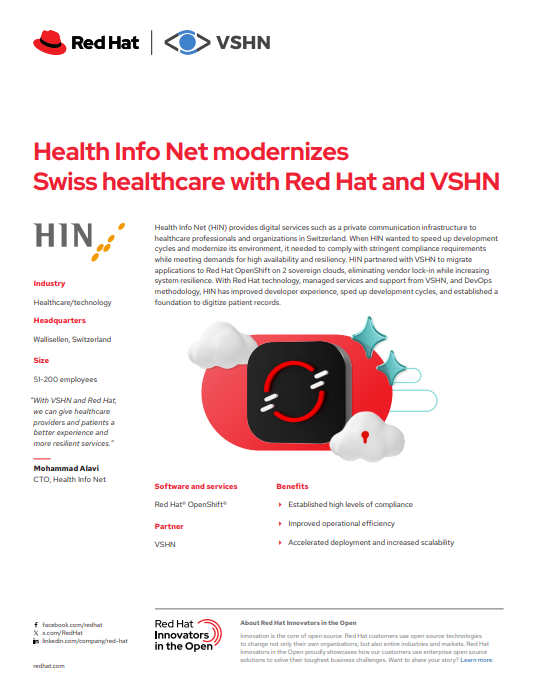
On March 10, 2026, at the Red Hat Switzerland Partner Day 2026 in Zurich, VSHN AG received the Red Hat Partner Award 2025 for “Platform Modernization of the Year.”

The award recognizes VSHN’s joint work with Health Info Net AG (HIN) to modernize one of the most important digital infrastructures in the Swiss healthcare ecosystem.

Supporting the backbone of digital healthcare

For almost thirty years, HIN has been at the forefront of digitalizing Swiss healthcare. The organization provides secure digital services such as encrypted @hin.ch email addresses for healthcare professionals and organizations including doctors, hospitals, pharmacies, and authorities across Switzerland.

Today, more than 50,000 healthcare professionals rely on HIN services, and the network connects over 90% of relevant actors in the Swiss healthcare system. This makes HIN an essential part of the country’s healthcare communication ecosystem.

Operating such a platform requires the highest standards of security, reliability, and scalability, as sensitive healthcare data and critical communication depend on it.

Building on a proven foundation

As HIN’s digital services continued to evolve, the underlying infrastructure increasingly reflected an earlier stage in the organization’s technical development. The existing environment, built around dedicated physical servers and long-term provider relationships, had proven reliable over many years.

At the same time, HIN saw the opportunity to complement this stable foundation with greater flexibility, standardization, and modern operating models.

To address this, HIN launched Project Phoenix – an initiative inspired by the principles of The Phoenix Project book – with the goal of reinventing its IT infrastructure and enabling a more agile and resilient organization.

The guiding principles of the project included:

  • GitOps and traceability, enabling a single, well-managed source of truth for configuration and infrastructure changes
  • A dual-vendor strategy to avoid vendor lock-in across infrastructure layers
  • A security-first architecture prioritizing privacy, compliance, and data protection
  • Standardization and scalability through open technologies
  • Automation and iterative improvement to increase operational efficiency
  • Faster time-to-market for new digital healthcare services

A strategically important part of the transformation is the planned implementation of the Secure Swiss Health Network (SSHN) based on the SCION Internet architecture, a next-generation networking architecture designed to provide highly available and secure communication paths.

A cloud-native platform for the future

To bring this vision to life, HIN partnered with VSHN to design and deploy a modern cloud-native platform.

The platform is built on Red Hat OpenShift, a Kubernetes-based container platform that enables scalable application deployment and modern DevOps workflows.

An important aspect of the platform architecture is a modern security approach based on the principles of Zero Trust and Defense in Depth. Unlike traditional perimeter-based network security models that rely primarily on a central firewall, a Zero Trust approach leads to much stronger network microsegmentation and therefore a more distributed security model.

At HIN, the infrastructure is separated into public and private environments, while the private networks are further segmented wherever possible using Kubernetes Network Policies.

This layered security architecture means that a potential attacker would first have to bypass multiple protection layers and then authenticate across different components using mechanisms such as OIDC or certificates. Even in the unlikely event of a successful breach, segmentation ensures that access would be limited to a specific zone rather than the entire platform.

To ensure long-term flexibility and avoid dependence on a single provider, the platform follows a dual-vendor cloud strategy and runs across two European cloud providers:

  • cloudscale.ch, a Swiss cloud provider specializing in sovereign infrastructure
  • Exoscale, a European cloud provider with data centers across Europe and strong privacy and compliance standards

This architecture allows HIN to operate a modern platform while maintaining independence and long-term flexibility in its infrastructure choices.

The results

The platform transformation delivered several important improvements for HIN:

  • Rapid deployment and scalability for applications
  • Enhanced security and compliance aligned with Swiss healthcare regulations
  • Operational efficiency through automation and reduced manual processes
  • A cultural shift toward DevOps, enabling continuous improvement and innovation

By combining cloud-native technologies with strong security and compliance principles, HIN is now well positioned to support the evolving needs of the Swiss healthcare sector.

Recognition from Red Hat

Sandhya Prabhu (Red Hat) & Tania Vonarburg-Romero (VSHN)

The Red Hat Partner Award for Platform Modernization of the Year recognizes projects that demonstrate how open technologies and modern platforms can successfully transform critical IT environments.

At the event in Zurich, Red Hat recognized several Swiss and international partners for projects implemented using Red Hat technologies across areas such as automation, hybrid cloud, virtualization, and platform modernization.

Receiving this award together with HIN highlights the impact that modern DevOps practices and open platforms can have in sectors where security, trust, and reliability are essential.

A strong ecosystem

Projects of this scale are only possible through collaboration. The modernization of HIN’s platform brought together technology providers, cloud infrastructure partners, and platform engineering expertise.

The project is also an example of the Open Sovereign ecosystem, where organizations collaborate to build secure, open, and sovereign digital infrastructure for critical sectors such as healthcare.

Want to learn more?

If you would like to explore the project in more detail, read the full HIN success story, where we explain the platform architecture, transformation journey, and collaboration behind the modernization of Switzerland’s healthcare communication infrastructure.

👉 Read our Success Story with HIN

Thank you

A big thank you to the teams at HIN, Red Hat, and everyone involved in this project.

We are proud to support platforms that play such an important role in Switzerland’s digital infrastructure and look forward to continuing this journey together.

Markus Speth

Marketing, Communications, People

Contact us

Our team of experts is available for you. In case of emergency also 24/7.

Contact us
Events General Tech

Cloud Native Computing Switzerland Meetup – March 2026 Recap

10. Mar 2026

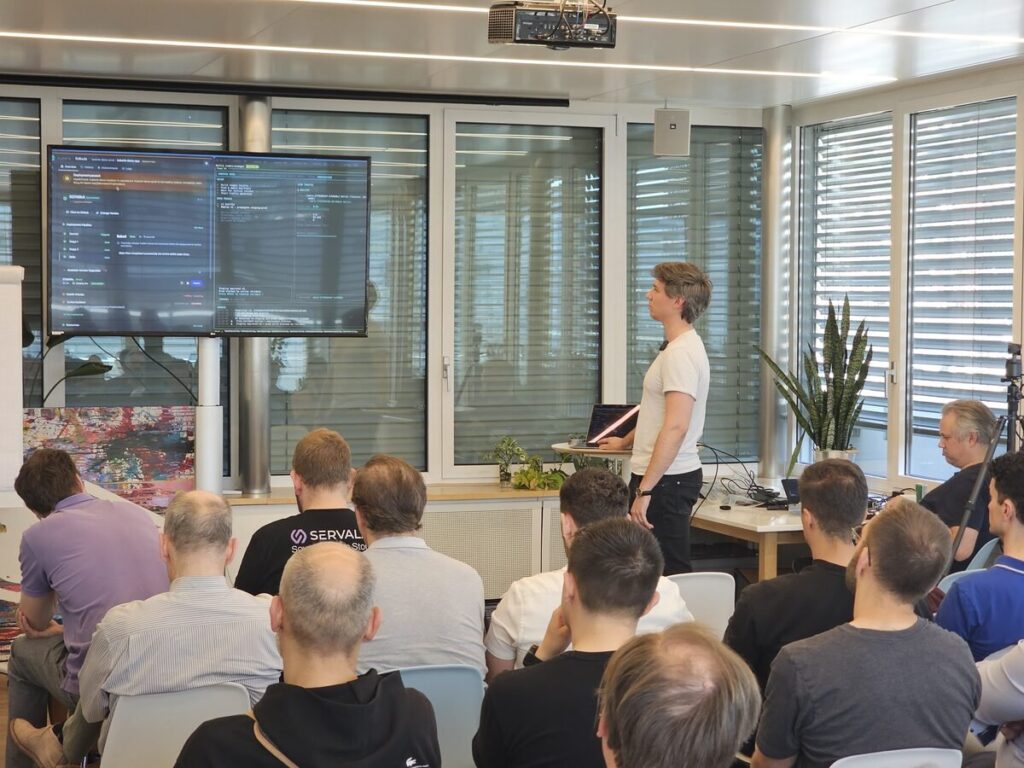
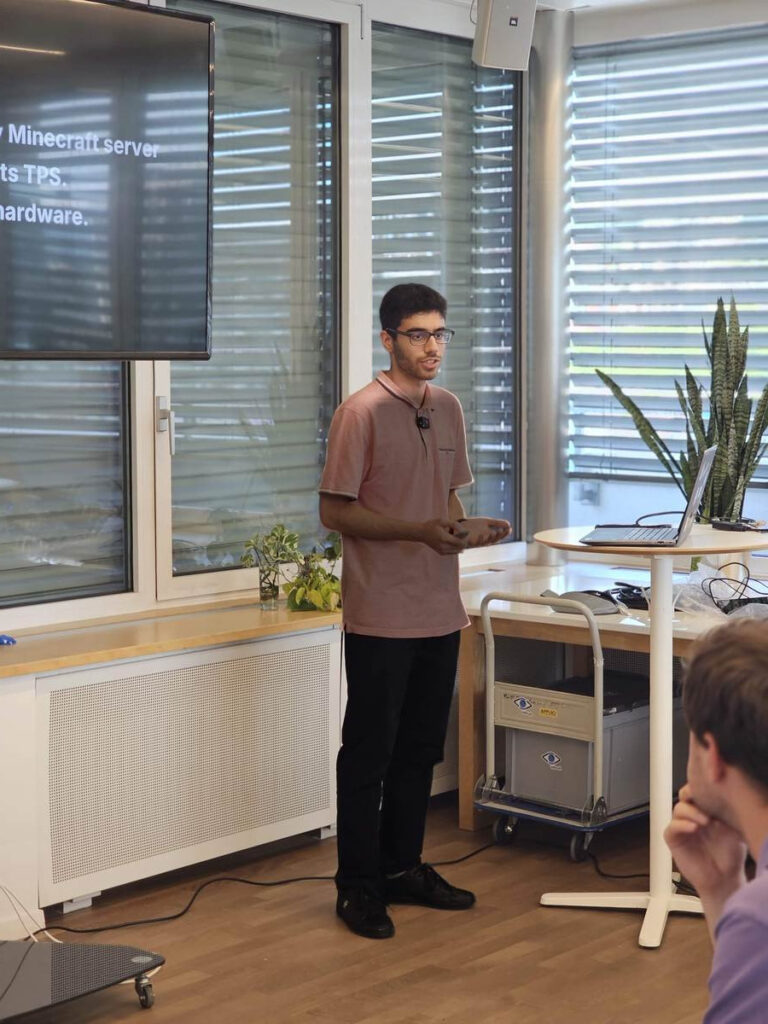
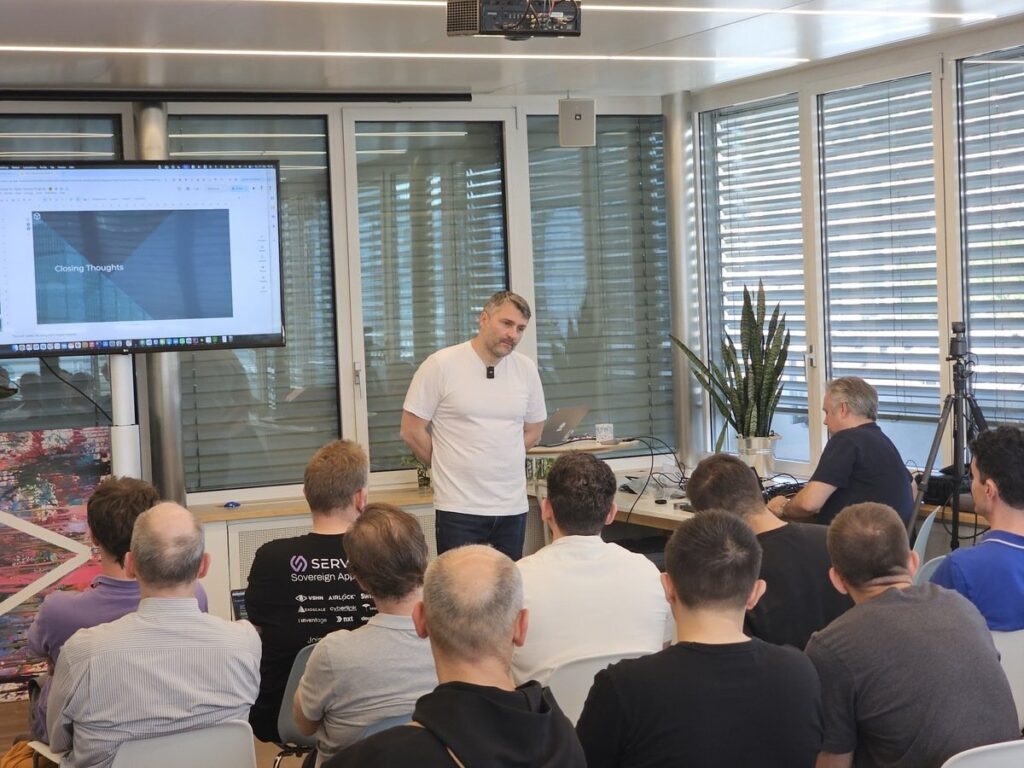
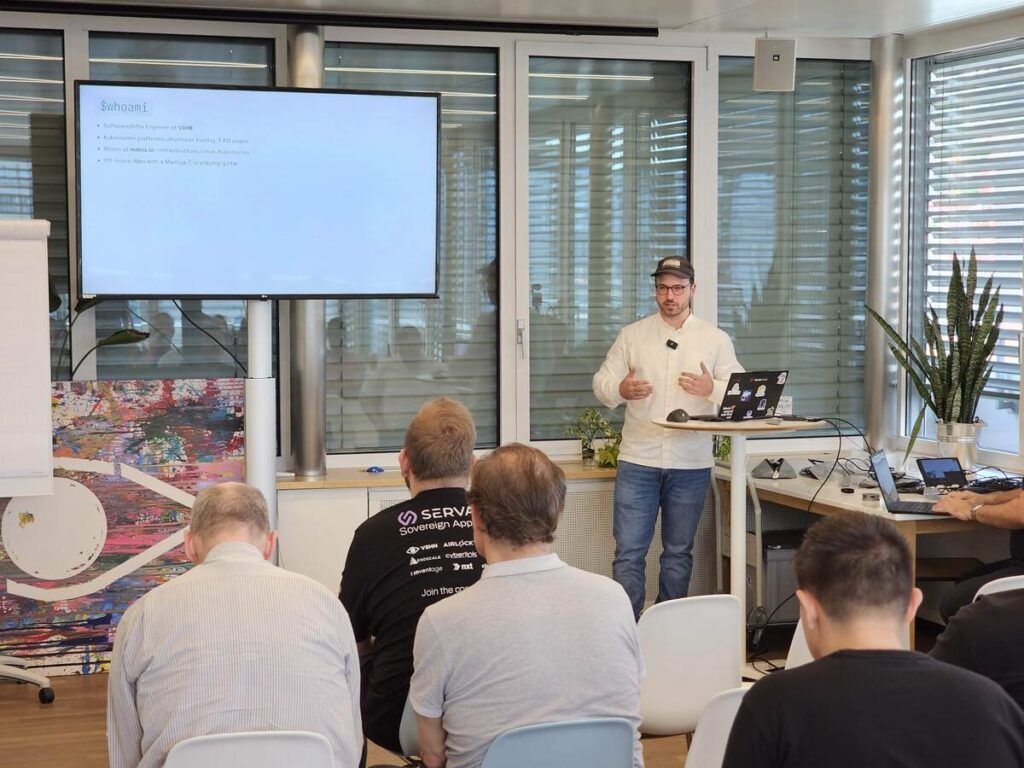
On March 10, the Cloud Native Computing Switzerland Meetup Community gathered again at the VSHN Tower in Zürich for an afternoon of technical talks, discussions, and community exchange.

With more than 3,000 members in the meetup group, the CNC Switzerland community continues to bring together platform engineers, DevOps practitioners, architects, and open-source enthusiasts from across the Swiss cloud-native ecosystem.

The March edition featured four talks covering topics from Kubernetes security and networking to platform engineering and MLOps.

Opening and Community Updates

Aarno Aukia and Patrick Mathers – VSHN

The meetup kicked off with a short welcome and community update by the organizers. As always, the CNC Switzerland meetup follows a few important principles:

  • All talks are technical and open-source focused
  • No product or sales pitches
  • Talks are held in English
  • Speakers from diverse backgrounds are strongly encouraged

These principles help keep the meetup a true technical community event rather than a marketing stage.

TLS Hot Reload in Kubernetes

Janne Kataja – SIX

Janne Kataja from SIX explained how applications can implement hot reloading of TLS certificates, allowing certificates stored in Kubernetes Secrets to be updated without restarting pods.

Instead of forcing service restarts during certificate renewals – which can introduce downtime and operational risk – hot reload mechanisms detect changes in mounted secret volumes and reload certificates dynamically.

This approach enables:

  • seamless certificate rotation
  • higher availability
  • the use of shorter-lived certificates for improved security

The talk demonstrated how relatively small architectural decisions can significantly improve reliability and operational resilience.

Application-Centric Platforms with OAM and KubeVela

Raffael Klingler – AXA Schweiz

The second session explored a topic that is gaining traction across many organizations: platform engineering and internal developer platforms.

Raffael Klingler from AXA introduced the Open Application Model (OAM) and how it shifts the focus from Kubernetes infrastructure toward application-centric definitions.

Instead of writing complex Kubernetes manifests, developers define applications using modular building blocks. These definitions are then rendered into deployable infrastructure resources using KubeVela.

The talk showed how this approach allows organizations to:

  • standardize application deployment patterns
  • reduce Kubernetes complexity for developers
  • integrate cloud services and GitOps workflows

As more companies build internal developer platforms, models like OAM illustrate how Kubernetes can become more accessible and developer-friendly.

DevOps for AI: Running ML in Production with Kubeflow

Fabrizio Lazzaretti (Wavestone) & Marco Crisafulli (enki)

AI is everywhere right now, but turning machine learning experiments into reliable production systems remains difficult.

Fabrizio Lazzaretti and Marco Crisafulli explored how MLOps practices and Kubeflow help bridge the gap between data science experimentation and production-grade systems.

The session demonstrated how Kubeflow enables:

  • reproducible ML pipelines
  • collaboration between teams
  • automated training workflows
  • integration with the broader CNCF ecosystem

Using a real end-to-end example, the speakers showed how organizations can move from ad-hoc AI experiments to repeatable, scalable ML platforms running on Kubernetes.

The talk highlighted a key insight: AI systems still need strong DevOps foundations.

Bye-bye Ingress-NGINX – Hello Gateway API

Urs Zurbuchen – Airlock

The final talk addressed a major architectural shift happening in the Kubernetes networking ecosystem.

Urs Zurbuchen from Airlock explained why the traditional Ingress model – often powered by the NGINX Ingress Controller – is reaching its limits.

Many Kubernetes users have experienced challenges such as:

  • configuration complexity
  • heavy reliance on annotations
  • security issues in older controller implementations

The emerging Gateway API aims to address these limitations with a more structured and extensible networking model.

The talk walked through:

  • the architectural improvements of Gateway API
  • why it is becoming the future standard
  • migration considerations for existing Kubernetes clusters

For many attendees, this session provided a helpful overview of where Kubernetes networking is heading next.

Networking and Apéro

After the talks, participants stayed for networking and the traditional Swiss meetup apéro, continuing discussions about Kubernetes, platform engineering, and the rapidly evolving cloud-native ecosystem.

Meetups like these highlight the strength of the Swiss cloud-native community: engineers from different companies sharing real-world experiences, lessons learned, and open-source solutions.

Watch the Talks

The sessions from this meetup will be published on the VSHN TV YouTube channel.

Subscribe to stay notified when the recordings become available.

Join the Community

The Cloud Native Computing Switzerland Meetup welcomes engineers, architects, and developers interested in cloud-native technologies and open source.

If you would like to present a talk or share your project, submit your proposal here.

We look forward to seeing you at the next meetup!

Markus Speth

Marketing, Communications, People

Contact us

Our team of experts is available for you. In case of emergency also 24/7.

Contact us
General Tech

DevOps for AI: Running LLMs in Production with Kubernetes and Kubeflow

9. Mar 2026

Large Language Models (LLMs) are rapidly becoming part of modern software systems. From chatbots and copilots to retrieval systems and AI agents, organizations are integrating generative AI into real production environments. But while building AI prototypes has become easier than ever, operating LLMs reliably in production remains a serious challenge.

At Kubernetes Community Days New York, Aarno Aukia shared practical insights into what it takes to run LLMs using proven DevOps practices. His talk highlighted an important reality: AI systems still need strong DevOps foundations – perhaps even more than traditional software systems.

Aarno Aukia’s talk at KCD New York

DevOps Meets AI

DevOps has always been about bridging the gap between development and operations. Developers focus on building application logic and managing data, while operations teams ensure that software runs reliably in production. Over the past decade, DevOps practices have matured around automation, observability, and continuous delivery.

In many organizations today, software follows a well-established pipeline: developers commit code to Git, automated CI/CD pipelines build and package the application, and Kubernetes deploys and runs it in production. Monitoring and logging systems then provide visibility into how the application behaves, allowing developers to continuously improve it.

This feedback loop has become the backbone of modern cloud-native development.

When AI enters the picture, however, the model changes in several important ways.

AI Systems Behave Differently

One of the biggest differences between traditional applications and AI-driven systems is determinism. Traditional software behaves predictably: given the same input, it produces the same output every time. LLMs behave very differently.

Large language models are probabilistic systems. They generate responses by predicting the next token based on context, effectively making statistical decisions about what comes next. This means that even small changes in prompts or user input can produce very different results.

A seemingly harmless modification to a system prompt can completely change the behavior of a model. In one example, simply adding a seasonal theme to a chatbot prompt caused the model to fail at answering basic questions.

For operations teams, this creates a new category of complexity. Instead of debugging deterministic systems, they now have to manage systems whose outputs can change subtly depending on context.

Testing therefore becomes significantly more complicated.

The Challenge of Testing AI

Traditional software testing is relatively straightforward. A test provides an input and verifies that the output exactly matches an expected value.

AI systems do not fit into this model. When an LLM generates an answer, the output might be correct even if the exact wording differs from what was expected. At the same time, the response could contain subtle factual errors or hallucinations.

Determining whether an answer is acceptable often requires semantic evaluation rather than strict comparisons. In some cases, organizations even use another LLM to evaluate the output of the first one. This introduces an entirely new testing paradigm that many teams are still learning how to manage.

More Artifacts to Manage

AI systems also introduce additional artifacts that must be tracked and versioned.

In traditional DevOps pipelines, the primary artifacts are source code and container images. With AI workloads, teams must also manage datasets, training artifacts, prompts, and model files. These models are often very large, sometimes tens of gigabytes in size, and must be stored and versioned carefully.

Without proper versioning, it becomes extremely difficult to debug issues or reproduce results later. If a model behaves unexpectedly, teams need to know exactly which model version, dataset, and configuration were used during deployment.

This dramatically increases the operational complexity of AI systems.

Observability Becomes Critical

Because LLMs are non-deterministic, observability becomes even more important than in traditional systems.

Logging must capture far more context than before. Instead of logging only application events, teams may need to record the full prompt, the model response, the model version, and the surrounding configuration. This allows operators to reconstruct what happened when something goes wrong.

Without detailed observability, debugging AI systems can quickly become impossible.

Open Models vs Hosted APIs

Another important operational consideration is the choice between closed and open models.

Hosted AI APIs offer convenience and powerful capabilities, but they also come with trade-offs. In many cases, organizations cannot control exactly when model updates happen or which minor version is running at a given time. This can make debugging and reproducibility difficult.

Open-weight and open-source models provide more operational control. They can be downloaded, versioned, tested locally, and deployed on internal infrastructure. This allows organizations to decide when and how updates are rolled out.

For many regulated industries such as finance, healthcare, or government, this level of control is essential.

Kubernetes as the Foundation

This is where Kubernetes becomes an important part of the AI infrastructure stack.

Kubernetes already solves many of the operational challenges associated with running distributed systems. It provides mechanisms for container orchestration, resource management, autoscaling, and fault tolerance. Importantly for AI workloads, it can also manage GPU resources.

However, operating Kubernetes itself is not trivial – as discussed in our article Best Kubernetes Distributions in 2026 – And Why You Might Not Want to Run Them Yourself, running clusters in production requires significant operational expertise.

Kubeflow and the Machine Learning Lifecycle

Kubeflow extends Kubernetes with specialized components for machine learning workflows. It helps manage the entire lifecycle of AI models, from training to production inference.

Kubeflow Pipelines allow teams to automate workflows for model development and training. These pipelines can orchestrate complex processes such as data preprocessing, training runs, evaluation steps, and packaging models for deployment.

For many organizations using LLMs, however, the main focus is not training models but serving them reliably in production.

This is where KServe plays a key role.

Serving LLMs with KServe

KServe is a Kubernetes-native model serving framework that simplifies deploying and operating AI models. It allows teams to run inference services on top of Kubernetes using standard APIs.

A typical deployment consists of a container running a model server, often based on runtimes such as vLLM. The container loads the model, uses GPU resources for inference, and exposes an API endpoint for applications.

KServe integrates with Kubernetes autoscaling mechanisms and observability tools, making it possible to scale AI workloads dynamically and monitor their behavior in production.

Because everything runs as Kubernetes resources, teams can apply the same DevOps practices they already use for other applications.

A Rapidly Evolving Ecosystem

The ecosystem around AI infrastructure is evolving extremely quickly. New projects are emerging to address the unique challenges of running LLMs at scale.

One example is LLMD, a Kubernetes operator specifically designed for LLM inference. It builds on existing technologies such as vLLM but adds specialized capabilities like request routing, model selection, caching, and intelligent scaling.

These kinds of tools illustrate how the cloud-native ecosystem is adapting to the operational needs of AI workloads.

AI Still Needs DevOps

Despite the hype surrounding generative AI, one lesson is clear: AI systems still require strong operational foundations.

Running LLMs in production involves far more than simply calling an API. It requires careful management of models, infrastructure, observability, and deployment processes.

Kubernetes and Kubeflow provide a powerful platform for addressing these challenges. By applying proven DevOps principles to AI systems, organizations can build platforms that are not only intelligent but also reliable and scalable.

As AI becomes a standard component of modern applications, the ability to operate these systems effectively will become just as important as the models themselves.

This is also where platform approaches come into play. Instead of every team building and operating complex stacks themselves, platforms can provide ready-to-use services on top of Kubernetes. One example is Servala – Sovereign App Store, a Kubernetes-native marketplace that connects organizations with a catalog of managed cloud-native services such as databases, storage, developer tools, and AI-ready infrastructure components.

Markus Speth

Marketing, Communications, People

Contact us

Our team of experts is available for you. In case of emergency also 24/7.

Contact us
General Kubernetes

Best Kubernetes Distributions in 2026 – And Why You Might Not Want to Run Them Yourself

2. Mar 2026

Kubernetes has become the backbone of modern digital infrastructure – powering everything from SaaS platforms to mission-critical systems in healthcare, finance, and public administration.
Yet one thing is still widely underestimated: Kubernetes by itself is not enough.

Running Kubernetes in production requires far more than the upstream project. You need networking, storage, observability, security hardening, upgrade tooling, and operational processes – all tightly integrated and continuously maintained.

That’s where Kubernetes distributions come in.

And if you don’t want to run all that complexity yourself, there’s another step up the abstraction ladder: Managed Kubernetes or Managed OpenShift.

In this post, we look at the Kubernetes distribution landscape in 2026 and explain why outsourcing operations is often the smartest choice.

What Is Kubernetes?

Kubernetes (K8s) is the open source orchestration system for containerized applications. Originally released by Google, it has become the de-facto standard for deploying, scaling, and operating containers across cloud, hybrid, and on-premises environments.

Today, Kubernetes is governed by the Cloud Native Computing Foundation (CNCF), ensuring vendor-neutral development, open standards, and a strong community-driven roadmap.

Kubernetes itself is best understood as the engine.
To actually go somewhere, you need the car built around it – and that’s exactly what Kubernetes distributions provide.

If you want to learn more about Kubernetes itself – what it does and how it powers modern applications – check out: What is Kubernetes? The Engine of the Digital World, Simply Explained.

Kubernetes Version Support in 2026

The latest Kubernetes version as of March 2nd, 2026 is v1.35. The Kubernetes project maintains release branches for the most recent three minor releases (currently 1.35, 1.34, 1.33). Kubernetes 1.19 and newer receive approximately 1 year of patch support. Kubernetes 1.18 and older received approximately 9 months of patch support.

At any given time, the three most recent minor versions are in mainstream support, with each release supported for roughly 14 months. This means regular upgrades are not optional – they are a core operational requirement.

Industry reports consistently show that the majority of production clusters run supported versions, but a significant share still lags behind due to operational complexity. According to Datadog’s 2025 Kubernetes adoption report, 78% of hosts are running Kubernetes versions in mainstream support, 19% are on older versions with extended support, and only 3% are running unsupported releases. This highlights how important regular updates and lifecycle management have become in production environments – and how easily they can be overlooked in self-managed setups.

What Defines a Kubernetes Distribution?

Much like Linux – where the kernel is combined with drivers, utilities, and configuration to form a complete operating system (a Linux distribution) – Kubernetes also needs to be bundled with essential tools and services to be usable in production. That’s what a Kubernetes distribution provides.

Just as there are different Linux distributions tailored for different needs – like Ubuntu, Debian or Red Hat Enterprise Linux (RHEL) – there are also many Kubernetes distributions, each offering different trade-offs in terms of usability, support, performance, and ecosystem integration.

A Kubernetes distribution is a pre-packaged version of upstream Kubernetes that combines the core components (API server, scheduler, controller manager, etc.) with the tools and services needed to operate it reliably.

Typical features bundled by distributions include:

  • Installer and upgrade tooling for control plane and worker nodes
  • Networking (CNI), ingress, and sometimes service mesh
  • Storage support through CSI drivers and backup integration
  • Security features like authentication, RBAC, and audit logs
  • Monitoring, logging, and alerting (often based on Prometheus and friends)
  • Developer tooling like GitOps pipelines, CLI, or dashboards

A distribution helps standardize your setup, reduce integration effort, and align with best practices. But even the best distribution still needs to be installed, upgraded, patched, and supported – which brings us to the next level.

Kubernetes and Red Hat OpenShift in 2026

Red Hat OpenShift is probably the most famous Kubernetes distribution and it comes with a clear opinionated approach. It builds on upstream Kubernetes and extends it into a full application platform.

Key characteristics of OpenShift include:

  • Full-stack lifecycle management and upgrades
  • Integrated developer experience with pipelines, GitOps, and image builds
  • OperatorHub for lifecycle-managed services
  • Strong multi-tenancy, access control, and policy enforcement
  • Built-in observability and compliance capabilities

OpenShift is designed for production from day one, particularly in regulated environments or large organizations that value consistency and governance.

The current OpenShift 4.21 platform (released in February 2026) is based on Kubernetes 1.34 and CRI-O 1.34. It reinforces OpenShift’s position as a trusted and comprehensive application platform where AI workloads, containers, and virtualization run side by side – across hybrid cloud environments, with integrated tools and services for cloud-native, virtual, and traditional applications.

If you’re in a regulated industry or need a platform that’s ready for production from day one, OpenShift is a strong candidate. If you prefer flexibility or want a minimal setup, other distributions might be a better fit.

The Kubernetes Distribution Landscape in 2026

While there are dozens of Kubernetes distributions, most fall into four practical categories.

Enterprise-Grade Kubernetes Distributions

Designed for large-scale and regulated environments with strong lifecycle management and governance requirements:

  • Red Hat OpenShift – feature-rich, highly integrated platform with built-in governance, observability, and developer tooling
  • VMware Tanzu Kubernetes Grid – integrates tightly with vSphere and enterprise lifecycle tooling
  • D2iQ Kubernetes Platform (DKP) – focuses on multi‑cluster, hybrid and edge operations with strong lifecycle and governance capabilities.
  • Mirantis Kubernetes Engine (MKE) – hardened enterprise distro with support for air-gapped and FIPS-compliant environments
  • Rancher RKE2 – secure Kubernetes distribution focused on hybrid and multi-cluster operations

Enterprise distributions often provide lifecycle automation (upgrades, patching), hardened security (CIS Benchmarks, FIPS), and tools for consistent multi-cluster policy enforcement and hybrid-cloud deployment.

Cloud-Managed Kubernetes Services

These services abstract away most of the control plane and offer Kubernetes as a service:

  • Amazon Elastic Kubernetes Service (EKS)
  • Google Kubernetes Engine (GKE)
  • Azure Kubernetes Service (AKS)
  • IBM Cloud Kubernetes Service, Oracle OKE, and others

These are ideal if you prefer to consume Kubernetes without managing infrastructure. They’re tightly integrated with their respective cloud ecosystems and handle the upgrades for you.

Lightweight and Edge-Optimized Kubernetes

Perfect for IoT, remote locations, or constrained environments:

  • k3s (by Rancher) – single-binary Kubernetes for edge, CNCF-certified
  • k0s (by Mirantis) – minimal, declarative, and ideal for embedded or hybrid deployments
  • MicroK8s – Canonical’s snap-based distribution for edge and dev/test
  • Talos Linux + Kubernetes – fully immutable and API-driven

These distributions prioritize small footprint, minimal dependencies, and low operational overhead.

Self-Hosted Open Source Kubernetes Distributions

These are open source Kubernetes distributions aimed at teams that want full control and flexibility over their clusters. They come without vendor lock-in, but require more operational effort.

  • OKD – community distribution that forms the upstream of Red Hat OpenShift
  • RKE2 (Rancher Kubernetes Engine 2) – secure, hardened Kubernetes distribution by Rancher
  • Charmed Kubernetes – Canonical’s opinionated but modular Kubernetes stack
  • Talos Linux + Kubernetes – fully immutable and API-managed Linux OS designed for Kubernetes

They provide flexibility, but managing lifecycle, upgrades, and integrations remains your responsibility.

Why Choose Managed Kubernetes or Managed OpenShift?

Even with a well-designed distribution, operating Kubernetes remains complex.

Teams are responsible for:

  • Cluster health, availability and scaling
  • Regular upgrades and security patching
  • Incident response and troubleshooting
  • Governance across multiple clusters or environments
  • Compliance and audit readiness

Managed Kubernetes and Managed OpenShift services exist to offload exactly this burden.

At VSHN, we operate Kubernetes and OpenShift clusters with clear SLAs and production-grade processes, including:

  • Automated upgrades and lifecycle management
  • 24/7 SLA-backed monitoring and incident response
  • Consistent multi-cluster governance and policy enforcement
  • Integration with managed databases, identity, and observability services
  • Support for hybrid, multi-cloud, and sovereign cloud environments
  • Proven compliance with ISO 27001, ISAE 3402 Report Type 2, KCSP, and Red Hat Premier CCSP standards

With a managed approach, your team no longer needs deep Kubernetes operations expertise in-house. You can focus on applications, innovation, and delivery – while we handle the complexity of the underlying platform.

Why Talos Makes Managed Kubernetes Even Stronger

Modern, immutable foundations like Talos Linux fundamentally change how Kubernetes clusters are operated.

Talos removes entire classes of operational and security risks by design:

  • No SSH access
  • No package manager
  • No configuration drift
  • Fully declarative and API-driven

In a managed setup, Talos enables highly standardized, reproducible, and secure clusters at scale.
Upgrades become predictable, rollback-safe, and auditable – making Talos particularly attractive for regulated and sovereign environments.

Combined with managed operations, Talos represents a clear direction for the future of Kubernetes: immutable, automated, and reliable.

So – Which Kubernetes Distribution Should You Choose?

Here’s a quick guide based on your needs:

  • Want a full-featured platform for hybrid cloud with enterprise support? → Red Hat OpenShift
  • Prefer cloud-native services with minimal operational overhead? → EKS, GKE, AKS
  • Need lightweight, minimal, or edge-ready setup? → k3s or k0s
  • Want full control and are ready to do the work? → RKE2, MicroK8s, OKD
  • Want the benefits without the operational burden? → Go with a Managed Kubernetes or Managed OpenShift provider like VSHN

Final Thoughts

In 2026, Kubernetes is firmly established as the engine of the digital world. From cloud-native applications to mission-critical systems in enterprise and public sector environments, Kubernetes has become the foundation of modern IT platforms.

However, choosing the right Kubernetes distribution is only the first step. The real challenge lies in operating Kubernetes securely, reliably, and compliantly over time – especially in complex, regulated, or fast-growing environments.

In the enterprise space, Red Hat OpenShift has emerged as the de-facto standard. Its combination of mature lifecycle management, integrated security, strong governance mechanisms, and a comprehensive toolchain for developers and operators makes OpenShift the first choice for many organizations – particularly where compliance, scalability, and operational stability are critical.

At the same time, lightweight and modern distributions such as k3s, k0s, and Talos illustrate where Kubernetes technology is heading. Immutable, API-driven, and highly automated platforms significantly reduce operational complexity and attack surfaces. Their full potential, however, is only realized when they are operated in a standardized and professionally managed way.

This is where Managed Kubernetes, Managed OpenShift and Cloud Platform Operations come into play. They combine modern platform technologies with proven operational processes, clear SLAs, and continuous improvement. Teams can focus on applications, innovation, and business value without maintaining deep Kubernetes operations expertise in-house.

Whether it is OpenShift in the enterprise, cloud-managed Kubernetes, or modern immutable platforms like Talos, the decisive factor is not the distribution itself but an operating model that consistently delivers security, stability, and scalability.

If you want to run Kubernetes sustainably, securely, and future-proof, adopting a managed approach is often the most effective path – both technically and organizationally.

👉 Learn more about our offering:

Markus Speth

Marketing, Communications, People

Contact us

Our team of experts is available for you. In case of emergency also 24/7.

Contact us
General

Sovereignty in Practice Study 2026 – Take Part Now

9. Feb 2026

From DevOps to Digital Sovereignty

Over the past years, DevOps, platform engineering, and cloud-native technologies have fundamentally changed how organisations build and operate digital services. What originally started as a discussion about speed, automation, and efficiency has increasingly become a question of control, responsibility, and long-term resilience.

This shift became clearly visible in our DevOps studies. Technical maturity alone is no longer sufficient. Organisations are now asking more fundamental questions: Where does our data actually reside? Who controls our platforms? And how do regulatory, legal, and geopolitical conditions affect day-to-day IT and operations?

This is exactly where the Sovereignty in Practice Study 2026 comes in.

👉 Go directly to the survey.

What we learned from the DevOps Study

The DevOps Study showed broad adoption of cloud-native approaches, automation, and platform models across many industries. At the same time, recurring challenges became clearly apparent:

  • growing dependencies on a small number of providers
  • increasing regulatory pressure, especially in regulated environments
  • tension between agility, compliance, and long-term control
  • uncertainty about how much digital sovereignty is realistic and achievable

Digital sovereignty repeatedly emerged as a key topic – but often more as an abstract concept than as an established operational practice.

Why a dedicated sovereignty study

Together with Zühlke, we at VSHN decided to take the next step.

Instead of treating digital sovereignty as a side topic, the Sovereignty in Practice Study 2026 deliberately places it at the centre. The goal is not to provide a theoretical ideal definition, but to understand how organisations implement digital sovereignty in practice today.

The study focuses on questions such as:

  • How do regulatory and economic constraints shape real-world architectures?
  • How are decisions about data, workloads, and providers made?
  • How are these decisions enforced organisationally and technically?
  • Where are dependencies consciously accepted – and why?

From strategy to lived practice

Digital sovereignty is often discussed at a strategic level. In practice, however, it manifests in very concrete decisions – such as cloud contracts, platform architectures, operating models, and governance structures.

The study is conducted via a short online survey and is intentionally designed to be practical and experience-based. Responses should reflect the organisation’s perspective. If certain aspects are unclear or not yet decided, selecting “Not sure” is a fully valid and important response.

Who the study is for

The Sovereignty in Practice Study is aimed at organisations operating digital platforms or business-critical workloads – particularly in regulated sectors such as healthcare, financial services, public sector, and critical infrastructure.

Whether digital sovereignty is already strategically anchored or only emerging as an operational concern, every perspective contributes to building a realistic and meaningful overall picture.

Prize Draw

And just like in the DevOps Reports, we will have a prize draw! If you enter your email at the end, you’ll automatically enter a prize draw for one (1) Digitec / Galaxus voucher of 200 CHF or one (1) APPUiO Cloud voucher worth 200 CHF! We will contact the two winners privately and separately on Wednesday, April 1st, 2026. The terms and conditions apply.

Participate in the study now

  • Time required: approximately 5-7 minutes
  • Format: online survey
  • Participation deadline: March 31, 2026

For the purpose of the study, digital sovereignty refers to an organisation’s ability to make and enforce decisions about data, workloads, and providers under its regulatory and business constraints.

👉 Participate in the Sovereignty in Practice Study 2026

Markus Speth

Marketing, Communications, People

Contact us

Our team of experts is available for you. In case of emergency also 24/7.

Contact us
General

VSHN wins ‘Biggest Microgateway Deal 2025’ at the Ergon Airlock Partner Event

2. Feb 2026

On January 27th and 28th 2026, Ergon invited its partner ecosystem to the Airlock Partner Event on the Stoos – two days dedicated to collaboration, exchange and a shared view on the future of Identity Security.

VSHN was proud to join the event as an Airlock partner and to be part of an inspiring atmosphere with many interesting people, discussions and technical insights. The combination of deep conversations, strong community spirit and the impressive mountain setting made the event a special highlight right at the start of the year.

A strong partnership with Ergon and Airlock

Airlock and the Airlock Microgateway are part of Ergon’s security portfolio and play a central role in protecting critical digital services. As a partner, VSHN works closely with Ergon to help organisations operate these components reliably, securely and at scale – especially in environments where availability, compliance and trust are non-negotiable.

Events like the Airlock Partner Event or our Cloud Native Computing Meetups show how important close collaboration is when building and operating identity and access solutions that organisations can truly rely on.

Biggest Microgateway Deal 2025

A special moment for VSHN was receiving the partner award ‘Biggest Microgateway Deal 2025‘.

The award recognises our successful joint customer project with HIN – Health Info Net, Switzerland’s trusted network for the healthcare sector. Together with Ergon and Airlock, we support HIN in operating secure and highly available access infrastructure that meets the strict requirements of the healthcare ecosystem.

You can learn more about this project in our HIN (Health Info Net) Success Story.

This award is a strong confirmation of what is possible when technology, partnership and operational excellence come together.

On site with the VSHN team

Our VSHNeers Daniel Briner and Tobias Brunner represented VSHN during the two-day event and took part in many valuable conversations, sessions and partner exchanges. Both also joined interviews during the event – with more content, videos and insights to be published by Airlock in the coming days.

And last but not least: the Airlock mascot officially got a name during the event – meet Airbert.

Looking ahead

The Airlock Partner Event 2026 once again highlighted how much potential lies in strong ecosystems built on trust, openness and shared responsibility.

We are grateful for the invitation, the open exchange and the recognition of our joint work – and we are already looking forward to many more success stories with Ergon, Airlock and our customers in the future.

What is Airlock Microgateway?

Airlock is a well-established security solution by Ergon, designed to protect modern applications and APIs with strong identity and access controls. The Airlock Microgateway extends this approach into cloud-native and Kubernetes environments, enabling fine-grained access control, secure authentication flows and consistent enforcement of security policies close to the application.

For organisations running distributed, containerised workloads, the Microgateway provides a powerful foundation for Identity Security without adding unnecessary complexity to application architectures.

To make adoption and operations easier, Airlock Microgateway is available as a Managed Service on Servala – the Sovereign App Store by VSHN. This allows organisations to consume Airlock Microgateway in a fully managed, cloud-agnostic way while keeping control over data, governance and platform choices.

Learn more about the service on Servala.

Markus Speth

Marketing, Communications, People

Contact us

Our team of experts is available for you. In case of emergency also 24/7.

Contact us
Events General

Recap Red Hat Summit: Connect Switzerland 2026 in Zürich

15. Jan 2026

On January 14, 2026, the Swiss enterprise IT and open source community came together in Zurich for Red Hat Summit: Connect Switzerland 2026. The event offered a full day of insights, discussions, and exchange around hybrid cloud, OpenShift, automation, DevSecOps, AI, and above all, digital sovereignty.

For us at VSHN, it was a strong start into the new year and, as a Silver Sponsor, another clear signal of how relevant open source, cloud native platforms, and sovereign IT architectures have become for Swiss organizations.

VSHN in the opening keynote by Red Hat Country Manager Richard Zobrist

The day kicked off with a special moment right away: a strong quote about VSHN and our collaboration with HIN (Health Info Net), shared by Richard Zobrist, Red Hat Country Manager Switzerland, during the opening keynote. Aarno later summed it up with a wink: “Its not every day that the Red Hat country manager Richard drops my name during the opening keynote 🥰” – a great start to an exciting event day.

Focus on real enterprise challenges

Red Hat Summit: Connect Switzerland once again delivered a well-balanced mix of strategic perspectives and hands-on implementation topics. Across keynotes, breakout sessions, and partner talks, one thing became clear: organizations are no longer asking whether they should adopt hybrid cloud and Kubernetes, but how to operate these platforms reliably, securely, and in line with regulatory and sovereignty requirements.

Topics that were particularly in demand included:

  • Hybrid and multi-cloud architectures with OpenShift
  • Platform engineering as an enabler for developer productivity
  • Automation and Day-2 operations
  • Security and compliance in regulated environments
  • AI workloads on enterprise Kubernetes platforms
  • … and all of these topics in the context of digital sovereignty

Digital sovereignty is built, not bought

One of the highlights for us was the Partner Spotlight talk by Aarno Aukia, CTO & Partner at VSHN. In his lightning talk “Data Sovereignty Is Built, Not Bought“, Aarno addressed a topic that ran like a common thread through many conversations throughout the day.

The key message: sovereignty is not a label you can buy. It is an architectural and operational capability that must be intentionally designed and operated. OpenShift plays a key role here by decoupling applications and data from individual infrastructure providers and enabling consistent operations across on-premises, private cloud, and trusted public cloud environments.

This is exactly where platforms like Servala come into play – delivering managed services to OpenShift environments where the data already lives, without unnecessary data movement or lock-in.

Many great conversations at the VSHN booth

Throughout the day, our booth was a meeting point for customers, partners, and community members. We had many exciting conversations around:

Once again, it was striking how concrete the questions have become. Many organizations are deep into implementation and are looking for proven operating models rather than theoretical concepts.

Community, partners, and exchange

Beyond the sessions and breakout talks, Red Hat Summit: Connect Switzerland is first and foremost a community event and is rightly regarded as the largest open source event in Switzerland. The open exchange with Red Hat experts, partners, and peers made it easy to share experiences, challenges, and learnings.

A big thank you goes to Red Hat and the local team for organizing such a well-rounded and successful event in Zurich.

Looking ahead

The conversations clearly showed that 2026 will be another decisive year for digital sovereignty. We look forward to continuing to build reliable, open, and sovereign platforms together with our customers and partners – and to keeping the dialogue going at future community events.

Thank you to everyone who stopped by our booth, joined the sessions, and shared their perspectives. We are already looking forward to the next Red Hat Summit: Connect.

Contact VSHN

Would you like to learn more about what we do or how we can support you?
Then get in touch with us – we look forward to the exchange.

Markus Speth

Marketing, Communications, People

Contact us

Our team of experts is available for you. In case of emergency also 24/7.

Contact us
General

VSHN Year in Review 2025

17. Dec 2025

As we approach the end of the year, we would like to take a moment to say thank you. Thank you to our customers, partners, community members, and the entire VSHN team for the trust, collaboration, and shared learning throughout 2025. We wish you happy holidays, a restful end of the year, and a great start into 2026. We are looking forward to continuing this journey together.

Building sovereign, reliable cloud native platforms together

2025 was a year of momentum, focus, and collaboration for VSHN. Together with our customers, partners, and the wider cloud native community, we continued to do what we care about most: operating Kubernetes and OpenShift platforms reliably, delivering managed cloud native services from our Application Catalog, enabling developer productivity, and pushing forward open, sovereign digital infrastructure in Switzerland and Europe.

This year showed once again that reliable operations are not just a technical challenge, but a foundation for innovation, security, and trust. Digital sovereignty became one of the defining topics of the year – so much so that terms like “Sovereignty Washing” started to appear. This underlines how important it is to distinguish real architectural and operational sovereignty from marketing claims. If you want to dive deeper into this topic, we recommend Taking Back Control: The Case for Data Sovereignty and European Cloud Alternatives Matter.

Platform operations at scale

Throughout 2025, we operated and evolved a growing number of Kubernetes and OpenShift platforms for customers from the public sector, healthcare, finance, and many other industries. We were particularly happy to welcome new customers such as Gesundheitsamt Frankfurt and HIN (Health Info Net), and to showcase these successful collaborations in our customer success stories.

The focus across all platforms was clear: stability, security, and predictable operations in increasingly complex environments. What we see every day in practice is simple but essential: platforms need to be understandable, maintainable, and future-proof in order to scale sustainably.

If you want to build a solid foundation or refresh your understanding, What is Kubernetes? The Engine of the Digital World, Simply Explained remains one of our most-read pieces of the year.

Servala – from idea to ecosystem

One of the biggest milestones of 2025 was the continued growth of Servala – the Sovereign App Store. What started as a vision for an open, interoperable marketplace for cloud native services became a tangible and growing ecosystem this year.

A key moment was the Servala Ecosystem Day 2025 – Sovereignty in Action, where cloud providers, software vendors, and consulting partners came together to co-create and openly discuss what digital sovereignty means beyond buzzwords.

The accompanying recap blog post and video captured this shift from concept to collaboration and became one of the strongest Servala-related pieces of the year:

Throughout 2025, Servala also featured prominently in multiple talks, workshops, and partner discussions, reinforcing the idea that sovereignty is built through openness, standards, and shared responsibility – not isolation.

Community, events, and knowledge sharing

Community has always been at the heart of VSHN, and 2025 was no exception. We were present at numerous events across Switzerland and Europe – not just as sponsors, but as active contributors and participants.

Some highlights from the year included:

And last but not least: our Cloud Native Computing Meetups in Switzerland with now over 3’000 members!

Our upcoming events can be found here.

On the content side, we continued to publish blog posts, partner spotlights, and event recaps that connect theory with practice – always grounded in real operational experience and we have launched our DevOps in Switzerland Report 2025.

Strengthening partnerships

Strong ecosystems need strong partnerships. In 2025, we further deepened our collaboration with technology partners, cloud providers, and the open source community.

Our role as a long-standing Red Hat partner, our engagement in the CNCF ecosystem – including our own CNCF Sandbox project K8up – Kubernetes Backup Operator, Codey or Project Syn – and our close collaboration with Swiss and European cloud providers all contributed to delivering reliable, compliant, and sovereign platforms for our customers.

Partner spotlights and joint appearances at events underlined a shared belief: sustainable cloud native platforms are built together.

Growing as a team

Behind every reliable platform is a motivated team. In 2025, VSHN continued to grow – not just in numbers, but in experience and diversity of skills.

We invested in learning, internal knowledge sharing, and self-organisation, while also experimenting with new formats to make people and roles more visible. Stay tuned to learn more about our VSHNeers in 2026.

The combination of ownership, trust, and technical excellence once again proved to be a strong foundation.

Growing as an organization

2025 was also a year of growth and learning for VSHN as an organization. Beyond technical excellence, we continued to evolve how we collaborate, make decisions, and take ownership. We refined internal structures, clarified responsibilities, and invested in transparency and communication across teams.

One important milestone was the introduction of a new salary system, which we have been working on intensively for quite some time. The new model will take effect in 2026, once everything is ready. We will definitely share our experience, learnings, and outcomes in a separate blog post.

This ongoing organisational development enables us to scale without losing what defines VSHN: trust, self-organisation, and a strong sense of shared responsibility.

Looking ahead

2025 reinforced our belief that the future of cloud native platforms is open, interoperable, and sovereign. The challenges are real – from increasing regulation to growing technical complexity – but so are the opportunities.

With strong platforms, a growing ecosystem around Servala, and an engaged community, we are entering the next year with confidence.

Thank you to all our customers, partners, community members, and VSHNeers for being part of this journey. We are looking forward to what comes next.

Follow us

If you like what we’re doing, follow us and subscribe to our newsletters.

Markus Speth

Marketing, Communications, People

Contact us

Our team of experts is available for you. In case of emergency also 24/7.

Contact us
General Internal

Hi Roland

15. Dec 2025

Hello everyone,

My name is Roland and I am delighted to be taking on responsibility for the ISMS from December. In this role, I will be responsible for coordinating all aspects of information security.

As a child, I read Clifford Stoll’s book The Cuckoo’s Egg, which fascinated me greatly. That’s how I took my first steps with Linux using Yggdrasil Linux. I then moved on to SuSE 4.2 (Kernel 2.0!!!), which I bought in a bookstore, before switching to Debian. After completing my apprenticeship as a radio and TV electrician, I knew that I wanted to pursue a career in IT and focus on security in the long term. In recent years, I have worked as a Linux system engineer in various companies, primarily in the field of Internet and managed service providers.

In my free time, I enjoy sports and, as a licensed amateur radio operator, I like to tinker with technology.

Markus Speth

Marketing, Communications, People

Contact us

Our team of experts is available for you. In case of emergency also 24/7.

Contact us
Events General Kubernetes

VSHN at KubeCon Europe 2026 in Amsterdam – we look forward to seeing you!

11. Dec 2025

KubeCon + CloudNativeCon Europe 2026 – the cloud native community meets again in Amsterdam

From 23 – 26 March 2026, KubeCon + CloudNativeCon Europe returns to beautiful Amsterdam and brings together thousands of cloud native practitioners, platform engineers, SREs, developers and open source enthusiasts. For VSHN, this event has been one of the most important community gatherings for many years, and 2026 is no exception.

We will be on-site throughout the week, connecting with the community, learning about the latest CNCF developments, sharing our experience in operating reliable Kubernetes and OpenShift platforms, and meeting partners, customers, friends and fellow cloud native enthusiasts.

Community support – KubeTrain and KubeTrain Party

We are very excited to support the community as sponsor of KubeTrain 2026 and the KubeTrain Party.

KubeTrain – 22 March 2026: A fun and sustainable journey for everyone traveling together to KubeCon in Amsterdam. This initiative brings cloud native fans onto one train and creates networking and great conversations along the way.

KubeTrain Party – 22 March 2026: After arrival, the excitement continues at the official KubeTrain Party. Drinks, music, networking and a great start into KubeCon week.

Meet us at the KubeCon Swiss Apéro

Swiss Apéro – 24 March 2026: We will also be present and sponsoring the KubeCon Swiss Apéro 2026. It takes place at the Beach House, Strandzuid, Europaplein 22, 1078 GZ Amsterdam from 18:30. You can look forward to an evening full of conversations about Kubernetes, OpenShift, platform engineering, digital sovereignty, Servala and more.

Why you should meet us at KubeCon

VSHN is not just another Kubernetes service provider. For more than ten years, we have helped shape the cloud native landscape in Switzerland and beyond.

Here is why a conversation with us is worth your time:

  • We are the first Swiss Kubernetes Certified Service Provider (KCSP)
  • We are the first Swiss Red Hat Premier CCSP Partner
  • We operate Kubernetes and OpenShift platforms for organizations across Europe and beyond
  • We build and run Servala – the Sovereign App Store. Servala connects companies, developers and cloud providers with secure, scalable and user-friendly cloud native services and applications
  • Application Catalog – a large selection of managed services that integrate seamlessly into your development workflow
  • APPUiO – expert hosting for expert software engineers based on OpenShift
  • VSHN Solutions – your DevOps enabler – individual, modular, scalable
  • We help teams improve developer productivity, reliability and operational excellence
  • We live open source, collaboration and sustainable ecosystems
  • We actively grow and support the cloud native community

Our blog post What is Kubernetes? The Engine of the Digital World, Simply Explained explains the basics of Kubernetes in a simple and understandable way.

Our CNCF Sandbox Project – K8up

We also maintain our own CNCF Sandbox Project: K8up, a backup operator for Kubernetes and OpenShift that helps teams run backup and restore processes securely and automatically. As active maintainers, we contribute to strengthening the open source ecosystem and providing reliable tools for the Kubernetes community.

Community engagement – organizers of the largest cloud native meetup group in Switzerland

We organize the Cloud Native Computing Switzerland Meetup group with more than 3000 members, one of the most active tech communities in the country.

Our next Cloud Native Computing Meetup will take place on 10 March 2026 at the VSHNtower in Zurich – with exciting talks, exchange and networking. Join us.

And if you would like to contribute a talk, submit it here: https://cnc-meetup.ch/

What we are looking forward to at KubeCon 2026

  • The ongoing evolution of the Kubernetes ecosystem
  • Platform Engineering as a key discipline for modern software teams
  • Digital sovereignty and European alternatives
  • AI-assisted operations and smarter automation
  • New CNCF projects shaping the future of cloud native

Let us meet in Amsterdam

If you are attending KubeCon Europe 2026, we would love to meet you. Whether you want to talk about Kubernetes operations, OpenShift, Servala, cloud native strategies, backups with K8up or simply grab a coffee – get in touch with us.

You will find us:
🚆 On the KubeTrain
🎉 At the KubeTrain Party
🫕 At the Swiss Apéro
🇳🇱🌷🚲 All around KubeCon in Amsterdam

We look forward to seeing you in Amsterdam. Let us shape the future of cloud native together.

Markus Speth

Marketing, Communications, People

Contact us

Our team of experts is available for you. In case of emergency also 24/7.

Contact us
Events General

VSHN at Red Hat Summit: Connect 2026 in Zurich in January – proud to be a Silver Sponsor again

10. Dec 2025

The year 2026 starts with a highlight right away: Red Hat Summit: Connect Switzerland 2026 will take place on January 14 in Zurich and we are very happy to be part of it again this year as a Silver Sponsor. A full day of digital sovereignty, hybrid cloud, automation, DevSecOps, OpenShift, AI and enterprise IT innovation – right in Zurich.

The event brings together IT leaders, developers, platform engineers, architects and open source enthusiasts to learn from each other, exchange experiences, and connect with Red Hat experts. This fits perfectly with what we do every day at VSHN: running Kubernetes and OpenShift platforms reliably, enabling developer productivity, and supporting teams in modern infrastructure operations.

What to expect

The program is packed with keynotes, breakout sessions, labs, and plenty of networking time. A few highlights:

  • Keynotes on Open Hybrid Cloud, AI, platform strategy and digital sovereignty
  • Insights into RHEL 10, OpenShift AI and security in hybrid cloud environments
  • Sessions on IT automation, DevSecOps, platform engineering and infrastructure security
  • Hands-on labs in the afternoon
  • Networking opportunities for deep technical conversations and new connections

If you are interested in AI architectures, modern infrastructure, automation, delivery speed, or hybrid and multi-cloud strategies, you will definitely find what you are looking for.

VSHN and Red Hat

VSHN is the first Kubernetes Certified Service Provider (KCSP) in Switzerland and the first Swiss Red Hat Premier CCSP Partner. We are ISO 27001 certified, operate under strict FINMA guidelines, and hold an ISAE 3402 Report Type 2 audit. As a long-standing Red Hat partner with deep expertise in OpenShift and managed services, our focus is on security, reliability and professional 24×7 operations.

Meet VSHN on site

Visit our booth and talk to us about:

  • Servala – the Sovereign App Store that connects enterprises, developers and cloud providers with secure, scalable and user-friendly cloud-native services and applications
  • Managed OpenShift – we handle everything from setup and configuration to monitoring, maintenance and backups. Our goal: free your mind and simplify operations
  • Application Catalog – a wide selection of managed services that integrate seamlessly into your development workflow
  • APPUiO – expert hosting for expert software engineers based on OpenShift
  • VSHN Solutions – your DevOps enabler – individual, modular, scalable

We look forward to inspiring conversations, knowledge exchange from real projects, and exploring together how we can help teams operate modern software efficiently.

See you on January 14 in Zurich

If you are attending – stop by and say hello. Let us connect, learn, and shape the cloud-native future together.

Markus Speth

Marketing, Communications, People

Contact us

Our team of experts is available for you. In case of emergency also 24/7.

Contact us
Events General Kubernetes

KCD Suisse Romande 2025 at CERN – Community, Cloud Native, and Two Great Days in Geneva

5. Dec 2025

The first Kubernetes Community Days Suisse Romande took place on December 4-5, 2025 – and what a venue: CERN Science Gateway in Geneva. A place where science meets innovation made the perfect backdrop for the local cloud native community to come together, share ideas, learn, and collaborate.
VSHN was proud to be Silver Sponsor of the KCD.

Around 300 participants from Switzerland and beyond gathered for two days filled with workshops, sessions, hallway talks, and a whole lot of Kubernetes energy. The atmosphere was fantastic – friendly, curious, and buzzing with exchange. Exactly what KCDs should be about.

Workshops, Talks and Great People

Day 1 kicked off with three parallel hands-on workshops, followed by CERN and LHC tours for those lucky enough to grab a spot. The combination of technology and the magic of CERN definitely created excitement early on.

Day 2 continued with even more workshops – and later the stage belonged to the speakers. Nearly 50 sessions touched on Kubernetes, platform engineering, open source tooling, DevOps culture, security, AI topics and more. Talks were held in French and English, highlighting the multilingual and open nature of the Swiss tech scene.

Among the featured speakers were well-known community voices including:

  • Jessie Frazelle – Zoo.dev
  • Sarah Novotny – Kosai / Operant AI
  • Mauricio Salatino – LearnK8s
  • Aurélie Vache – OVHcloud
  • Engin Diri – Pulumi
  • Shérine Khoury – Red Hat
  • Luc Juggery – Exoscale
  • Kasper Nissen – Lunar

But beyond names and sessions, what stood out most were conversations in the corridors, shared learnings, and genuine collaboration. Networking at events like this is where ideas turn into projects.

Why Events like KCD Matter

KCDs are community-driven by design – organized for practitioners and by practitioners, supported by CNCF. They create a space where we meet as peers, share solutions, discuss challenges, and grow together. For us at VSHN, this is exactly the spirit we believe in.

Cloud native is evolving fast – platforms, automation, developer experience, sovereignty, and AI are changing how we build and operate software. Meeting the community in person helps everyone stay ahead and shape what’s next. Aarno and Pierre were very happy to meet so many interested people.

See You Again in 2026

A huge thank you to the Cloud Native Suisse Romande organizers, all speakers, sponsors, and every participant we met at the booth.
We loved the conversations, the exchange, and the energy inside CERN.

Already looking forward to next year!

📬 Want to continue the conversation about Kubernetes, OpenShift, or Servala?
Reach out – we’re happy to connect.

👉 More info about KCD Suisse Romande

Markus Speth

Marketing, Communications, People

Contact us

Our team of experts is available for you. In case of emergency also 24/7.

Contact us
Canada General

Coming Full Circle: Reconnecting with Canada at the Invest in Canada Roadshow

3. Dec 2025

Being back at the Invest in Canada Roadshow today in Zurich feels a bit like coming full circle for us. Since 2019, the Canadian Embassy has been a constant and trusted supporter of our journey. When we first started exploring the idea of expanding beyond Switzerland, they were one of our very first points of contact – and an invaluable resource in helping us understand what it really means to build a company in Canada.

Our motivation back then was simple: we wanted to offer true follow-the-sun support to our customers. Night shifts are no fun for anyone, and we believed we could do better. That vision led us to Vancouver, British Columbia, where we decided to establish our Canadian subsidiary. The Embassy supported us with guidance, connections, and practical help in navigating an unfamiliar system – something we are still very grateful for today.

Three years ago, we officially launched VSHN Canada. For us, this was much more than just an investment – it was a big personal and entrepreneurial step into a new market, a new culture, and a new way of working globally. Since then, international expansion has become a natural part of our story, and our customers benefit directly from extended support coverage and a stronger global

Today’s event at the Canada Investment Roadshow in Zurich was a great reminder of why we chose this path. The panel discussions on legal challenges, success factors, and real-life “war stories” from other companies were insightful and reassuring at the same time. Just as valuable were the many personal conversations and new connections with people who are genuinely passionate about helping companies grow

The Canada Investment Roadshow – organised by the Trade Commissioner Service – brings together Canadian government representatives, regional economic-development agencies, and interested European companies for panel discussions, sector briefings, and curated B2B-matchmaking opportunities. At the Zurich stop, participants explored potential across sectors such as advanced manufacturing, cleantech, digital technologies and life sciences – and had the chance to connect directly with Canadian cities and provinces keen to forge international partnerships.

VSHN Canada – The DevOps Company Inc. is a wholly owned subsidiary of VSHN AG. We started operations three and a half years ago with a clear mission: to provide our customers with outstanding services and truly global support – around the clock.

Markus Speth

Marketing, Communications, People

Contact us

Our team of experts is available for you. In case of emergency also 24/7.

Contact us
Events General

DINAcon 2025: Sovereignty Needs Collaboration, Courage, and Real Openness

21. Nov 2025

DINAcon 2025 took place on Tuesday, November 18 at the Kongresszentrum Kreuz in Bern, and VSHN was right in the middle of it. Tobias Brunner was invited as a panelist, joining Henry Poole, Nina Müller from Nextcloud, and Rahel Estermann to discuss digital sovereignty. The message was clear: we are moving in the right direction, but we are far from finished.

And the atmosphere? A mix of curiosity, realism, and momentum.

AI is everywhere. But it is not sovereign yet.

A dominant theme across the conference was Artificial Intelligence. Nearly every session, conversation, and coffee break circled back to it. The key realization: AI is already here, but it is not yet sovereign.

One highlight was the demo of MeLODy – Der intelligente Linked Open Data Chatbot, developed for public administration in the City of Zurich and the Canton of St. Gallen. Here, AI is not only being discussed in theory, but actively used in real applications. That is encouraging and shows that progress is not just conceptual, but operational.

Switzerland already has strong foundations: law, infrastructure, and community

There was also positive news. Tobias pointed out during the panel that Switzerland already has several important building blocks in place.

  • EMBAG creates clear legal requirements for the use of open source in public administration
  • GPU capacity for sovereign AI is already available, for example at Stepping Stone, and providers like Exoscale and Cloudscale also offer AI compute
  • With Apertus, a Swiss LLM is emerging. It is not finished yet and not on the level of large foundation models, but it is a start and publicly testable at Public AI Inference Utility

So the foundation exists. Now we need to build on it together.

Ecosystems are forming. Companies are investing.

Another key takeaway from DINAcon was the momentum in the European tech landscape.

  • The Heinlein Group is investing heavily in Open Cloud, a fork of ownCloud and direct competitor to Nextcloud, and is expanding its presence with a new office in Switzerland
  • Open source culture was visible not only in technology, but also creatively. There was even open source music: Music Album Open Up | Open Source | MD Systems GmbH

Solche Entwicklungen zeigen, dass Open Source längst kein Nice-to-have mehr ist, sondern StThese developments show that open source is no longer a nice-to-have. It has become a strategic differentiator.

Panel insights from Tobias Brunner

During the panel, Tobias addressed three key questions.

What was the worst misuse of the term digital sovereignty?

Tobias began with a clear definition of sovereignty, summarised in three pillars:

  • Confidentiality: Who has access to my data and under which jurisdiction?
  • Availability: Do I always have access or is there a technical or legal kill switch?
  • Control: Am I free to move or export my data, or am I locked into proprietary licenses, APIs, or opaque operating models?

Many providers today fulfil only one or two of these pillars, yet still label their solutions as sovereign. Unfortunately, many such offerings already exist and there is even a name for it: Sovereignty Washing.

Ein Beispiel, das er nannte: Ein Anbieter betreibt Infrastruktur in einem Schweizer Rechenzentrum und Tobias shared an example: a provider runs infrastructure in a Swiss data center and advertises Swiss hosting and data portability. Yet the provider is subject to a foreign jurisdiction with extraterritorial access laws. The result: the solution looks sovereign on the surface, but underneath it is not. These grey areas make decision-making extremely difficult for organisations striving for sovereignty.

How can Switzerland take a sovereign role in global software supply chains?

His answer was clear: not by doing everything alone, but by working together. Tobias stressed that historically, Switzerland has always found ways to be part of global value chains, even when production physically happened elsewhere. The same applies to software. To achieve this, three things are needed:

  • open standards instead of proprietary protocols
  • open source software as a shared foundation
  • shared ecosystems and collaboration between cloud providers, developers, and operators

For years, hyperscalers have repeated the narrative that data must move to them. Today, this has led to dangerous centralisation of power and infrastructure. Tobias flipped the logic: why not bring the services to the data?

This idea was the spark for Servala – The Sovereign App Store. An open platform that connects cloud service providers, software vendors, and enterprise clouds while giving customers true freedom of choice.

At the end of the discussion, the panelists were asked for their call to action for organisations and public institutions.

Tobias closed with a simple but clear message:

Understand the value of sovereign software services for your organisation and start using them. It is never too late to become sovereign.

Conclusion

DINAcon 2025 made one thing clear: we have the expertise, the community, the infrastructure, and the legal frameworks. But we need more courage and more collaboration to achieve real digital sovereignty.

Not just marketing terms. Not just buzzwords. But real control over data, infrastructure, and value creation.

At VSHN, we will continue to drive this vision forward. And we look forward to building this sovereign future together.

If you would like to continue the discussion or have questions, get in touch. We are happy to continue the conversation.

Tobias Brunner

Tobias Brunner is working since over 20 years in IT and more than 15 years with Internet technology. New technology has to be tried and written about.

Contact us

Our team of experts is available for you. In case of emergency also 24/7.

Contact us
Events General

VSHN at Red Hat Summit: Connect Darmstadt

20. Nov 2025

Yesterday we were at the Red Hat Summit: Connect in Darmstadt – and the trip was absolutely worth it. The event brought together cloud native specialists, platform engineers, partners, and long-time Red Hat users to discuss what’s next in AI, automation, Kubernetes, OpenShift, and enterprise open source.

For us at VSHN, events like this are always more than talks or product updates. They’re an opportunity to connect with the community, build new relationships, and exchange ideas with people who are actively shaping the future of digital infrastructure.

Aarno and Markus were at the VSHN booth, handing out delicious popcorn and talking with attendees about:

We had many great conversations with organizations expanding their OpenShift landscape, modernizing legacy applications, or taking on topics like digital sovereignty, automation, and hybrid cloud strategies.

A big thank you to the Red Hat team for the excellent organization, hospitality, and the strong community atmosphere we’ve come to appreciate.

Events like this remind us why open source continues to grow – because people come together, share knowledge, and build better technology together.

We’re already looking forward to Red Hat Summit: Connect in Zurich in January 2026, where we’ll once again be joining as a sponsor.

Markus Speth

Marketing, Communications, People

Contact us

Our team of experts is available for you. In case of emergency also 24/7.

Contact us
General

Hi Nabid!

Hi everyone!

I’m Nabid, and I’m excited to join VSHN as part of Corporate IT while supporting the Polaris team! I graduated almost two years ago as a System Engineer (now called Platform Developer) and have since worked as a Workspace Engineer and in support at a financial institute.

Following a brief detour as an electrical planner, I’m thrilled to finally be working in the field I love. My journey into tech started young, after accidentally installing Ubuntu on the family computer and figuring out how to use it, I knew this was my path. IT has always fascinated me, especially hardware. During my IT apprenticeship, I even wrote laptop reviews for an Italian gaming/tech blog.

Outside of work, I’m into espresso making, tinkering with my home server, watches and playing Magic: The Gathering.

Looking forward to growing and contributing at VSHN!

Markus Speth

Marketing, Communications, People

Contact us

Our team of experts is available for you. In case of emergency also 24/7.

Contact us