Aarno and Markus were invited to participate in the Swiss Digital Apéro Podcast and were interviewed by Philipp Meier of Red Hat on the topic of managed services. Under the headline “Why does VSHN rely on Red Hat in the Managed Service area” we were allowed to participate in our very first podcast and tell something about the history of VSHN and our cooperation with Red Hat. Many thanks to Red Hat and Tech Data for letting us participate in the podcast. Enjoy listening and let us know what you think of our first podcast attempt. 🙂
Listen to the Podcast (in German)
Aarno Aukia has founded the company VSHN more than 6 years ago, since now about 2 years Markus Speth accompanies him as CMO. The two “VSHNeers” are active in the areas of strategy, product development as well as sales & marketing and therefore responsible for the direction and growth of VSHN. The idea and motivation to stir up the Swiss hosting market with Red Hat as Managed Service Partner was put into action with the brand APPUiO – Swiss Container Platform. Today, a large number of companies already trust in this powerful cooperation and VSHN ensures the operation of various business critical applications, independent of industry, from fintech to software developers to public authorities. Spotify Apple Podcast
About VSHN – The DevOps Company
VSHN was founded with the intention to fundamentally shake up the hosting market. As a lean startup, we focused on the operation of IT platforms through automation, agility and a continuous improvement process. Completely independent of location and without our own hardware, we operate extensive applications according to the DevOps principle agile and 24/7 on any infrastructure, so that software developers can concentrate on their business and IT operations are relieved. VSHN (pronounced like “vision”) is the leading Swiss partner for DevOps, Docker, Kubernetes, OpenShift, Rancher & 24/7 Cloud Operations. Learn more on www.vshn.ch
About APPUiO – Swiss Container Platform
APPUiO is the largest Swiss container platform for the design, development and operation of applications. Based on proven Open Source concepts such as Docker and Kubernetes, APPUiO enables DevOps: through automation and self-service, development, deployment and operational processes are accelerated and the collaboration between software developers and business organization is improved. APPUiO is a joint brand of VSHN und Puzzle ITC. Learn more on www.appuio.ch
Markus Speth
Marketing, Communications, People
Latest news
Events
General
Recap Cloud Native Computing Meetup September 2026
Migrating OpenShift Container Platform (OCP) 3 to 4: learn about possible migration paths and why you should make the move to the new version of OpenShift.
Recap: what is OpenShift?
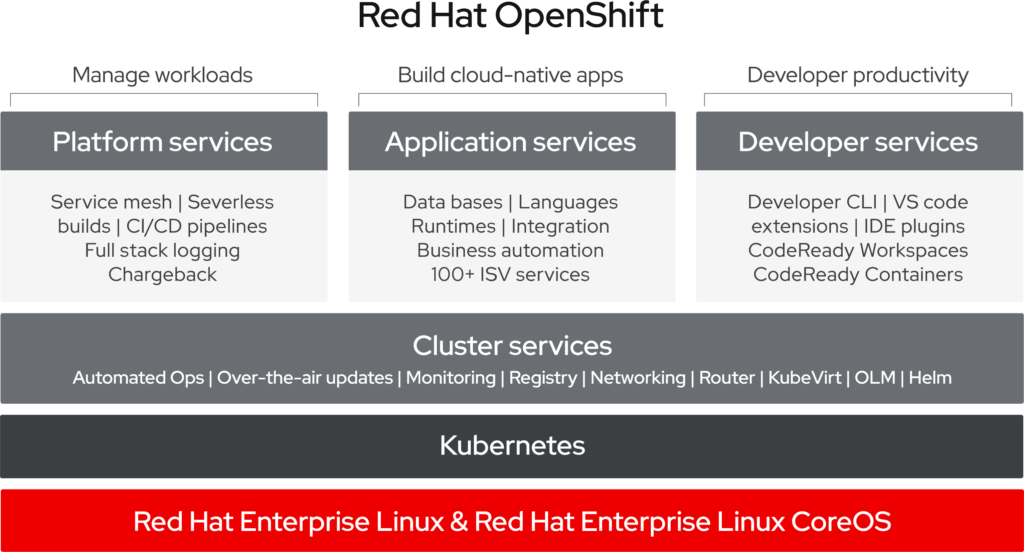
Red Hat OpenShift is a hybrid cloud, enterprise Kubernetes application platform for developers and business applications. OpenShift provides a secure and stable platform for container-based deployments without the need for big IT investments. This means that much needed legacy applications can be used alongside new cloud native and container-based ones. Red Hat OpenShift is a Kubernetes distribution. An extensive article with more details about Kubernetes and how Kubernetes compares to OpenShift can be found here. OpenShift consists of platform, application, and developer services. It is used to manage workloads, build cloud-native apps, and to boost the productivity of developers.
OpenShift 4 was introduced at the Red Hat Summit in May 2019. In this major release, Red Hat redefines Kubernetes for the enterprise through full stack automation. OpenShift 4 includes new technologies and functionality that results in self-managing, flexible, and automated clusters. New key elements of OpenShift 4 include:
Immutable Red Hat Enterprise Linux CoreOS;
Operator framework;
OpenShift service mesh; and
Knative framework.
OpenShift 4 is Kubernetes at its core and in this release, Red Hat has completely re-architected how OpenShift is installed, upgraded and managed, introducing innovations such as Kubernetes Operators. Operators automate life cycle management of containerized applications with Kubernetes, and drives installation and upgrades of OpenShift and all of its services. This includes Kubernetes core services, along with Prometheus, Grafana, Elasticsearch, software-configured networking, storage, registry and other components of the OpenShift Kubernetes platform. OpenShift 4 is an Operator-driven platform that delivers full-stack automation from top to bottom. OpenShift 4 also offers multiple cluster management across multiple clouds, and enables hybrid cloud services with Operators & OperatorHub. OpenShift 4 is designed to deliver a unified experience across hybrid cloud by driving automated installation and updates across Kubernetes deployments everywhere, all powered by Kubernetes Operators. OpenShift 4 is still built on top of Red Hat Enterprise Linux, and delivered in a new immutable form as Red Hat Enterprise Linux CoreOS. OpenShift 4 also brings a number of new developer services and capabilities needed to build cloud-native applications, to deploy them consistently across any supported on-premises, private, or public cloud infrastructure. Red Hat OpenShift 4 is Kubernetes for the Enterprise, designed to power businesses’ digital transformation, and to unite development teams on a single platform.
What are the advantages of migrating to OpenShift 4
OpenShift 3 will only be supported until 2021, so besides the need to migrate to the new version, we also think that OpenShift 4 brings many advantages for both operators and users. The level of maturity of operators leaves little to be desired. For the operation of a cluster, updates are much faster and at the same time, easier to handle and more stable. This also simplifies operations, as operators can react to changes and correct errors if needed. Operators are a new concept also for the operation of applications for users of OpenShift. The switch from Docker to Buildah for container builds now allows to build container images in a more secure way. This is a welcome innovation for all multitenant clusters, such as public platform providers and corporate clusters with multiple users. With the introduction of the OpenShift Service Mesh, developers in particular will gain new insights and new possibilities to visualize, secure and optimize the communication of their applications. OpenShift 4 represents a significant change in the way that OpenShift Container Platform clusters are deployed, managed, and developed upon. OpenShift 4 includes new technologies and functionality, for both developers and cluster administrators. Operators, Serverless, Service Mesh, and Red Hat Enterprise Linux CoreOS (RHCOS), are all new to OpenShift 4. They are redefining what’s possible with the next generation of Kubernetes platforms. This technology shift enables clusters to self-manage functions previously performed by administrators, and empower developers to innovate on a consistent and stable platform that is simple to install and scale. The advantages of OpenShift 4 include:
Operators: implement and automate common Day-1 (installation, configuration, etc) and Day-2 (re-configuration, update, backup, failover, restore, etc.) activities in a piece of software running inside your OpenShift cluster, by integrating natively with Kubernetes concepts and APIs.
Red Hat Serverless: enables an application to consume only the compute resources necessary, scaling up or down automatically depending on usage. This removes the overhead of server provisioning and maintenance from the developer, letting them focus on application development instead.
Red Hat Service Mesh: controls how different parts of an application share data with one another through a built-in dedicated infrastructure layer. This visible infrastructure layer can track different parts of an app and their interactions, to optimize communications and to avoid downtime as it grows.
Red Hat Enterprise Linux CoreOS: combines the ease of over-the-air updates from Container Linux with the Red Hat Enterprise Linux kernel, to deliver a more secure, easily managed container host.
OpenShift’s goal is to help developers to innovate more rapidly, to address the needs of the business quicker. Cloud native application development brings new challenges. As developers adopt microservice architectures, managing the communication between each service, securing those services and getting better service to service traceability to debug issues is an absolute necessity. These are the challenges that the Istio open source project seeks to address. The OpenShift 4 Service Mesh takes Istio and combines it with other key projects, like Jaeger for tracing and Kiali for visualization, to provide better manageability and traceability to microservices deployments. Developers can focus on building the business logic, letting the service mesh manage how each microservice communicates based on policies they define. They can also leverage the tracing and visualization capabilities to debug issues when they occur. Development approaches haven’t stopped evolving, and serverless is yet another way developers are looking to build applications, by leveraging function as a service based offerings. The Serverless model enables scaling down to zero, so as to only consume compute resources when functions execute. This can be an effective way to control operational costs, particularly in the public cloud. FaaS offerings were first pioneered by public cloud providers like AWS, but have the potential to lock your applications into a single cloud environment. This is why Red Hat is working to bring these capabilities to a hybrid cloud environment via Knative. Red Hat is an active member of the Knative open source project, collaborating with the Kubernetes community to drive upstream development that enables hybrid serverless capabilities. Using the Knative framework enabled in OpenShift, users can extend Kubernetes to build, deploy and manage serverless applications, supporting containerized and serverless deployments from a single Kubernetes control plane.
Who is OpenShift 4 for?
Almost a year after the initial release of OpenShift 4, we believe that OpenShift Container Platform 4 is ready for productive workloads. If you are currently running OpenShift 3, you have to evaluate and plan migrating to OpenShift 4. What are your options?
Do you want to run and operate OpenShift yourself?
This way you “keep full control” and you decide on every detail with all the implications
Do you have enough staff with the needed know-how to run OpenShift operations yourself 24/7? This might mean that you have to re-train your staff and also re-engineer all operations tools.
You might need to hire new people or train your existing staff.
External consultants might be needed for specific tasks such as the setup or migration part.
Or do you want to work with a partner who takes care of your OpenShift installation and ensure 24/7 operations?
Work with a hyperscaler like AWS/Azure/Google Cloud etc.:
You are super flexible, you can spin up your own cluster and the additional tools you need and you can do everything yourself “at a fingertip”
But you are also bound to one platform and you have to ensure the actual 24/7 management and operations
Work with a specialized partner like VSHN / APPUiO:
You can be sure that you have the latest OpenShift know-how and enough people who take care of your operations, both on premises or in any cloud of your choice.
A certified, Swiss based Red Hat partner who knows how to run OpenShift even in the most sensitive areas and industries such as banking & finance with a focus on the business-relevant application, not the “generic platform”
You get Managed OpenShift, 24/7 operations, additional Managed Services for a recurring monthly fee, at the end you save time & money so that your people can focus on developing your product and / or services.
At the end, it’s not a question of if, but when to migrate to OpenShift 4.
How to migrate from OpenShift 3 to OpenShift 4
There is no planned update path from OpenShift 3 to 4. Red Hat provides migration tools, however, that can migrate not only the Kubernetes resources, but also the data from persistent volumes, where S3 Storage is used as a cache. The migration tool supports migrations from version 3 to 4 as well as migrations between different OpenShift 4 clusters. According to the website openshift.com, the migration process from OpenShift 3 to 4 can be completed in 5 steps:
Spin up a new cluster running OpenShift 4.
Configure the new OpenShift 4 cluster.
Create a migration plan which includes how to handle data from the applications that are being migrated.
Run migration plan.
Move your DNS or Load-balancer configuration to your new cluster.
To successfully transition from OpenShift Container Platform 3 to OpenShift Container Platform 4, it is important that you review the following information:
Planning your transition: Learn about the differences between OpenShift Container Platform versions 3 and 4. Prior to transitioning, be sure that you have reviewed and prepared for storage, networking, logging, security, and monitoring considerations.
Performing your migration: Learn about and use the tools to perform your migration:
Control Plane Migration Assistance Tool (CPMA): the Control Plane Migration Assistance tool helps you configure the new cluster OpenShift 4 cluster that will be the destination for the applications that are being migrated from your existing OpenShift 3 cluster. This tool reduces the possibility for human error in the configuration process, matching when possible the existing settings in the source cluster. It also allows you to review the resources that will be applied to the new cluster.
Cluster Application Migration Tool (CAM): the Cluster Application Migration tool (CAM) migrates stateful and stateless applications from the source cluster on OpenShift 3 to a destination cluster running the latest OpenShift. It also can migrate applications between OpenShift 4 clusters. It is installed on your destination cluster via an Operator. Through the rich user interface take advantage of the simplified, customizable workflows. Decide which applications to start with and which migration approach best fits each application and your needs.
If you need detailed instructions about your OpenShift migration, head over to this page to learn more about the migration process and how to utilize the migration tooling. And of course, if you need help with your migration, we will be very happy to help you.
VSHN and APPUiO
VSHN is a Red Hat Advanced CCSP partner and we offer Managed OpenShift since 2016 through our brand APPUiO, both in the cloud of your choice or on premises. In 2020, we are operating OpenShift clusters for 350 customers and partners in 16 clouds around the globe. If you want to learn how we helped acrevis Bank in Switzerland with the move and how we operate OpenShift for them, check out our Success Story.
APPUiO OpenShift 4 Fact Sheet
Our APPUiO OpenShift Fact Sheet explains the benefits of OpenShift 4 in an easy to read 2-pager.
Download the Fact Sheet below.
OpenShift 4 Tech Labs
Join our free OpenShift 4 Tech Labs. Need help migrating and operating OpenShift 4? Contact us, we are here to help.
Markus Speth
Marketing, Communications, People
Latest news
Events
General
Recap Cloud Native Computing Meetup September 2026
WeAreDevelopers Live Week with Aarno & Adrian as speakers
2. Oct 2020
The recordings of the WeAreDevelopers Live Week 2020 sessions have been uploaded – enjoy watching below.
WeAreDevelopers Live Week Oct 5-9th 2020
It’s on again. Join us for the second edition of the WeAreDevelopers Live Week – with a jam-packed, all-online coding experience coming to you. Two VSHNeers are taking part with a talk, join us and “Welcome home, developers!”.
Aarno’s talk in the Security track
Monday, October 5th 4:30 pm – 5:30 pm (CEST) DevSecOps: Security in DevOps You managed to introduce an agile development and operations process to your team(s). And now? How can you add security to your DevOps and get to the next level? Join us on our journey and see the tools and processes we tried and learned to value. Listen to our experiences so you do not have to make all of them yourself.
Aarno Aukia, CTO & Co-founder of VSHN – The DevOps Company
Adrian’s talk in the DevOps track
Friday, October 9th 4:45 pm – 5:30 pm (CEST)
DevOps in the enterprise
DevOps is not the realm of startups or Silicon Valley giants only. What are the strategies to keep in mind when introducing DevOps to a company with a vast digital portfolio? And more important: How do you stick with it and deal with different release cycles?
Adrian Kosmaczewski, Developer Relations at VSHN AG
About WeAreDevelopers Live Week
Welcome to the second edition of the WeAreDevelopers Live Week. Join 12,000+ of the world’s brightest minds in software development to learn, share secrets and connect online from the comfort of your home – and for free. For 5 days, WeAreDevelopers will stream 5 tracks, consisting of hyper-focused coding sessions, hands-on workshops and live Q&A sessions to help take your skills to the next level. WeAreDevelopers Live Week is organized in cooperation with digitalswitzerland and Helvetia.
Markus Speth
Marketing, Communications, People
Latest news
Events
General
Recap Cloud Native Computing Meetup September 2026
As announced in our blog post, we are changing our corporate governance. After André Keller left the management and Marco Fretz joined with a strong focus on organizational development and daily operations, we are now taking the next step.
Markus Speth is a new member of the management of VSHN as of October 1st, 2020.
“I am extremely pleased to take on responsibility as a member of the management and to be able to influence the fate of VSHN even more. We have many ideas on how we can continue on the growth path for VSHN and how we can develop as an organization to focus even stronger on customers, partners and VSHNeers. Let’s do this together.”
– Markus
The new management structure will have a strong focus on people, organizational development (OrgDev) and the refining of the strategy set by the board.
Markus is very much looking forward to be a member of the management and to being a driving force behind VSHN, playing a key role in its further growth and mastering future challenges.
Markus joined VSHN in July 2018 as Chief Marketing Officer. In addition to the daily business as Squad Master of our SOL Squad (Sales & Marketing) he is responsible for marketing and growth as well as partners and strategic topics.
In his role als CMO, Markus is responsible for all activities that VSHN carries out to promote and sell its services. From now on he will represent these important aspects of the corporate governance in the management.
“I have had the opportunity to experience several stations in my professional career, but VSHN clearly stands out from the crowd. What I particularly like is the way we deal and communicate with each other, be it with customers and partners or the VSHNeers with each other. We all meet as equals and everyone is heard. There is no boss / employee or customer / supplier relationship that has a great potential for conflict. Each VSHNeer can contribute to any topic and develop topics independently and our customers are partners who appreciate VSHN as “extended arm of software development”.
I have never experienced this in this form before and I am looking forward to shaping this culture together for many more years to come.”
– Markus
Markus Speth
Marketing, Communications, People
Latest news
Events
General
Recap Cloud Native Computing Meetup September 2026
“swiss hosting” was developed by swiss made software to create comparability and a reference to Swissness in the field of hosting & cloud. swiss hosting is a transparency label that guarantees data sovereignty, because in addition to the provider’s place of business, the cloud or data center and hardware must be in Switzerland and may not belong to any foreign company. swiss made software is the nationally and internationally recognized flagship for Swiss quality in software development. More than 650 companies have been awarded the label “swiss made software”. This corresponds to more than 12,000 employees in the core ICT industry in Switzerland.
Requirements of the swiss hosting label
The following criteria must be met in order to use the “swiss hosting” label:
Business location in Switzerland
Hosting in a Swiss data center. Data protection and data security must be subject to Swiss law.
Protection of the hosting environment against access from abroad
swiss hosting at VSHN: the customer decides
As a Swiss company with the option to host data exclusively in Swiss clouds & data centers, we are now the proud bearer of the “swiss hosting” label. We are clearly committed to Swissness and support the idea of “swiss hosting” to create comparability among the various hosting providers. Since VSHN itself does not operate any infrastructure or cloud, the “swiss hosting” label for VSHN is only valid in connection with a Swiss cloud or data center provider. With our APPUiO Public offering we can ensure swiss hosting because the platform is operated in the cloud of our friends at cloudscale.ch and the data is therefore hosted in a Swiss data center. Another example would be APPUiO Managed on Swisscom DCS. If customers choose a Swiss data location and the corresponding cloud or data center provider meets the criteria, the “swiss hosting” label can be guaranteed. For many of our Swiss customers, the Swissness and data location Switzerland is still an important factor. Especially for business critical applications and the processing of sensitive data, location and data sovereignty are of central importance. The “swiss hosting” label underlines this quality claim.
About VSHN – The DevOps Company
VSHN (pronounced ˈvɪʒn like “vision”) is Switzerland’s leading DevOps, Docker, Kubernetes and 24/7 cloud operations partner. VSHN was founded with the intention to fundamentally shake up the hosting market. As a lean startup, we have focused on operating IT platforms through automation, agility and a continuous improvement process. Completely location-independent and without our own hardware, we operate extensive applications according to the DevOps principle agilely and 24/7 on every infrastructure, so that software developers can concentrate on their business and IT operations are relieved.
Markus Speth
Marketing, Communications, People
Latest news
Events
General
Recap Cloud Native Computing Meetup September 2026
We’re very happy to announce Red Hat OpenShift 4 services on APPUiO!
The whole VSHN team has been working hard on making OpenShift 4 a reality for our customers. We are fully committed on the strategic importance of our Red Hat partnership and OpenShift as a main pillar of APPUiO and VSHN services.
OpenShift 4 on APPUiO beta program
To celebrate this milestone we’re happy to provide the community with time-limited OpenShift 4 test accounts, at no charge except for one thing: your feedback. If you are interested in testing OpenShift 4 on APPUiO, please sign up here for our beta program:
Do you want to shape the future of APPUiO Managed OpenShift 4? Send us your feedback! To make it easier, we use a feedback voting system, where you can easily join the discussion and vote for your preferred features and services.
History of OpenShift & VSHN
OpenShift has been and continues to be the strategic Kubernetes platform for VSHN. VSHN was founded in 2014 with the idea of not doing everything ourselves, but rather focus on what we do best: Specialize in operating and onboarding customers and don’t own hardware, servers or data centers is one of the main aspects of why we exist. This led to a strong focus on innovation & automation, PaaS & container technology with the belief of being cloud native & cloud neutral. Shortly after in 2015, we created the brand APPUiO in cooperation with Puzzle ITC, and started deploying the first OpenShift 3 beta releases. In close collaboration with Puzzle ITC and Red Hat we launched APPUiO.ch container platform in production in 2016. Why did we choose OpenShift? A couple of arguments why OpenShift is our “way to go”:
Multitenancy, RBAC, WebGUI, container based images, “best of both PaaS and CaaS”
Delivery model: open source, available & supports both cloud/hyperscalers and on-premises/CCSP-infrastructure
Red Hat: trusted brand, marketing generating demand, customers ask for Red Hat
Flexibility fits perfect to our strategy & managed service business
Perfect for our future growth and open source practice
OpenShift enabled us to enter the Enterprise market through:
Enabling DevSecOps through RBAC and other security-by-default
Enterprise supported Kubernetes
Embracing open standards, enabling infrastructure/cloud abstraction and mobility, enabling cloud-native (and not necessarily cloud-only)
So the foundation for VSHN and APPUiO was set up which led to a strong & healthy natural growth through focus on what we do best. In 2020, we are still open & transparent and are embracing Open Source & partnerships, are still owner-run and managed and are ISO27001 certified and ISAE3402 audited. VSHN is the first Swiss Kubernetes Certified Service Provider (KCSP) and VSHN is Red Hat Advanced Business Partner (CCSP). So after using OpenShift since 3.0 beta 1, today we are operating 50 clusters in 16 countries. From Zurich to Sydney, the USA and China, numerous happy customers trust us in the banking, financial services, insurance brokering, medical insurance, medical, governmental, and many other online business fields. Our customers embrace Enterprise Kubernetes features such as multi-tenancy, authentication, and security hardening, in combination with the “batteries included” approach to auxiliary services: container building, logging, and metrics. OpenShift 4 includes a lot more features complementing this offering, bringing lots of value to our customers.
A container platform changes the way we develop, deliver and operate software. APPUiO presents OpenShift 4 in a Techlab: a free half day training course.
Target audience
The OpenShift Techlab is for anyone who wants to understand how a containerized application can be deployed and run on OpenShift.
First change in the VSHN management, André and Marco
16. Jul 2020
As announced in this blog post we’re changing our corporate governance. A first step is that André Keller leaves the management and Marco Fretz joins with a strong focus on organizational development and daily operations. This change happens on request of André because he decided to shift the focus back to technical work and day-to-day customer service management and resign from his management role. Here is why:
When VSHN was founded back in 2014 the first management of VSHN was assembled. VSHN always followed a role concept, this includes the members of the management. This means that being a member of the management is not considered a full-time job (yet) but an additional role. Members of the management work primarily in System Engineering, Finance, Sales or Project- and Product management.
With VSHN rapidly growing over the last years, certain roles became more and more effort and mental load for VSHNeers – especially the management member role. This made it harder for VSHNeers to concentrate on their daily job – which in case of André was always being a System Engineer and taking care of customer needs in projects and daily business.
“In fall 2018, the management team went to Malta for a week-long retreat, where we focused on the challenges that came with our growth as well as the company strategy for the upcoming years. Among other topics, part of these discussions were the individual goals of the members of the management. This was when I first started to really think about my own role in the company and what the things are that I enjoy doing and I find interesting and what aspects of the job I would rather do without. As you can imagine this is not something that is easily figured out in a few hours. At least for me it was a process lasting several months.
At the end of this process I started to realize that it is not my ambition to be part of the management, I would rather concentrate on the day-to-day business, working on projects together with our customers and partners.”
– André
“One of the things I love about VSHN is the fact that everyone has the chance to evolve beyond the current job description, that you can take new roles and resign from roles you don’t like anymore.”
– Marco
The new board and management structure will have a strong focus on people, organizational development (OrgDev) and the refining of the strategy set by the board. André is happy to handover his position in the management to Marco Fretz who has been supporting the management in an advisory capacity for some time. Marco started early 2016 as a system engineer at VSHN. From the beginning he became more and more interested in organizational topics far beyond his daily job and contributed with constructive ideas and concepts to the success of VSHN.
“Being an “old” VSHNeer, knowing all the good and bad stories and having an open mind I’m sure I can be a driver for the changes VSHN needs to overcome future challenges. Together, we can improve things for us as VSHNeers and our customers likewise – and maintain our great family-like culture we value that much.
I know André long before VSHN and I’m convinced this decision is the right one for both André and me. We all should focus on where our ambitions are to be successful and happy – privately and in our job.”
– Marco
Marco Fretz
Marco is one of VSHN's General Managers and Chief Operating Officer.
Latest news
Events
General
Recap Cloud Native Computing Meetup September 2026
How time flies! Almost six years ago we founded VSHN. In the beginning, eight of us sat in an open-plan office. Decisions could be made quickly and easily in a team. The flip side of the coin was that due to the limited number of people, many VSHNeers had to take on several roles within the company. There was no dedicated unit to take care of the employees’ needs. Or one that drove technical developments. The same applied to marketing, and not only there. We all wore many hats at once.
In the meantime, VSHN has grown to five times its size. And many tasks – including those mentioned above – are now carried out by certain bodies. One area, however, was not affected by these changes: the leadership of VSHN. The same VSHNeers continue to sit on the management and board. While this continuity is gratifying, it was gradually recognized that change would do us good here too and that we should pass on the baton. Especially since focus and interests of some members of the management have changed and the role of management as such has moved towards a more of a coaching function. Furthermore, we want to ensure that VSHNeers who are closer to the day-to-day business can influence important decisions more directly based on their knowledge. Therefore, we have decided to change and expand the Corporate Governance of VSHN this year.
On the one hand, the role of the board will be strengthened in order to relieve the management, increase compliance and represent the owners. In addition to the strategic planning and orientation of the company, the core tasks of the board will include supervision of the management and medium- to long-term financial planning. The management will focus on the operational management of the company and the implementation of the corporate strategy, short-term financial planning and the representation of the company internally and externally.
This will result in several personnel changes in the coming months, primarily in the management of VSHN. The first switch took place at the beginning of the month. André Keller, who has been a member of the VSHN management since the beginning, has decided to devote more time to his squad and daily business and to pass on his management hat. In his place Marco Fretz joined the management on 1 July.
At this point we would like to thank André for the last almost six years in the management (and countless further VSHNeer years to come!). And we are looking forward to working closer with Marco as a member of management.
André and Marco explain in the following blog post in detail what this change means for them.
Updates:
As the next step, Markus Speth joins the management of VSHN on October 1st, 2020.
VSHN appoints new Co-CEOs and Members of the Management.
Patrick Mathers
Patrick is Founder and Member of the Board of VSHN.
Latest news
Events
General
Recap Cloud Native Computing Meetup September 2026
Zurich, June 23, 2020: VSHN is proud to announce a strategic partnership with Rancher Labs.
Who or what is Rancher?
Rancher Labs delivers open-source software that enables organizations to deploy and manage Kubernetes at scale, on any infrastructure across the data center, cloud, branch offices, and the network edge. With 30,000 active users and greater than 100 million downloads, its flagship product, Rancher, is the industry’s most widely adopted Kubernetes management platform. For additional information, visit www.rancher.com and follow @Rancher_Labs on Twitter. With Rancher, we are adding another Kubernetes distribution to our portfolio besides Red Hat OpenShift. An extensive article with many more details about Kubernetes can be found here and Sebastian Plattner from Puzzle explains in his blog post, how to build a Kubernetes Cluster with the help of Ansible and Rancher.
Why Rancher?
VSHNhas been working successfully with Rancher since 2018 and is now officially a Rancher Partner. With Managed Rancher, VSHN takes care of the setup, 24/7 operation, monitoring, backup and maintenance of a Rancher cluster. Hosted in a public cloud of your choice or on-premise in your own data center. We offer our Managed Rancher Services under the brand APPUiO. Tobias Brunner, Head of DevOps & Partner of VSHN – The DevOps Company said about the partnership:
„With the addition of Rancher, we are diversifying VSHN – The DevOps Company’s portfolio by adding another Kubernetes distribution and listening to both the market and our partners who have asked for Managed Rancher.”
Rancher Rodeo event 2020 in Zurich
VSHN and Rancher Labs have already had joint appearances, for example at the first official Rancher Rodeo Event in Zurich on February 19, 2020, where our VSHNeer Adrian was able to hold a talk: https://twitter.com/vshn_ch/status/1230057034772553731
About Rancher
Rancher was started in 2014 to create software that would simplify the lives of teams who were building applications using containers. The market was new, Docker had just been introduced and questions about how to manage, secure and orchestrate containers were pressing and exciting problems to solve. Within a year we introduced the first version of Rancher, an open-source software platform for teams innovating around containers. By 2016 we had adopted Kubernetes as an orchestrator and had thousands of teams using Rancher to run containers in production. As our community has grown, we haven’t stopped innovating. Rancher 2.0 became the first enterprise-grade platform for delivering Kubernetes as an enterprise service. Projects like K3s and submariner continue to push the Kubernetes community forward. All along we’ve maintained a commitment to building open-source software that supports users as they innovate everywhere.
About VSHN – The DevOps Company
VSHN (pronounced ˈvɪʒn like “vision”) is Switzerland’s leading DevOps, Docker, Kubernetes and 24/7 cloud operations partner. VSHN was founded with the intention to fundamentally shake up the hosting market. As a lean startup, we have focused on operating IT platforms through automation, agility and a continuous improvement process. Completely location-independent and without our own hardware, we operate extensive applications according to the DevOps principle agilely and 24/7 on every infrastructure, so that software developers can concentrate on their business and IT operations are relieved.
Markus Speth
Marketing, Communications, People
Latest news
Events
General
Recap Cloud Native Computing Meetup September 2026
Recruiting and onboarding new employees during Corona
12. May 2020
A lot has been written about home office and remote work during the Corona / Covid-19 crisis. We also wrote a blog post about our experience, but more on a social than on a tool or process level (everyone has probably heard now that there is a videoconferencing tool called “Zoom”).
But what about hiring? What about onboarding new employees remotely?
As we at VSHN already gathered quite some experience with both topics, want to share this experience with you.
Recruiting employees remotely
We were searching for several new #VSHNeers, both in the technical area and non-technical within sales & marketing, when the Corona pandemic hit the economy and life of millions of people.
We as a company agreed on 100% home office, which works brilliant since day one, but how to continue our hiring efforts? How can we figure out if someone is #VSHNary if we can’t meet them in person? After a short discussion and because we are always trying to be practical, we figured out we have to somehow transform our current physical interviews to online meetings. Our (physical) recruiting process looked like this: a first 1h in person or video call and after that, the 2nd round for which we planned half day to allow the candidate to meet as many VSHNeers as possible including a lunch break together with the whole company. Our recruiting process is described in detail in our handbook if you are interested. At the end, we basically moved the whole structure and all parts of the interviews, meeting different people in groups of 2 and also a quick test afterwards to fully remote. Everything except the lunch break, which is a shame because that was the moment when the candidate meet the whole company and talk to other VSHNeers who were not involved in the interviews. But other than that, the recruiting process was shifted to remote.
It actually worked pretty well, the feedback from our candidates was also very positive and we were able to already recruit new VSHNeers fully remote. As a nice side effect, moving the recruiting process remote also helped us to further streamline it and make it more standardized. One important thing we learned is that you need one moderator who is responsible for the whole meeting process and the video calls, so that the candidate has one go-to person for questions.
Onboarding employees remotely
This month (May 2020), already two new VSHNeers started their journey at VSHN. Delia and Sandro are currently trained fully remote by their “Götti” (mentor) after meeting once in person to receive their new work laptop and office keys.
Of course, it is not an optimal start that we can’t meet in person to get to know us. Video calls work perfect for technical things, but it’s really hard to grasp the non-obvious like the company culture. But as we all know, it will only be a temporary situation and we hopefully all get back to normal soon, so we have to make the best out of it. But of course we are all looking forward to meeting each other again in person soon.
We believe having a “Götti” (mentor) for new starters is remotely even more important than physical. It just makes it easier for the new hires to ask questions and just have someone to talk to about all the non-standard or documented things.
We will keep you updated about our remote experience and hope this helped you a bit.
If you want to learn more about how we at VSHN work remotely together, check out our handbook.
All other Coronavirus / Covid-19 related information and how we cope with the situation can be found here.
Thanks for reading and all the best.
Markus Speth
Marketing, Communications, People
Latest news
Events
General
Recap Cloud Native Computing Meetup September 2026
Having Fun in Home Office Times We’re already at our second week of Home Office in the COVID-19 quarantine. It is time for me to reflect and make a short interim evaluation. As the person responsible for People Ops in VSHN, it is my natural concern to ensure that all VSHNeers stay motivated in these times, that we keep in touch with each other, and that nobody feels alone. And since we always wanted to enable work flexibility, so that anyone could work from anywhere in the world, the rollout of Home Office happened fast and without complications. Each one of us has their company laptop, and many of us had enjoyed working from home, way before the coronavirus crisis. Therefore we could find ways to motivate each other, and we could ask each other for guidance; for example, whether it is really necessary to wear trousers (apparently yes) and whether it is normal to have really unproductive days (yes, it is. Don’t put yourself under too much pressure.) The team could find answers to all of these questions without any trouble. But how can we keep the team together if we can only see each other through a webcam? Have regular remote meetings After a short while we came up with the “Z’noomi” (a pun between “Zoom” and “Znüni”), a daily videocall meeting every morning and every afternoon, where we just hang out with a cup of coffee and talk to everyone. The idea of a “remote beer” every Friday afternoon also caught up quite quickly with the team. Rumour has it, that even part-time employees not working on Fridays participate in it! Take the time to know each other better During our Z’noomis we can meet the pets of our colleagues (particularly when they walk on the keyboards) or enjoy a small tour of their homes! Hobbies provide yet another possibility to learn each other better. This is why we watched a presentation of the renovation of the home of one of our colleagues, or became “beta listeners” to freshly recorded tunes from the guitar of another VSHNeer. Play with one another! The classic “LAN-Parties” aren’t new, but who has tried playing Dungeons and Dragons remotely? VSHN has! Another game that started this week: show your gardening skills. Each VSHNeer will receive (or has already received) a small package with a starter kit inside (earth, seeds, and pot) to brew their own beer, and prove themselves that they are up to the situation, and can grow something out of these seeds. Which plant will appear first? Which will be the biggest, strongest, or more beautiful? To be honest, we VSHNeers are not well known for our gardening skills, but this exercise will surely teach us about it (well, as long as the Post is able to deliver all packages…)
And if your french isn’t that strong, no worries, we have Google translate for that! 😂
Small gifts keep friendships alive Whether you ask somebody how they are doing in an unscheduled videocall, or pat them virtually on the back, or make sure that a change worked out well and that a customer has been successfully served, or praise their haircut (even if no hairdressers are available): show your gratitude! Praise is balsam for the soul. What do you do to keep contacts alive? We’d be glad to hear about any ideas you might have, so that we can keep the fun in our home offices in the upcoming weeks. 😊 Stay healthy! Your VSHNeers
Aarno Aukia
Aarno is Co-Founder of VSHN AG and provides technical enthusiasm as a Service as CTO.
Latest news
Events
General
Recap Cloud Native Computing Meetup September 2026
We are experiencing unprecedented times due to the coronavirus. The COVID-19 pandemic has a significant impact on people’s health, our daily lives, as well as on businesses and the economy. In these special times and increasing challenge that we all currently have to master, we at APPUiO would like to make a contribution. Therefore we offer you as “immediate help” an APPUiO Public account on cloudscale.ch with 1100 mC CPU, 2.0 GiB memory for a full 90 days free of charge, which corresponds to a value of CHF 300. Just go to , enter your e-mail address and the following voucher code: APPUIO-COVID19 Hurry up, there is a maximum of 100 codes available and the promotion is valid 1x per user or company. Best regards and stay healthy! Your APPUiO team and your VSHNeers
Markus Speth
Marketing, Communications, People
Latest news
Events
General
Recap Cloud Native Computing Meetup September 2026
Moneycab.com: Herr Mathers, bitte erläutern Sie kurz was Ihr Unternehmen macht. Patrick Mathers: Die Digitalisierung macht heute vor keiner Branche mehr halt. Das bedeutet, dass so gut wie alle Unternehmen nun auch gleichzeitig IT-Firmen sein müssen, egal ob es sich hierbei um einen Finanzdienstleister oder einen Detailhändler handelt. Zudem wird die benötigte IT komplexer, schnelllebiger und risikoreicher, weswegen Software kontinuierlich weiterentwickelt werden muss. Damit sich unsere Kunden trotzdem auf ihre Kernkompetenzen konzentrieren können, entlasten wir sie, indem wir uns um den Betrieb ihrer Applikationen kümmern – unabhängig davon, ob diese in einer Cloud oder im Rechenzentrum der Kunden betrieben werden.
«Die VSHN hat von Anfang an auf Kollaboration, Agilität, Open Source und auf starke Kundenbeziehungen gesetzt.» Patrick Mathers, CEO VSHN
Was machen Sie besser oder anders als Ihre Mitbewerber? 2014 haben wir festgestellt, dass sich der Markt zwischen Software-Engineering und Hosting/Betrieb auseinander entwickelt. Gleichzeitig kamen neue Themen und Innovationen wie DevOps und Container-Technologien auf. Die Nachfrage nach einem spezialisierten Betriebspartner, der mehr als nur reines Hosting anbot, stieg. VSHN unterstützt Kunden partnerschaftlich auf ihrem Weg der digitalen Transformation, um Applikationen automatisch testbar, deploybar und skalierbar zu machen und auf beliebiger Infrastruktur zu betreiben. Neben der engen, agilen und offenen Zusammenarbeit und Beratung übernehmen wir auch die Verantwortung für die Stabilität unserer Services inklusive 24/7 Support. Ihr Unternehmen hat beim Digital Economy Award in der Kategorie Highest Digital Quality gewonnen. Laut Jury-Präsident Marcus Dauck setzten Sie einen neuen Qualitäts-Massstab fest. Wie ist Ihnen das gelungen? Die VSHN hat von Anfang an auf Kollaboration, Agilität, Open Source und auf starke Kundenbeziehungen gesetzt. Dieses Ökosystem an Partnerschaften hat es uns ermöglicht, fokussiert Innovationen voranzutreiben und ein hohes Qualitätsniveau zu erreichen. Daraus ist beispielsweise Appuio hervorgegangen, unsere Schweizer Container Plattform basierend auf Red Hat OpenShift, die wir zusammen mit unserem Partner Puzzle ITC aufgebaut haben. Speed, Fokussierung und Qualität auf höchstem Niveau haben die Jury begeistert. Das ist auch personell eine Herausforderung, richtig? In der Tat! Es stellt eine grosse Herausforderung dar, wenn man technologisch immer an vorderster Front stehen möchte und hierfür qualifizierte Mitarbeiter gewinnen will. Wir versuchen jedoch ein positives Arbeitsumfeld zu schaffen, welches bei bestehenden und zukünftigen VSHNeers nicht nur mit Fringe Benefits wie Office-Massagen, flexible Arbeitszeiten, Home Office oder dem attraktiven Standort gleich beim Zürich HB punktet. Wir erreichen dies auch mit einem hohen Grad an Transparenz und Mitsprache, die nicht bloss auf dem Papier besteht, sondern tatsächlich gelebt wird. Es kann zum Beispiel jeder VSHNeer an den Management-Sitzungen teilnehmen und eigene Themen einbringen sowie sämtliche Sitzungsprotokolle einsehen. So sind auch der Open Source Gedanke und die Transparenz in unserem öffentlich zugänglichen VSHN Handbook für jeden klar ersichtlich: https://handbook.vshn.ch Weshalb und wofür betrachten Sie den Preis als Bestätigung? Wir betrachten den Preis als Bestätigung für unsere bisherigen Arbeit und als Ansporn, uns kontinuierlich weiterzuentwickeln.
«Mit Project Syn können wir bei unseren Dienstleistungen beinahe 100% an Automatisierungsgrad erreichen und mittels ausgefeilter Tools den Self-Service für den Benutzer optimieren.»
Ihr nächstes Projekt steht bereits am Start: Project Syn, Next Generation Managed Services. Was genau ist Project Syn? Mit Project Syn bauen wir die neue Grundlage für Managed Services auf beliebigen Kubernetes Clustern auf, sei dies in der Cloud oder beim Kunden vor Ort. Ausschlaggebend für die Entwicklung sind unsere gemachten Erfahrungen im Betrieb von Managed Services auf klassischen Virtual Machines mit Mitteln, welche für moderne Cloud Native Infrastrukturen nicht mehr zeitgemäss sind. Mit Project Syn können wir bei unseren Dienstleistungen beinahe 100% an Automatisierungsgrad erreichen und mittels ausgefeilter Tools den Self-Service für den Benutzer optimieren. Im Zentrum steht dabei immer der Softwareentwickler und die Applikation, welche betrieben wird. DevOps, das perfekte Zusammenspiel von Entwicklung und Betrieb, wird dabei dank vielen integrierten Werkzeugen unterstützt. So nimmt zum Beispiel GitOps, die Versionisierung von Konfigurationsdaten, eine tragende Rolle ein. Project Syn ist ein von uns initiiertes Open Source Projekt und kann von allen genutzt werden. Der Code ist auf GitHub gespeichert: https://github.com/projectsyn. Somit bringen wir uns auch ein weiteres Mal aktiv in die Open Source Community ein. Im Zuge von Project Syn geht VSHN eine strategische Partnerschaft mit Crossplane ein. Warum gerade Crossplane? Crossplane bietet eine innovative Multi-Cloud-Management-Plattform für Cloud Native Applikationen und Infrastrukturen über verschiedene Umgebungen und Clouds hinweg an, welches ein integraler Bestandteil von Project Syn ist. Und da unsere beiden Firmen ähnliche Werte wie Transparenz, Kollaboration und vor allem den Open Source Gedanken leben, streben wir eine vertiefte Zusammenarbeit an.
«Wir peilen ein stabiles Wachstum in der Schweiz an und planen mittelfristig Niederlassungen in Kanada und Malaysia, um unsere Kunden noch besser und rund um die Uhr betreuen zu können.»
Was waren und sind die Herausforderungen, welche mit diesem Projekt verbunden sind? Die grösste Herausforderung ist es, eine gute Balance zwischen dem Aufbau der neuen und der gleichzeitigen Weiterentwicklung der bestehenden Betriebsplattform zu finden. Wir bewegen uns in einem sich stetig wandelndem Umfeld, täglich werden neue Projekte angekündigt und die verwendeten Tools werden unentwegt weiterentwickelt. Hierbei muss VSHN am Ball bleiben und die richtigen Prioritäten setzen, was uns dank engagierter und aktiver Mitarbeiter sehr gut gelingt. Was können Sie uns zu Ihrem Unternehmen sonst noch sagen? Mit derzeit 42 Mitarbeitern, den sogenannten „VSHNeers“, betreuen wir weltweit für mehr als 350 verschiedene Partner über 1’500 Server in verschiedenen Clouds und bei Kunden On-Premises und überwachen mehr als 85’000 Services von unseren Büros in Zürich aus. Da hohe Datensicherheit unabdingbar ist, sind wir zudem seit drei Jahren ISO 27001 zertifiziert. Wie sehen die mittel- und langfristigen Pläne von VSHN aus? Wir sind noch lange nicht am Ziel! Unser Credo ist, uns jeden Tag aufgrund der Feedbacks unserer Kunden und Partner weiterzuentwickeln. Wir peilen ein stabiles Wachstum in der Schweiz an und planen mittelfristig Niederlassungen in Kanada und Malaysia, um unsere Kunden noch besser und rund um die Uhr betreuen zu können. Und natürlich werden wir weiterhin täglich bestrebt sein, unseren Kunden unsere Services auf höchstem Level anzubieten.
Markus Speth
Marketing, Communications, People
Latest news
Events
General
Recap Cloud Native Computing Meetup September 2026
The Cloud Native Computing Foundation’s flagship conference gathers adopters and technologists from leading open source and cloud native communities in Amsterdam, The Netherlands from March 30 – April 2, 2020. Join Kubernetes, Prometheus, Envoy, CoreDNS, containerd, Fluentd, TUF, Jaeger, Vitess, OpenTracing, gRPC, CNI, Notary, NATS, Linkerd, Helm, Rook, Harbor, etcd, Open Policy Agent, CRI-O, TiKV, CloudEvents and Falco as the community gathers for four days to further the education and advancement of cloud native computing.
VSHN at KubeCon & CloudNativeCon
Also at KubeCon + CloudNativeCon Europe 2020 in Amsterdam #VSHNeers will be onsite to see the latest developments and gather impressions.
Please contact us if you would like to meet us on site. We look forward to hearing from you!
Swiss CNC Get Together at the KubeCon & CloudNativeCon 2020 in Amsterdam
VSHN will again organize a Swiss CNC Get Together Meetup at this year’s KubeCon + CloudNativeCon Europe 2020 in Amsterdam to bring together Swiss colleagues & friends in a relaxed atmosphere who are attending KubeCon.
Please register on our Cloud Native Computing Meetup page, if you want to participate in the Swiss CNC Get Together. We are looking forward to meeting you!
Markus Speth
Marketing, Communications, People
Latest news
Events
General
Recap Cloud Native Computing Meetup September 2026
At least we hope you like our report on our DevOps in Switzerland study and the results.
In autumn 2018 and one year later in 2019, we conducted a study to investigate how Swiss companies understand DevOps and whether they already work according to DevOps principles. The status of DevOps in Switzerland was clarified, reasons for and against an introduction of the DevOps philosophy and where the development is going. The results were compared between the years in order to be able to directly identify conclusions and trends.
Download the Report
Here you can download the report: DevOps in Switzerland Report 2020 Enjoy reading and we look forward to your feedback on the study. Your VSHNeers
Markus Speth
Marketing, Communications, People
Latest news
Events
General
Recap Cloud Native Computing Meetup September 2026
In the last months of 2019, Daniel, Manuel, and I were working in Vancouver. You can find more about the reasons behind choosing Canada in our blog post VSHN goes to Vancouver. But now, enjoy the recap video about our findings and to give you a glimpse into life in Canada. Enjoy and let us know what you think. 😃
matthias.indermuehle
Matthias is co-founder of VSHN AG, member of the executive board, and partner
Latest news
Events
General
Recap Cloud Native Computing Meetup September 2026
The year 2019 is drawing to a close. With this review of the year we want to look back on an awesome year. Of course we will be there for you over the holidays – see our opening hours Christmas/New Year 2019. We wish you and your family a merry Christmas and a happy new year.
Another milestone in the still young, 5-year history of VSHN. With exciting new projects such as acrevis Bank or neon and partnerships with Red Hat and Crossplane we have been strengthened in our daily work and in our strategy again and again this year. Also the decision to focus on the operation of modern container platforms and future technologies such as Docker, OpenShift and Kubernetes and the close cooperation with partners still seems to be right. Thanks to the continuous and healthy growth, we were also able to increase our workforce to 42 employees. Our new VSHNeers in 2019 are Simon G., Janine, Daniel H., Adrian, Soufiane, Nuno, Tatjana, Isabel, João, Ivan, Daniel B., Gabriel, Manuela. We see the daily contact with our partners and customers as a confirmation of our previous path and at the same time as a motivation to become even better in the future and to push the DevOps philosophy forward. This philosophy also includes lived transparency, which is proven by the publication of our VSHN Handbook. At this point we would like to thank our employees, partners and loyal companions. 👏 We will continue to develop in the future and will not rest on our laurels. And that we don’t just talk, but also do is proven by K8up or, above all, our Open Source Project Syn:
Project Syn
Project Syn is a pre-integrated set of tools to provision, update, backup, observe and react/alert production applications on Kubernetes and in the cloud. It supports DevOps through full self-service and automation using containers, Kubernetes and GitOps. You can find more infos about Project Syn on: https://vshn.ch/syn Check out Project Syn on GitHub: https://github.com/projectsyn
VSHN wins gold at Digital Economy Award in the category Highest Digital Quality. Who would have thought? VSHN – The DevOps Company wins gold at the Digital Economy Award in the category Highest Digital Quality. We couldn’t be happier and would like to thank all #VSHNeers who made this success possible.
Computerworld once again ranked the top 500 of the strongest Swiss ICT companies in 2019. The measured total turnover of the companies listed in the ranking rose further to around 78 billion Swiss francs, driven by digitisation and cloud adoption.
Together with our partner Puzzle ITC, VSHN AG is building an OpenShift-based technology platform for the Eastern Swiss regional bank acrevis. The technology platform consists of business, integration, security and delivery layers and enables acrevis to implement a two-speed IT.
Open Source has become indispensable in many areas. One of the most important advantages of Open Source software is the gained speed and flexibility, which are essential not only for Fintechs, but also for traditional banks.
DevOps stands for a new culture and approach in the collaboration of traditionally separated departments. Development (software development) and Operations (IT operations) are pulling together to increase software quality and availability and thus customer satisfaction.
iX Magazine article: Cloud-to-Cloud MigrationOur CTO Aarno Aukia has contributed an article in iX Magazine 4/2019 on cloud-to-cloud migration. The challenge of Cloud-to-Cloud MigrationThere are many reasons to change the cloud provider or the cloud model. But migration is not an easy task. There are different migration options based on the underlying data.
VSHN supports VIS. Some of our VSHNeers are former ETH students and try to maintain contact with the students through various alumni associations. For example, VSHN supports VIS – the Association of Computer Science Students at ETH Zurich – by sponsoring various events. Recently an information evening took place in our office, where interested students could ask us about our daily work. We were very happy about the active participation and look forward to the next time. 🙂
VSHN is Bronze Sponsor of Hack’n’Lead. We are very happy to support women++ and the hackathon Hack’n’Lead as Bronze Sponsors. Hack’n’Lead is the first women-friendly hackathon in Switzerland and aims to promote diversity in IT and to inspire women to pursue careers and computer science.
The first participation in the Powercoders program for refugees was a complete success: we were able to hire Bashar as fulltime VSHNeer after his internship.
VSHN is Red Hat Advanced CCSP (Certified Cloud and Service Provider) Business Partner. We are very pleased to announce that we are now official Red Hat Advanced CCSP Partner. With this certification we want to further strengthen our cooperation with Red Hat and the Red Hat Ecosystem and look forward to a successful partnership.
VSHN is proud to announce a partnership with Crossplane. Zurich, Nov 21, 2019: VSHN is proud to announce a strategic partnership with Crossplane.io for Project Syn – VSHNs next generation Managed Services framework.
VSHN is Cloud Native Computing Foundation (CNCF) member. Among other things, VSHN supports the CNCF by organizing the Cloud Native Computing Meetups in Zurich and we sponsor the KubeCon and CloudNativeCon 2019 in Barcelona.
Those who understand the cloud only as an IT topic have already lost. Many companies want to move their IT into the cloud, but how does that actually work? At the Glenfis Cloud Talk, visitors learned from three perspectives how to take advantage of the cloud and how to avoid obstacles. Daniel Wolf (Glenfis), Dominik Zemp (Microsoft), Aarno Aukia (VSHN) and Harald Häuschen (Helsana) gave inputs on the subject of cloud computing.
CNC meetup #5 2019. Our fifth Cloud Native Computing Meetup 2019 took place on November 7th at Ergon Informatik in Zurich. Many thanks to Ergon for providing the great premises and sponsoring the Apéro.
Forum EPFL 2019. On Tuesday, October 8th, the VSHN team participated in the Forum EPFL 2019 in Lausanne, Switzerland. Forum EPFL is the largest recruitment event in Switzerland. It was a fantastic opportunity to meet talented engineers in the French-speaking side of the country!
APPUiO at the Cloud Computing Conference 2019 in Germany. APPUiO participated 2019 as Cloud Native Loft Sponsor at the Cloud Conferences of the Vogel IT-Academy in Bonn, Hanau, Hamburg and Munich. Success Story by APPUiO and Flexis at the Cloud Conference Hamburg 2019: From the Road to the Cloud – Optimization of Logistics Processes with Docker, Kubernetes and APPUiO.
VSHN at AWS Summit Switzerland 2019: As we previously announced, we are proud to have participated in the last AWS Summit Switzerland as Bronze Sponsors. The event happened on Wednesday, October 2nd 2019 in Trafo Baden. It was a great opportunity to meet partners and customers, and to learn more about the thriving AWS ecosystem.
Red Hat Forum Zurich 2019. Also this year we attended Red Hat Forum Switzerland in Zurich with APPUiO as sponsor and with a booth on site. In 2019 the event took place at StageOne in Oerlikon and the number of visitors this year was even higher than in the last years. About 900 participants found their way to the 8th Red Hat Forum.
VSHN at topsoft 2019. topsoft 2019 is one of the most important Swiss IT trade fairs for systems, technologies and know-how for future-oriented companies. Together with our partners Batix, Webgate and Migros, VSHN exhibited at topsoft 2019.
VSHN receives Rising Star award: VSHN – The DevOps Company receives the award Rising Star of the ISG Provider Lens Switzerland 2019 study at the award ceremony night in Spreespeicher Berlin. We are of course very happy that we were able to place ourselves so successfully in the study alongside many well-known global players from the IT world. The VSHNeers Patrick Mathers (CEO) and Markus Speth (CMO) receive the Rising Star from ISG Director Heiko Henkes and are very pleased about the award.
KubeCon & CloudNativeCon Europe 2019 in Barcelona: KubeCon Europe 2019 took place in Barcelona at the Fira exhibition centre, where the Mobile World Congress also takes place. As Silver Sponsor of the Linux Foundation, VSHN was present with its own booth. The flagship conference of the Cloud Native Computing Foundation gathered users and technology savvy people from leading open source and cloud communities from Kubernetes to Prometheus, OpenTracing, Fluentd, gRPC, containerd, rkt, CNI, Envoy, Jaeger, Notary, TUF, Vitess, CoreDNS, NATS, Linkerd, Helm, Harbor and etcd from 20 to 23 May 2019 in Barcelona. For four days, like-minded people met to promote the know-how and further development of cloud computing.
DevOpsDays Zurich 2019. We were Platinum Sponsor at the DevOpsDays Zurich 2019 and had our own booth with APPUiO. The number of visitors doubled again this year and you can definitely say that DevOpsDays has developed into one of the most important DevOps events in Zurich.
Our third Cloud Native Computing Meetup took place on Thursday May 9 in the Swisscom Tower in Zurich. Many thanks to Swisscom for providing the great premises and to Cloudreach for sponsoring the Apéro. The third CNC-Meetup 2019 was very well attended and after interesting speakers we had an exciting round of talks in a pleasant atmosphere and a wonderful view over Zurich.
Switzerland is the 6th region in Europe (europe-west6) and the 19th region of the Google Cloud Platform worldwide to offer computing, storage, big data and network services. It is connected to Google’s well-equipped, secure and private network to provide global access to all services of the Google Cloud Platform.
Our second Cloud Native Computing Meetup took place on Thursday Feb 21 in the Swisscom Tower in Zurich. Many thanks to Swisscom for providing the great premises and to Nine for sponsoring the Apéro.
On January 30th and 31st 2019, the Container Stack, a two-day event on Kubernetes with one day of workshops and one day of conference, took place for the first time at the FIFA World Football Museum Zurich. VSHN was co-sponsor of the event.
Between the Container Stack workshop on Wednesday Jan 30th and the conference on Thursday Jan 31st 2019, we organized a Knative CNCF meetup at VSHN. Mark Chmarny (TPM Serverless, Google) and Sebastien Goasguen (Founder, Triggermesh) spoke about about Knative, the Kubernetes framework for building, deploying, and managing serverless workloads. Despite the short notice (we planned the meetup 1 week in advance) we had a full house at VSHN.
On Jan 31st 2019, the Inside Channels Forum 2019 with the big players of the Swiss ICT industry took place in the Kultur- and Kongresshaus in Aarau. VSHN was there and our CTO Aarno held a Transformation Talk with the topic “How we made the entry into the IT business with DevOps, Cloud and Docker” (in German).
Welcome to another VSHN.timer! Every Monday, 5 links related to Kubernetes, OpenShift, CI / CD, and DevOps; all stuff coming out of our own chat system, making us think, laugh, or simply work better. This week we are going to finish this amazing 2019 with the latest news about Kubernetes.
Welcome to another VSHN.timer! Every Monday, 5 links related to Kubernetes, OpenShift, CI / CD, and DevOps; all stuff coming out of our own chat system, making us think, laugh, or simply work better. This week we are going to talk about Cloud Security, its many facets and threats, and how smart teams can mitigate them.
Welcome to another VSHN.timer! Every Monday, 5 links related to Kubernetes, OpenShift, CI / CD, and DevOps; all stuff coming out of our own chat system, making us think, laugh, or simply work better. This week we are going to showcase some cool examples of excellent learning resources created by and for the DevOps community.
Welcome to another VSHN.timer! Every Monday, 5 links related to Kubernetes, OpenShift, CI / CD, and DevOps; all stuff coming out of our own chat system, making us think, laugh, or simply work better. Last week was full of conferences, new product announcements, and exciting news! There was ServiceMeshCon, then KubeCon / CloudNativeCon, and even MulticloudCon. This VSHN.timer will feature what we think are the five most prominent news of the week.
Welcome to another VSHN.timer! Every Monday, 5 links related to Kubernetes, OpenShift, CI / CD, and DevOps; all stuff coming out of our own chat system, making us think, laugh, or simply work better. In this exceptional edition with 7 items we are going to talk about managing „classic“ virtual machines with Kubernetes, a subject suggested by VSHNeer João Pinto; then we’ll dive into Helm 3.0 and into a deluge of conferences!
Welcome to another VSHN.timer! Every Monday, 5 links related to Kubernetes, OpenShift, CI / CD, and DevOps; all stuff coming out of our own chat system, making us think, laugh, or simply work better. In this edition we are going to talk about languages, tools, and good ideas to write quality code.
Welcome to another VSHN.timer! Every Monday, 5 links related to Kubernetes, OpenShift, CI / CD, and DevOps; all stuff coming out of our own chat system, making us think, laugh, or simply work better. In this edition we are going to talk about building containers without falling in the root trap! This subject has been suggested by VSHNeer João Pinto, based on his research on the topic.
Welcome to another VSHN.timer! Every Monday, 5 links related to Kubernetes, OpenShift, CI / CD, and DevOps; all stuff coming out of our own chat system, making us think, laugh, or simply work better. In this edition we are going to talk about how to learn and to get started with Kubernetes, the standard platform for cloud-native applications.
Welcome to another VSHN.timer! Every Monday, 5 links related to Kubernetes, OpenShift, CI / CD, and DevOps; all stuff coming out of our own chat system, making us think, laugh, or simply work better. In this edition we are going to talk about ideas, tools, and approaches that make (or break) early 21st century startups.
Welcome to another VSHN.timer! Every Monday, 5 links related to Kubernetes, OpenShift, CI / CD, and DevOps; all stuff coming out of our own chat system, making us think, laugh, or simply work better. In this edition we are going to review the latest Kubernetes news, tools, and events. Hang tight, for the world of Kubernetes is advancing fast, fast, FAST!
Welcome to another VSHN.timer! Every Monday, 5 links related to Kubernetes, OpenShift, CI / CD, and DevOps; all stuff coming out of our own chat system, making us think, laugh, or simply work better. In this edition we are going to talk about ethics, remote teams, writing skills, and career development in a modern, distributed DevOps team.
Welcome to another VSHN.timer! Every Monday, 5 links related to Kubernetes, OpenShift, CI / CD, and DevOps; all stuff coming out of our own chat system, making us think, laugh, or simply work better. In this edition we are going to talk about container runtimes, the basic building blocks enabling everything we do every day at VSHN.
Red Hat OpenShift 4: This summer Red Hat released OpenShift 4. At first glance, the new major version is a continuous development of OpenShift 3 with relatively manageable changes for the user. But if you look under the hood, you will quickly see a completely revised OpenShift. The blogpost of Benjamin Affolter on the APPUiO blog examines the changes of OpenShift 4 and describes them in detail.
Welcome to another VSHN.timer! Every Monday, 5 links related to Kubernetes, OpenShift, CI / CD, and DevOps; all stuff coming out of our own chat system, making us think, laugh, or simply work better. In this edition we are going to showcase several solutions for developers to deploy Kubernetes clusters locally. Turns out there are a lot of them!
Welcome to another VSHN.timer! Every Monday, 5 links related to Kubernetes, OpenShift, CI / CD, and DevOps; all stuff coming out of our own chat system and making us think, laugh, or simply work better. This week we are going to talk about GitOps, the new trend in the world of cloud-first apps and Kubernetes.
Welcome to another VSHN.timer! Every Monday, 5 links related to Kubernetes, OpenShift, CI / CD, and DevOps; all stuff coming out of our own chat system and making us think, laugh, or simply work better. This week we are going to talk about OpenShift, the Kubernetes-based container technology by Red Hat.
Welcome to another VSHN.timer! Every Monday, 5 links related to Kubernetes, OpenShift, CI / CD, and DevOps; all stuff coming out of our own chat system and making us think, laugh, or simply work better. This week we are going to talk about Kubernetes security; hang tight, this is a hot topic and there is a lot of material in this edition!
Welcome to another VSHN.timer! Every Monday, 5 links related to Kubernetes, OpenShift, CI / CD, and DevOps; all stuff coming out of our own chat system and making us think, laugh, or simply work better. This week we feature interesting articles about HumanOps, the next logical step in a path that leads to software made by humans, for humans.
Welcome to another VSHN.timer! Every Monday, 5 links related to Kubernetes, OpenShift, CI / CD, and DevOps; all stuff coming out of our own chat system and making us think, laugh, or simply work better. This week we will talk about Quality, the Saint Graal of software characteristics, particularly critical in these days of 12 factor apps.
What a great time! Deployment automation, cloud platforms, containerization, short iterations to develop and release software—we’ve progressed a lot. And finally it’s official: Kubernetes and OpenShift are the established platforms to help us do scaling and zero downtime deployments with just a few hundred lines of YAML. It’s a great time.
Welcome to another VSHN.timer! Every Monday, 5 links related to Kubernetes, OpenShift, CI / CD, and DevOps; all stuff coming out of our own chat system and making us think, laugh, or simply work better. This week we feature interesting articles about DevOps, one of the most widely misunderstood and misquoted words in the modern business of software.
Welcome to the new VSHN.timer! Every Monday, 5 links related to Kubernetes, OpenShift, CI / CD, and DevOps; all stuff coming out of our own chat system and making us think, laugh, or simply work better. This week we feature a few articles stating what is in everyone’s mind: Kubernetes is becoming the new standard platform for cloud applications.
VSHN – The DevOps Company is pleased to announce K8up (pronounced /keɪtæpp/) at KubeCon / CloudNativeCon 2019, our Open Source backup operator for Kubernetes and OpenShift.
Serverless is one of those hot topics that, as many others in our industry, looks a bit like a good old idea recycled and brought back to fashion. Yet Serverless (or “Function as a Service”) looks like a natural evolution to a movement that started more than a decade ago, when Heroku and Google App Engine came under the spotlight. (This blog post is the transcription of the presentation given at the CNC Switzerland meetup, May 9th 2019. Slides are available at the end of this page.)
Section 1 – Kubernetes Operators, Operator Framework, and Operators SDK: Here we discuss in a general setting about Operators, Operator Framework, and Operators SDK.Then we will discuss about the Operators SDK emerging popularity in GitHub, and in general about the “Operator SDK workflow” adopted for generating and handling operators.
#VSHN5 – the big party for the 5th birthday of VSHN. On November 20 2019 we celebrated #VSHN5 together with our partners and friends. The party for the 5th birthday of VSHN took place in the Heile Welt in Zurich.
VSHN is proud to announce Project Syn, the next generation Open Source managed services framework for DevOps and application operations on any infrastructure based on Kubernetes.
5 years VSHN – The DevOps Company. We can hardly believe that it has been 5 years since we founded VSHN. Our first 5 years were fantastic and it is hard to find words for the experiences we made during that time. Just this much can be said: We say thank you 1000 times to all partners, customers and all others who have accompanied us on the way so far and look forward to the future and the next 5 years! 🎂
VSHN goes to Vancouver – Part 1: Currently Daniel, Manuel, and I are working from Vancouver. Therefore I want to tell you a bit about why we are here and then give you a glimpse into life in Canada. VSHN grew a lot since we started. We went from one customer to over 350. With the number of customers, their requirements and the number of managed systems grew as well, and with all of that the amount of work we have to do during the night.
VSHN was sponsor of the Lehner Cup 2019. World class ice hockey in Sursee. The Lehner Cup 2019 is already history again. With a 5 : 3 victory against the team from Kazakhstan, Barys Nur-Sultan (HK Barys Astana), the EV Zug secured its second tournament victory at the Lehner Cup after 2014.
On Wed. August 7 2019, the 5th VSHN DAY took place, where our team meets annually for a voluntary off-site strategy day to discuss the future of VSHN. VSHN Day 2019 Intro: Back to the Future. VSHN co-founder Tobias Brunner (@tobruzh) ignited VSHN Day 2019 with a review. What was the idea behind VSHN? Why did the first VSHNeers join forces in 2014 and founded VSHN AG?
In Switzerland, a father is legally entitled to only one day’s leave for the birth of his child, that is just as much as you get for relocating. That’s why VSHN introduced four weeks paternity leave last year. I was very lucky to be the first VSHNeer to benefit from it: end of November our son Lias was born.
VSHN AG is the leading Swiss partner for DevOps, Docker, Kubernetes, OpenShift and 24/7 Cloud Operations. VSHN helps software developers run their applications agile and 24/7 on any infrastructure while relieving the burden on IT operations. VSHN was founded with the intention to fundamentally shake up the hosting market. As a lean startup, we have focused on operating IT platforms through automation, agility and a continuous improvement process. Completely location-independent and without our own hardware, we operate extensive applications according to the DevOps principle agilely and 24/7 on every infrastructure, so that software developers can concentrate on their business and IT operations are relieved. With APPUiO.ch, we have created a Red Hat OpenShift based Swiss container platform, where we can offer Managed Services as a PaaS solution (Platform-as-a-Service) on any infrastructure: public, dedicated, private and on-premises. At VSHN, we believe in openness and transparency, so we let you decide where to store your data (we call this multi-cloud strategy). Either locally in your own data center (on-premise) or at a cloud provider location of your choice. Take a look at our services and learn more about our services and how we can possibly support you. Subscribe to our newsletter and follow us on Twitter (@vshn_ch and @APPUiO), to keep up with the latest news.
Markus Speth
Marketing, Communications, People
Latest news
Events
General
Recap Cloud Native Computing Meetup September 2026
We wish you all a wonderful Holiday Season and a happy New Year!
Opening hours holidays 2019
We are there for you during Christmas and New Year to ensure the operation of your platforms.
During the holidays we are reachable as follows:
Dec 24 2019: 9.00am – 4.00pm
Dec 25 2019: closed
Dec 26 2019: closed
Dec 27 2019: 9.00am – 6.00pm
Dec 30 2019: 9.00am – 6.00pm
Dec 31 2019: 9.00am – 4.00pm
Jan 1 2020: closed
Jan 2 2020: closed
from Jan 3 2020: 9.00am – 6.00pm
Of course, we are available day and night for our 24/7 Support SLA customers also during Christmas and New Year in case of an emergency. Happy holidays and see you soon in the new year!
Markus Speth
Marketing, Communications, People
Latest news
Events
General
Recap Cloud Native Computing Meetup September 2026
VSHN is Red Hat Advanced Certified Cloud and Service Provider Business Partner
12. Dec 2019
We are very pleased to announce that we are now official Red Hat Advanced CCSP Partner. With this certification we want to further strengthen our cooperation with Red Hat and the Red Hat Ecosystem and look forward to a successful partnership.
What is Red Hat CCSP?
Certified Cloud and Service Provider Program Enterprise IT organizations are using cloud technologies to reduce costs, improve operational flexibility, and compete in today’s market. The Red Hat® Certified Cloud and Service Provider (CCSP) program lets you offer trusted cloud services to your customers with the products they already use in their datacenters, accompanied by Red Hat’s award-winning technical support.
“The Red Hat Certified Cloud and Solution Provider program is designed to encompass nearly all service provider models, spanning the public cloud to on-site managed services, offering our customers a secure, stable, and trusted partner ecosystem upon which to build their next-generation IT projects using Red Hat solutions.”
MICHAEL FERRIS VICE PRESIDENT, PRODUCT MARKETING, RED HAT
About Red Hat
We’re the world’s leading provider of enterprise open source solutions, using a community-powered approach to deliver high-performing Linux, cloud, container, and Kubernetes technologies. We help you standardize across environments, develop cloud-native applications, and integrate, automate, secure, and manage complex environments with award-winning support, training, and consulting services.
About VSHN
VSHN is the Ops in DevOps: VSHN – The DevOps Company automates the operation of applications so that software developers can focus on their business. VSHN is the leading partner for DevOps, Docker, Kubernetes, OpenShift & 24/7 Cloud Operations. With APPUiO, we operate one of the largest container platforms in Switzerland on which we can offer managed services as a PaaS solution (Platform-as-a-Service) on any infrastructure. WE RUN YOUR APPLICATION – in the cloud or on-premise.
Markus Speth
Marketing, Communications, People
Latest news
Events
General
Recap Cloud Native Computing Meetup September 2026
Zürich, 28.11.2019: VSHN wins gold at Digital Economy Award
VSHN wins gold at Digital Economy Award in the category Highest Digital Quality
Who would have thought? VSHN – The DevOps Company wins gold at the Digital Economy Award in the category Highest Digital Quality. We couldn’t be happier and would like to thank all #VSHNeers who made this success possible. The moment of certainty was captured on video by our friend David Kilchenmann from Puzzle, thank you very much, Dave! 😊
The Digital Economy Award Night
At the Digital Economy Award Night, 600 guests from the digital industry, research, business and politics celebrated the digital achievements of the year. The award ceremony took place in the Hallenstadion in Zurich in the presence of Federal Councillor Guy Parmelin.
Winner in the category Highest Digital Quality 2019: VSHN – The DevOps Company
Jury president Marcus Dauck:
«VSHN is setting a new benchmark for both SMEs and larger companies in the clearly defined service segment with the highest quality and strong global growth from Switzerland. As a young company, in a technologically rapidly changing environment, relying on sustainable but flexible services is not a matter of course and requires perseverance. Speed, focus and quality are at the highest level and have impressed the jury.»
The entire wording of the winning speech can be found in the official press release of the Digital Economy Award AG.
The Certificate Holders
At the Digital Economy Award Night on November 28, companies and organizations in five special disciplines were again awarded certificates: • Security: First Security Technology • Industrie 4.0: Side Effects • Lean, Agile & Scrum: SBB Informatik, VSHN, Aduno Gruppe / Viseca Cards Services SA, Five Up Community • Open Source: Zammad • User Experience: ti&m, Aduno Gruppe / Viseca Cards Services SA, interactive friends
About Digital Economy Award
The Digital Economy Award is organised by the ICT trade association swissICT and the specialist publisher Netzmedien AG and was created through a merger of the Swiss ICT Award and the Swiss Digital Transformation Award. The next award ceremony will take place on November 25 2020 in the Hallenstadion in Zurich.
All #VSHNeers celebrate the award together
The day after the Digital Economy Award, the entire team was able to take a look at the “Cup” at our Christmas party.
What’s next?
Even after winning the Digital Economy Award, it won’t get boring – have a look at our “Next Big Thing”, Project Syn.