We are thrilled to announce the second edition of our “DevOps in Switzerland” report!
From autumn 2020 until early this year we conducted a study to learn how Swiss companies implement and apply DevOps principles.
We compiled the results into a 30-page PDF file (only available in English), and just like in the previous edition, we provided a short summary of our findings in the first pages.
You can download the report directly from our website. Enjoy reading and we look forward to your feedback!
Aarno Aukia
Aarno is Co-Founder of VSHN AG and provides technical enthusiasm as a Service as CTO.
Latest news
Events
General
Recap Cloud Native Computing Meetup September 2026
My name is Stephan and I’m joining team Sirius at VSHN.
I always liked working with computers and electronics and have quite a journey behind me. I found my way to VSHN while i was working with Golang and came in contact with all the DevOps ideas that seemed to surround Go. My professional career began as an electronics technician, though. Which lead me to study IT with a focus on embedded systems at ZHAW. After finishing my bachelors degree I worked for a while for the Institute of Embedded Systems, also at ZHAW, which was quite fun and challenging. At VSHN I rediscovered that fun as we have a high degree of self governance in our teams, much of which I missed working as a software engineer (Golang) at a more traditional top-to-bottom company. But its not just fun it is also quite challenging, like starting a new job and integrate into a team completely from the home office.
See you at the office, Stephan
Markus Speth
Marketing, Communications, People
Latest news
Events
General
Recap Cloud Native Computing Meetup September 2026
Success in OCRE tender: VSHN and Exoscale as cloud providers in catalog for European universities and research institutions
25. Mar 2021
PRESS RELEASE
Success for VSHN – The DevOps Company together with Swiss cloud provider Exoscale in OCRE tender for more than 10,000 research institutions.
VSHN and Exoscale now in catalog for European universities and research institutions as cloud providers.
Zürich/Lausanne, 25. März 2021 – Universitäten und Forschungseinrichtungen in 38 europäischen Ländern können ab sofort die Lösungen der Schweizer Firmen VSHN und Exoscale nutzen. Die Institute können die sicheren Cloud-Dienste der Unternehmen im Rahmen des Open Clouds for Research Environments (kurz OCRE-) EU-Projekts einsetzen. Insgesamt wurden 27 Angebote in den Katalog aufgenommen. Eines davon das gemeinsame Angebot von VSHN und Exoscale, das ab sofort verfügbar ist.
Das OCRE-Projekt zielt darauf ab, die Nutzung von Cloud-Computing durch die Forschungsgemeinschaft in und um Europa zu beschleunigen, indem es Forschungs- und Bildungseinrichtungen einsatzbereite Dienstleistungsvereinbarungen mit Cloud Providern bietet. Über 10.000 Forschungs- und Bildungseinrichtungen können die Cloud-Angebote über den Servicekatalog der European Open Science Cloud (EOSC) direkt nutzen. In 38 Ländern zählen die beiden Schweizer Unternehmen VSHN und Exoscale zu jenen Cloud-Anbietern, die die strenge Prüfung durch OCRE bestanden haben und die entsprechenden Dienste realisieren.
„Wir sind gemeinsam mit Exoscale ins Rennen gegangen, um diese sehr wichtige internationale Ausschreibung zu gewinnen. Diese Wahl hat sich als goldrichtig erwiesen: Damit zählen wir jetzt zu jenen Cloud-Anbietern, aus denen mehr als 10.000 Forschungseinrichtungen auswählen können“, freut sich Aarno Aukia, Partner & Verwaltungsrat VSHN. „Neben der DSGVO-konformen Infrastruktur von Exoscale war der gute, transparente Service mit einem persönlichen Ansprechpartner für Kunden ausschlaggebend.“
Aarno Aukia, Partner und Verwaltungsrat VSHN
„Als europäischer Anbieter erfüllt Exoscale auch strengste datenschutzrechtliche Ansprüche und fällt nicht – wie die großen Hyperscaler – unter den US Cloud Act“, erläutert Mathias Nöbauer, CEO Exoscale und Director Cloud A1 Digital. „Von Anfang an haben wir uns darauf konzentriert, eine zuverlässige und leistungsfähige Cloud-Plattform zu einem marktführendem Preis-/Leistungsverhältnis anzubieten. Und damit eine souveräne europäische Alternative zu bieten, vor allem wenn es um die Verarbeitung von sensiblen – zum Beispiel personenbezogenen – Daten geht. Gerade bei Universitäten und Forschungseinrichtungen handelt es sich nicht selten um äußerst sensible, schützenswerte Informationen.“ Exoscale betreibt je eine Zone in Zürich und in Genf, und vier weitere in der EU – in Frankfurt, München, Wien und Sofia.
Mathias Nöbauer, CEO Exoscale und Director Cloud A1 Digital
Durch den Rahmenvertrag zwischen OCRE und VSHN mit ihrem Partner Exoscale können Schweizer Bildungs- und Forschungseinrichtungen jetzt ohne zeit- und kostenaufwändiges Ausschreibungsverfahren die Exoscale-Plattform als eine von 27 Möglichkeiten nutzen und die gewünschten Dienste konsumieren. Dazu zählen neben dem neuen Exoscale Scalable Kubernetes Service (SKS) auch Compute, Object Storage, GPU Servers und Virtual Private Cloud.
Weitere Informationen
Weitergehende Informationen zu den offerierten Services, verfügbaren Regionen sowie Security & Compliance sind unter vshn.ch/ocre/ zu finden.
Über Exoscale und A1 Digital
Exoscale ist Teil von Akenes SA, einem 2011 gegründeten Privatunternehmen mit Hauptsitz in der Schweiz, das seit 2017 zur A1 Gruppe gehört und eine Tochtergesellschaft von A1 Digital International ist. Exoscale setzt auf schnelle und flexible Self-Service-Lösungen für Kunden. Es bietet europäischen Teams dank einer einfachen und intuitiven Web-Administrationsoberfläche eine stabile, hochskalierbare Infrastruktur und eine breite Palette an Dienstleistungen, um beim Aufbau von Cloud-Nativen Anwendungen sowie komplexen Projekten zu unterstützen. Mit Sitz in Lausanne, Schweiz, und Rechenzentren in der gesamten Schweiz, in Wien, in Frankfurt, München und in Sofia profitiert Exoscale von den Schweizer sowie europäischen Datenschutzbestimmungen und erfüllt damit alle Richtlinien der EU-DSGVO. Zu den aktuell größten Projekten, an welchen Exoscale aktuell beteiligt ist, gehört unter anderem GAIA-X. Mehr auf www.exoscale.com.
Über A1 Digital: A1 Digital macht die Digitalisierung nutzbar.
A1 Digital setzt mit Unternehmen Digitalisierungsprojekte um: Der Fokus liegt auf branchenspezifischen Anwendungen im Bereich Internet of Things (IoT) sowie auf cloudbasierten Produkten für den modernen Arbeitsplatz sowie Security Lösungen für Cloud und IoT. Mit skalierbaren Services ist A1 Digital zudem ein idealer Partner für digitale Projekte im Mittelstand. Als Teil der A1 Telekom Austria Gruppe und damit von América Móvil greift das Unternehmen auf die gewachsene Infrastruktur einer der weltweit größten Mobilfunkbetreiber zurück. Neben der Deutschlandzentrale in München verfügt A1 Digital über regionale Vertriebsorganisationen und bietet Cloud Lösungen über Rechenzentren in Deutschland, Österreich und der Schweiz an.
Über VSHN – The DevOps Company
VSHN wurde mit der Absicht gegründet, den Hostingmarkt grundlegend aufzumischen. Als Lean Startup haben wir uns durch Automatisierung, Agilität und einen kontinuierlichen Verbesserungsprozess auf den Betrieb von IT-Plattformen konzentriert. Völlig standortunabhängig und ohne eigene Hardware betreiben wir umfangreiche Applikationen nach dem DevOps-Prinzip agil und 24/7 auf jeder Infrastruktur, damit sich Software-Entwickler auf ihr Business konzentrieren können und der IT-Betrieb entlastet wird. VSHN (ausgesprochen wie „Vision“) ist der führende Schweizer Partner für DevOps, Docker, Kubernetes, OpenShift, Rancher & 24/7 Cloud Operations. Erfahre mehr auf www.vshn.ch
Markus Speth
Marketing, Communications, People
Latest news
Events
General
Recap Cloud Native Computing Meetup September 2026
Making a Virtue of Necessity during the Pandemic – interview by startup.info
15. Mar 2021
Startup.info talked to Patrick Mathers, Co-founder of VSHN on how we automate the operation of applications in the cloud or on-premise, so that software developers can focus on their business and here is what he said about it.
The interview was published 11/03/2021 by Kossi Adzo of startup.info.
First of all, how are you and your family doing in these COVID-19 times?
Patrick Mathers: My family and I are doing well under the circumstances, thank you very much. Despite two lockdowns so far and the limited freedom to travel, we have had an eventful 2020. Last May we moved to a new home and in August our second daughter Aylin was born.
Tell us about you, your career, how you founded VSHN.
Patrick Mathers: I grew up near Zurich as the son of a Northern Irish father and a Swiss mother. I started my first job at KPMG, after which I was the CEO of an IT startup for seven years.
In 2014, I co-founded VSHN AG with Aarno Aukia, our CTO, as we identified a business gap between software developers and traditional hosting companies. As a Lean Startup, VSHN specialized in the operation of IT platforms through automation, agility, and a continuous improvement process so that software developers could focus on their business and IT operations were relieved. Completely location-independent and without its own hardware, VSHN today operates applications according to the DevOps principle on any infrastructure or cloud.
Based in Zurich and with over 40 employees, VSHN currently manages more than 1,500 servers in various clouds and on-premises for 350 different partners and monitors more than 100,000 services. VSHN counts Swiss banks and fintechs, telcos, large e-commerce retailers, and the Swiss as well as the Australian government among its customers.
How does VSHN innovate?
Patrick Mathers: Today, digitalization no longer stops at a single business sector. This means that virtually all corporations must now also be IT companies, whether they are financial service providers or retailers. In addition, the IT required is becoming more complex, fast-moving, and risky, which is why software must be continuously developed.
VSHN supports its customers on their path to digital transformation in order to make applications automatically testable, deployable and scalable and run them on any infrastructure. In addition to close, agile and open collaboration and consulting, we also take responsibility for the stability of our services, including 24/7 support.
VSHN has prioritized strong customer relationships since the very beginning. Our ecosystem of partnerships has enabled us to drive innovations systematically and achieve a high level of quality. This has resulted, for example, in APPUiO, our Swiss container platform, which we built together with our partner Puzzle ITC.
Security is a further top priority, which is why VSHN AG is also ISO 27001 certified and audited according to ISAE 3402.
How does the coronavirus pandemic affect your business, and how are you coping?
Patrick Mathers: In spring 2020, we adjusted our risk analysis due to the pandemic and then assumed no increase or even a decrease in turnover over the next few months. Fortunately, this did not happen. We were able to close 2020 with strong growth.
When the first lockdown was called here in Switzerland in mid-March 2020, all staff transferred to the home office. This went relatively smoothly, as the home office had already been possible for all employees beforehand and was being actively used. Additional hardware besides the laptop, e.g., extra monitors, were provided by VSHN. Since the COVID situation has not yet calmed down and we are now in the second lockdown, most staff members have consistently remained in the home office since last March.
The real challenge was to compensate for the loss of direct social interactions. With the absence of informal conversations in the office lounge or when fetching a glass of water, an emptiness opened up that had to be filled in order to prevent employees from feeling lonely at home.
We appointed a “remote advocate,” Adrian, to give all team members a good start in their home offices. Michèle, our manager responsible for PeopleOps (that’s what we call our HR), sent everyone a small plant to take care of and bring back to the workplace once things have calmed down. In the meantime, our plants have become an emotional topic of numerous conversations.
We also have a Zoom Room, which is open during the day and where staff can meet and chat with a coffee at hand. Remote gaming sessions are often arranged, e.g., playing a few rounds of “Among us.”
Since our annual Christmas dinner fell flat, each employee got a fondue and wine to serve themselves. We then held a joint Christmas dinner via Zoom. We did the same during Advent with mulled wine and do so every now and then after work.
Another challenge was the training of new staff. Last year we hired ten new employees, most of whom we have not yet been able to welcome personally at our offices. Induction by means of video calls led to Zoom fatigue. Therefore, it was and is right and important to consider exactly which calls are necessary and which could be dispensed of.
Did you have to make difficult choices, and what are the lessons learned?
Patrick Mathers: Especially when you are not together on location in the office, communication with the staff is immensely important. How are they doing, how can we support them, what do they need from us? In recent months, countless one-on-one meetings have been held to meet this need.
One project we had to postpone until after the pandemic was setting up new offices in Vancouver and Kuala Lumpur. Since we offer 24/7 support to our clients, a follow-the-sun strategy with offices around the world is the way to go.
What specific tools, software, and management skills are helping you navigate the crisis?
Patrick Mathers: We made a virtue of necessity and turned our management upside down. Since we were already all decentralized and had a flat hierarchy in the company, we invested a lot of time developing the company and increasing scalability through self-organizing, customer-oriented, and semi-autonomous teams and further evolved the necessary organizational structures, based heavily on the concept of Sociocracy 3.0. We are already seeing the fruits of this development: Management meetings have become noticeably shorter, as many decisions are now made in the aforementioned teams.
As an open and transparent company, we furthermore feel committed to the open-source idea, supporting the Linux Foundation and the Cloud Native Computing Foundation, among others, and therefore now also publicly communicate our principles, goals, and values and how we work in our handbook.
Most of the tools we use, such as ERP, CRM, ticketing system, chat tool, Wiki, or our document management system, were already running on our private cloud and therefore could be easily accessed from home. Zoom, as our tool of choice for video calls, we now additionally use for incoming and outgoing phone calls. Each employee thus has his or her own telephone number and the required soft clients on their devices.
For training, retrospectives, and our annual strategy day, which all staff attended remotely this time, we now use collaboration software such as Miro Boards, Retrotool or Kahoot!
Who are your competitors? And how do you plan to stay in the game?
Patrick Mathers: Our competitors include providers of Managed Services, especially Managed PaaS. Increasingly, the big cloud companies are also entering the market. This is another reason why we are constantly developing our services and building on our existing products such as APPUiO.
With Project Syn, we are establishing the future basis for our Managed Services on any Kubernetes cluster, whether in the cloud or at the customer’s premises. The decisive factor for the development is our experience in the operation of Managed Services on classical virtual machines with means that are no longer up to date for modern cloud-native infrastructures. With Project Syn, we can achieve almost 100% automation of our services and optimize the self-service for the consumer by using sophisticated tools. The focus is always on the software developer and the application that is being operated. DevOps, the seamless interaction of development and operation, is supported by many integrated tools. For example, GitOps, the versioning of configuration data, plays a key role.
Project Syn is an open-source project initiated by us and can be used by everyone. The code is stored on GitHub. This way, we can actively contribute to the open-source community and expect to expand our technical lead.
Your final thoughts?
Patrick Mathers: When it became clear that the pandemic would affect us all, the uncertainty was huge. But with excellent staff who are all pulling in the same direction, such a disruption can also be a great opportunity to push for profound changes.
– Home office requires that you trust your staff completely. There is no alternative.
– And in the current troubled phase, it’s even more important to take care of each other.
– And last but not least: I am already looking forward to the day when the pandemic is over, and we can all meet again at the office. And if you, dear reader, are close to Zurich’s main station, then: come and see us. Our coffee is excellent!
Thanks Kossi Adzo and startup.info for the interview!
Markus Speth
Marketing, Communications, People
Latest news
Events
General
Recap Cloud Native Computing Meetup September 2026
We have been working in our home offices for almost a year now. VSHN has not been deterred by this and has diligently recruited and trained new VSHNeers, all remotely instead of on-site. Of course, this brought new challenges, which many companies are struggling with. What is the recipe for success so that new team members can be successfully trained and integrated without ever having met a colleague? Our tips should help you to carry out a successful remote onboarding process.
Work equipment
Make sure your new team member has a work tool on the first day. We now send this directly to the new employee’s home, as there is no one in the office to receive the package. Allow some lead time for the delivery to be on time. The post office is still overloaded and sometimes a device is not immediately available. Since everyone has a personal hardware budget to choose their preferred work tool, it is a tradition at VSHN that everyone sets up their work tool themselves (if needed, you can get help of course) and sets it up so that they can work with it optimally. This can be done on the first day of work together with the mentor.
Welcome Box
One of the highlights of home office: getting packages unexpectedly! We let our newest team members know that we are happy they are now part of VSHN with a nice welcome box. This consists of some company swag, some sweets, and a nice welcome greeting card.
Provide a mentor
The first day in a new job is exciting in itself for new VSHNeers. Whether we work remotely or in-person, at VSHN we assign an experienced VSHNeer as a mentor to each new colleague, providing them with advice, support, and other superpowers. In a remote setup, such a reference person is worth his or her weight in gold. Not only is the mentor a direct and emotional companion during the start-up process, but it also helps introducing other teams and the company culture – which, needless to say, is much more difficult to do remotely than in person. A mentor can best convey what the company stands for, what makes it tick, and what working here is like.
Meet every day!
Just 10 minutes is enough! The best time is right at the first coffee in the morning to plan the day and possibly again after lunch. Discuss how the new employee’s workload is, whether they know which topics they should work on today and where they might have difficulties.
Integrate into the team
Something you can’t underestimate remotely: it’s not so easy to make connections if you don’t know anyone yet. Whereas on-site you could just start talking to new people during breaks, remotely you have to actively add yourself to Zoom meetings to get to know your new colleagues. We support our new colleagues by having the mentor formally introduce them to the team and make sure they are invited to all the necessary meetings.
Plan workloads for the first few weeks
Structuring the probation period helps both sides to assess how the new employee is developing, and where they still need some help. We have solved this with weekly tickets so that the new VSHNeer has an overview of what work is still ahead of them. But don’t overload these weeks and leave enough time to get acquainted with other topics and ask questions. A 60/40 ratio has proven in practice to be a good proportion.
Keep appointments
It is a sign of appreciation to keep your promises. Don’t postpone appointments until the last minute, take your appointments with team colleagues just as seriously as client meetings (this is not only valid for new hires!)
Proactively invite to company events!
If your company has a daily coffee together via video call, or a beer get-together in the evening, actively invite the new employee! The inhibition threshold to get to know your new colleagues remotely can sometimes be quite high for newcomers. Make it easy for them to get started and invite them to join.
We hope that these tips are helpful for you. How do you train your new teammates remotely? What has worked well, and what have you failed with?
Aarno Aukia
Aarno is Co-Founder of VSHN AG and provides technical enthusiasm as a Service as CTO.
Latest news
Events
General
Recap Cloud Native Computing Meetup September 2026
In our blog post last November we already talked about our ISO27001 certification and our ISAE 3402 Report Type 1. I am happy to announce that we successfully completed the ISAE 3402 Report Type 2 in January 2021.
About ISAE
Even though not mentioned explicitly in the Rundschreiben 2018/3 circular, lots of FINMA regulated companies requires a ISAE 3402 Report Type 2 from their suppliers. This report provides substantial added value, ensuring conformity to current regulations.
In Switzerland there are the two FINMA circulars: Rundschreiben 2008/21 and Rundschreiben 2018/3, the latter regulating outsourcing rules for companies in the financial sector.
As mentioned before, we completed the ISAE 3402 Report Type 1 in June 2020, which assesses the suitability, design, and implementation of controls. During January 2021 we completed the ISAE 3402 Report Type 2 for the year 2020. This report additionally evaluates the effectiveness of the controls during the test period, that is, their definition and concrete implementation.
If your company requires a yearly ISAE 3402 report for audit or revision, please contact our sales and marketing team. We remain at your service for any enquiry; contact us if you need more information.
Aarno Aukia
Aarno is Co-Founder of VSHN AG and provides technical enthusiasm as a Service as CTO.
Latest news
Events
General
Recap Cloud Native Computing Meetup September 2026
Yesterday I had the pleasure and the privilege to talk with Victoria Marchand and Thierry Weber in their daily “Cominmag” podcast. We talked about Cloud, DevOps, and the Swiss perspective: is it mandatory to jump into the Cloud? Are there providers here in Switzerland? (TL;DR: Yes there are!) What about the “hybrid” cloud? And much more!
Watch the video (in French) here or directly at cominmag.ch, the most important magazine about media, web, and marketing on the French side of Switzerland!
Aarno Aukia
Aarno is Co-Founder of VSHN AG and provides technical enthusiasm as a Service as CTO.
Latest news
Events
General
Recap Cloud Native Computing Meetup September 2026
2020 – what a year. The Corona pandemic has overtaken every area of life, including ours, of course. For most of the year, VSHNeers saw each other in Zoom calls instead of meeting in person. Our office would probably be unrecognizable to many of us, some VSHNeers who started new at VSHN in 2020 only know our office from photos (see also: Hiring and Onboarding New Employees During Corona and if you still need home office tips, see here, but don’t forget to have fun while doing it :). ).
But it is what it is, we just have to make the best of the situation. And VSHN made the best of it: despite the difficult and unplannable situation, we reacted in the best way possible. The transition to home office went smoothly, as we were already practiced in working remotely; the only thing we still had to “digitize” was the landline. Of course, we in the IT world are also privileged – not every industry can switch to home office “just like that”, and we should always be aware and gratious of that.
Now we have been in this situation for almost a year and of course the first “signs of wear and tear” such as “Zoom fatigue” are appearing, but what the VSHNeers miss most is socializing. Simply doing something together, be it a joint lunch or beers after work. At the beginning of the pandemic, the “Zoom beerings” were fun, but today no one wants to hang out in yet another Zoom in the evening. 🙂
Despite all this, VSHN as a company has also developed positively in 2020 and we have now grown to over 40 VSHNeers. We are very happy about this, and also a little bit proud. Each and every VSHNeer deserves a big thank you at this point. A big thank you also goes to our partners and customers, thank you for staying loyal to us despite the difficult situation.
Project Syn, our open source managed service framework, has been further developed (see intro video) and will continue to play a key role in our product portfolio in 2021.
In addition to the ISO 27001 certification, we are now also audited according to ISAE 3402 Type 1 (very recently also according to Type 2, more information on this soon on vshn.ch).
Transparency and openness are among our cornerstones, which is why we have further expanded our employee handbook and almost everything is open to the public.
We have organized a lot of events or participated as speakers, e.g. the WeAreDevelopers Live Week with Aarno & Adrian as speakers, participated in the Crossplane Community Day where Tobias held a lightning talk, went to the Red Hat forums in Austria and Germany, participated in the first Swiss Rancher Rodeo and organized the CNC meetups, APPUiO beerups, initiated the NGINX Meetup group Zurich and held a joint webinar with GitLab on Improving collaboration & software delivery using GitLab CI and Kubernetes.
VSHN appoints new Co-CEOs and Members of the Management
1. Feb 2021
VSHN – The DevOps Company – appoints two additional Members of the Management and appoints new General Managers.
Markus Speth (previously CMO) and Tobias Brunner (previously Head of Engineering) are now taking over as Co-CEO and form, together with Michèle Leibenzeder (Head of People Operations) and Manuela Banz (CFO) as well as Marco Fretz (Organizational Development) and Matthias Indermühle (Customer Projects), the new 6-person Management of VSHN. The founders Aarno Aukia (CTO) and Patrick Mathers (previously CEO) will in future focus on strategic development as Members of the Board in addition to their operational activities in growth and backoffice.
VSHN Management 2021 (Tobias Brunner, Markus Speth, Michèle Leibenzeder, Manuela Banz, Marco Fretz, Matthias Indermühle)VSHN Board 2021 (Patrick Mathers, Aarno Aukia, Bruce Mathers)
Zurich, February 1 2021
VSHN – The DevOps Company, the leading IT platform provider and expert in container, Kubernetes and managed services, is expanding its leadership team and realigning both its Management and Board.
CEO Patrick Mathers and CTO Aarno Aukia move from the Management to the Board and appoint Tobias Brunner and Markus Speth as new Co-CEOs. In addition, Michèle Leibenzeder and Manuela Banz join the Management. Marco Fretz and Matthias Indermühle complete the future Management of VSHN. With these appointments, VSHN is ushering in the next generation of the management and growth stage and is making itself fit for the future.
VSHN is a fast-growing Swiss technology company based in Zurich with an international customer base, winner of the Digital Economy Award, first Swiss Kubernetes Certified Service Provider and has been ranked in the top 10 fastest growing ICT companies two times in a row. With over 40 employees, VSHN manages more than 100,000 services for 350 different partners in various clouds and on-premises. VSHN counts Swiss banks and fintechs, telcos, large ecommerce retailers, the Swiss Federation and the Australian government among its customers and operates APPUiO.ch, one of the largest container platforms for customers on-premises and in the cloud.
VSHN is investing heavily in scalability through self-organizing, autonomous teams and is constantly developing the organizational structures required for this, for example with patterns from Sociocracy 3.0. The personnel changes in management and leadership represent the next logical step in growth and enable a better focus and division of work areas and responsibilities.
Both Patrick Mathers as previous CEO and Aarno Aukia as CTO will concentrate in the future on the strategic development of VSHN in the Board in addition to their operational activities and will therefore withdraw from the Management. The General Management will be taken over by two long-time VSHNeers in tandem as Co-CEO: Tobias Brunner and Markus Speth.
“Due to the growth of VSHN, this is a logical step. In the first few years, I was very close to the day-to-day business and was able to manage the financial aspects in particular well. However, the strategic development of VSHN is becoming more and more important. And since we have been able to recruit extremely competent people for the management and as Co-CEOs, I can face my new challenges with peace of mind and pleasure.”
Patrick Mathers
“Patrick and I have realized that we simply do not have enough time to take care of the future company strategy and strategic development. We are handing over the management to 6 extremely capable VSHNeers, three of whom have been with us since the founding. Tobias and Markus complement each other perfectly for the task as Co-CEO and both will positively develop the ‘VSHNaryness’ in our sense for many years.”
Aarno Aukia
“We are very pleased with this huge trust placed in us and gladly accept the task to jointly represent VSHN as Co-CEO in the future.”
Tobias Brunner and Markus Speth
“When I started at VSHN in the fall of 2014 as the very first employee, with no office and no (corporate) infrastructure at all, just my personal laptop at home, I would never, ever have predicted that VSHN would grow to over 40 VSHNeers in this short period of time. This is absolutely exciting. VSHN has always been an unconventional company in terms of how we are organized and how we operate – it’s part of our DNA. VSHNeers have always been involved in the decisions of the company. With the move to organize our company according to the principles of Sociocracy 3.0 (S3), we have further strengthened the involvement of every VSHNeer in the decision-making process. Together with Markus Speth, we will form a Co-CEO team, which I feel is a good thing to do things as a team rather than alone. Since I have known Markus for a very long time and we have worked together at various previous companies, we know how to work together. We will share this task and do our best to move VSHN forward and keep the momentum we have gained.”
Tobias Brunner
“I am very much looking forward to being the driving force behind VSHN as Co-CEO alongside Tobias, to be an important pillar in the further growth and to master future challenges. When I started as Chief Marketing Officer at VSHN in July 2018, I was no stranger to the VSHNeers as we already knew each other from various engagements and I knew the drive the people behind VSHN have. I am absolutely convinced of our strategic direction and especially of our team, the VSHNeers, who ultimately make the difference. We have a lot of ideas for the next chapters of VSHN, how we can take further growth paths and develop as an organization as a whole to focus even more on customers, partners and VSHNeers. Let’s tackle it together.”
Markus Speth
In addition, VSHN has appointed further Members to the Management: Manuela Banz as CFO and Michèle Leibenzeder, responsible for People Operations. Marco Fretz, who joined the Management in July 2020, continues to be responsible for organizational development and operations, and Matthias Indermühle, who has been a Member of the Management since the founding and who is responsible for customer projects, complete VSHNs Management.
Michèle Leibenzeder is a VSHNeer since the founding of VSHN and has single-handedly mastered the balance between the various areas of people, finance, events and purchasing as Office Manager until 2019. In 2019, VSHN had reached a size where it became necessary to split these areas to ensure the best possible coverage. For this reason, Michèle was appointed Head of PeopleOperations to be able to focus on the needs of our employees and to work towards achieving the North Star Goal “VSHNeers are the happiest employees”.
“I have never worked for a company as long as I have for VSHN. It’s probably because the company values match my values. VSHN gives us freedom and trust, values personal initiative and that you are constantly developing. At VSHN, no one is still doing the same job he or she was hired for after five years. That is super exciting and fulfilling for me. I am convinced that the success or failure of a business idea (and the business strategy derived from it by management) depends on one single factor: the people who implement it. VSHN draws the consequence from this realization that a seat for PeopleOperations is needed in the Management. This positions VSHN in the “war for talents” and further emphasizes the importance of people.”
Michèle Leibenzeder
Manuela Banz joined VSHN in 2019 and has taken over as Head of Accounting.
“I have been a VSHNeer for just over a year and thus am a part of this enterprise. I am all the more pleased that I have already been appointed to the Management team. I am honored to strengthen the Management and to be able to contribute my expertise in finance now to the Management team. I am convinced that this reorganization of the Management will enable us to master future challenges and continue to grow as a company.”
Manuela Banz
VSHN lays the foundation for further successful and healthy growth and has big plans for the future. As an open and transparent company, VSHN is committed to the open source idea, supports CH-Open, the Linux Foundation and the Cloud Native Computing Foundation, among others, and publicly communicates Values, Beliefs and Goals in its handbook: https://handbook.vshn.ch/
Patrick Mathers and Aarno Aukia founded VSHN in 2014 because they saw a big gap between software developers and traditional hosting companies. As a Lean Startup, VSHN has focused on IT platform operations through automation, agility, and a continuous improvement process so that software developers can focus on their business and IT operations are relieved. Completely location-independent and without its own hardware, VSHN today operates applications according to the DevOps principle on any infrastructure or cloud in various countries worldwide.
Markus Speth
Marketing, Communications, People
Latest news
Events
General
Recap Cloud Native Computing Meetup September 2026
It’s hard to believe what has become of the joint project between Puzzle ITC and VSHN. Today, APPUiO is the leading Kubernetes-based container platform for the design, development and operation of applications. Based on proven open source concepts such as Kubernetes, APPUiO supports the DevOps approach. This accelerates development, deployment and operation processes through automation and self-service. Likewise, collaboration between software developers and operations organization is improved.
Of course, as you know us, we would have loved to celebrate with you in person and toast our 5th birthday. But since this is still not possible, we thought of something new and created a video that briefly explains what we do with APPUiO and who is behind it. Have fun watching!
How VSHN’s organization evolves using Sociocracy 3.0
23. Dec 2020
As we grew beyond 25 VSHNeers (that’s what we call our employees), we realized more and more things that were preventing us from meeting our customers’ needs, developing innovative new products or maintaining our unique employee culture. The bigger we got, the more we thought we needed to improve the organization to stay fit for the future. This is about the first steps on our journey how Sociocracy 3.0 helps us evolve our organizational structure, empower people and improve customer service.
VSHN automates software build, deploy, provisioning, backup, observability, alerting and incident management for production applications on any cloud with 24/7 support. A top down, waterfall like hierarchical organization would probably not have helped or brought us there. We always worked in a very agile and democratic way. Furthermore we believe that people do their best if the organization effectively empowers them to do so. Most of the organizational changes were just done by “gut feeling” and talking to each other.
Identifying Pain Points
We felt that it is no longer scalable or beneficial to organize our tech teams around technology (like OpenShift or Puppet managed services). This separation worked well as long as customers used one technology stack or the other. Today’s customers benefit from all the technologies in which VSHN has expertise. As a consequence, customers have been served by two or more teams. To counteract this lack of customer ownership somewhat, we have introduced the concept of Service Managers, who take responsibility for a customer across multiple teams.
Ultimately, this still resulted in customers being served inconsistently. Customers had to be in contact with two or more teams. Both is by no means efficient or customer-friendly.
The teams sometimes felt controlled and overruled by the Service Managers. It also led to a sort of “fight” between Service Managers as to who would get a team’s help first.
Teams also could not decide for themselves how best to serve a customer or change their work methods.
Day-to-day business and customer projects usually took precedence over product development. This is, because there was no clear separation between these areas of activity.
It was often not clear who to ask regarding a particular product or customer.
In order to change such organizational conditions, we lacked the structures to make major decisions as a company with the involvement of everyone affected. This resulted in some decisions being made by individuals, which negatively impacted some of the teams. “Gut feeling” was no longer good enough.
As you can see, it was time to rethink aspects of our organization to keep VSHN fit for the future – and to better enable VSHNeers to do their jobs and improve customer experience as well.
Where to Start
One of the first organizational changes we thought about was organizing our teams by customer and product instead of by technology group. An idea that already started to emerge at the VSHNDay 2019.
We want several cross-functional Customer Solution Teams, each of which is assigned a group of customers. This means that a customer is served solely by one team. With the Service Manager as a full member of the team, the team could decide independently on the working methods, work planning and the most suitable solutions for their customers in order to provide the best possible service.
Additionally we want one or more Product Teams, each responsible for a specific group of products. With the product owner as a team member, the team could decide autonomously about the product backlog, working methods and technical solution approaches. This would allow the team to fully focus on its products to develop features, fix bugs and maintain the (code-) base, and support the Solution Teams which use their products.
So how do we do this? At the end of 2019, we decided that we will start using patterns from Sociocracy 3.0 as soon as we see something we can use to evolve. Sociocracy 3.0 – or S3 for short – (not the Simple Storage Service ) because it fits best what we have already been doing implicitly for the last few years – mainly the principle about equivalence and consent.
Autonomy of Teams
Just give our teams autonomy to do what they think is best, right? Fortunately, there’s more to this story. We want to give autonomy to a team, as long as the team is aligned with the wider company goals, knows its area of influence, its tasks, and its constraints. Or, to put it another way, each team needs to know the parameters within which it exists, works, and can grow as a team. But that’s not all, each person or team will encounter situations that they cannot address or decide on their own, we need structures to support our teams in discussing and deciding on issues that affect multiple teams or other domains of the business.
We (and S3) call this Accountability which includes Autonomy and Alignment. To achieve company alignment and team accountability, we figured out that we need:
Goals transparent to everyone that clearly show a chain of purpose: So we started building our own Alignment Framework orienting ourselves on the idea of Spotify Rhythm.
Clear descriptions on what a team is accountable for: This is where S3 Domains and Circles came into play.
Once we knew our areas of influence within the company (the domains) we could find out how they relate to or are contained in each other. This lead us to a clear idea of who delegates “accountability” a team for example.
Decision Making
Starting to transform our organizational structures required us to make a lot of decisions.
We needed a way to make those decisions quickly while still involving the people affected.
We needed a way to make decisions on “usable” over “perfect” solutions.
S3 with the concepts and patterns of Consent, Navigate via Tension and Proposal Forming is the way we choose to address this challenge. Now we could start making decisions that are good enough for now, safe enough to try until the next review.
Good enough might sound wrong, right? Not really, in the volatile, uncertain, complex and ambiguous world we live in, there is never a perfect plan or solution. Something we knew from Agile Software Development. We want iterative and small changes, learn fast what impact something has and react by reviewing and making the next decisions quickly again. VSHN actually did this from day one – just that now we need to do this for decisions with wider reach, affecting much more people and customers.
The key here is Consent. Consent does not mean that everyone agrees (often confused with consensus), it means to do something unless there is a reason not to do it, until we review it again. One reason might be if there is a risk to the organization or if we would overlook a worthwhile opportunity to directly improve the proposal.
Who decides
Involving everyone in every decision that we have to make can hinder agility and speed. Furthermore getting involved in too many different topics would also put a high mental strain on everyone. The key here is to limit people’s areas of influence through domains, that is, to make it clear which decisions are the responsibility of which group.
In response to that, we adapt the S3 concept of Delegate Circles. Here, all teams that would be affected send a representative to form a “virtual” circle. Delegates can then make decisions on behalf of their teams. This is about trust – people should be able to trust their delegate or other teams or groups that are responsible for other domains in the company. In return, they have the peace of mind that they don’t have to take care of everything that goes on in your company themselves – knowing that ultimately they will always have a means to raise an objection to a past decision, existing agreement or activity.
Sociocracy 3.0 (S3) in a Nutshell
Sociocracy 3.0 (S3) is a free social technology for growing agile and resilient organizations at any size, from small start-ups to large international organizations. Using S3 can help to achieve objectives and successfully navigate complexity. You can make changes one step at a time, without the need for sudden radical reorganization or planning a long-term change initiative. S3 is:
Flexible: adaptable patterns, independent and mutually reinforcing, to help you with all aspects of collaboration
Principles-based: a coherent way for growing organizational integrity and developing an agile mindset
Where we are right now and what the next steps are
We have managed to form three accountable Teams. One product team and two customer solution teams. The first review of these teams shows that our approach of building teams around customers OR products works. The autonomy allows our teams to find the best way to work and improve as a team.
We have clear domain descriptions for most areas of VSHN by now. This already helps other teams that are not directly affected by the ongoing team changes by clarifying who is responsible for what.
Our Alignment Framework already gives us clarity on what VSHN actually is, what our goals are and how we prioritize features and products for product development and drivers for organizational improvement.
We found a way to implement Consent Decision Making (from Tension, Driver over Decision Making and Review of Agreement) in a mostly asynchronous and written way, which is important in the current, nearly fully-remote world. We call this the VSHN Improvement Process.
As a side effect we’re getting rid of the terms Squad and Chapters which came from the Spotify “model” (There Is No Spotify Model).
Next steps
Bring the remaining old tech teams into the new model of Solution Teams.
Sociocracy 3.0 Internal Learning Group and Educations – we need to spread the S3 knowledge.
S3 Facilitators that can lead by example. It’s important that people can guide VSHNeers in their daily work live and through decision making.
Summary – Our Experience
Change is hard. But overall so far, we believe that we are on the right way. We understand why we are making these changes, together as VSHN and while keeping a strong customer focus.
We learned that organizations can be broken down into two “spaces”. There is the system and there are people in the system. People need the system to see their purpose, to know what they are responsible for, what is expected of them, and where the boundaries and limitations are. Without people finding their place and being committed to make the system work, the system can’t work. We focused a lot on the new structures in the last months. Now again we need to focus on continuously invest in people to enable them to thrive in the system.
What we really like about S3 is the iterative approach. Incremental changes, experimenting and flexibility combined with consent decision making – all these patterns form a better organization in our view. On the other hand incremental changes can leave people between an old and the new world – we saw this being a problem, confusing people and breaking processes that worked earlier – it’s important to find the balance between small enough, incremental changes and not loosing track of where we want to go.
What do you think? What are your experiences? We would be happy to hear the stories you can tell about organizational changes.
Marco Fretz
Marco is one of VSHN's General Managers and Chief Operating Officer.
Latest news
Events
General
Recap Cloud Native Computing Meetup September 2026
we are pleased to inform you about our opening hours during Christmas and New Year. Of course, we will ensure a smooth platform operation also this year over the holidays.
We are available for you as follows:
12/24/2020: 9:00am to 12:00am
12/25/2020: closed
12/30/2020: 9:00am to 6:00pm
12/31/2020: 9:00am to 12:00am
01/01/2021: closed
From Monday, January 4 2021 we are back recovered and fit from 9:00 am to 6:00 pm for you.
Of course, our customers with 24/7 support SLA will enjoy our support day and night also on Christmas and New Year in case of emergency. VSHN AG and all VSHNeers wish you all wonderful, contemplative, and happy holidays! See you soon and here’s to a promising 2021!
Markus Speth
Marketing, Communications, People
Latest news
Events
General
Recap Cloud Native Computing Meetup September 2026
Lightning talk at the Crossplane Community Day December 2020
I attended the Crossplane Community Day (actually evening for the Europeans) on December 15th 2020 which was titled „Modernizing with an API-centric Control Plane“.
In my lightning talk „Crossplane as a cornerstone in a next-gen hosted DevOps platform“ I introduced the project which we’re currently working on with Swisscom and revealed the Open Sourcing of our Crossplane Open Service Broker API integration. This Open Service Broker (OSB) integration with Crossplane allows to consume Crossplane objects by any OSB capable client infrastructure like Cloud Foundry and makes it possible to offer any kind of services via the many Crossplane providers. More of what we do with this integration will be written in an upcoming blog post. The application is currently in a PoC state and available on GitHub under https://github.com/vshn/crossplane-service-broker-poc. We’re actively working on the production implementation in https://github.com/vshn/crossplane-service-broker.
Crossplane was released in version 1.0 at this event. I was eagerly waiting for this release since about a year when we first discovered Crossplane and experimented with it. Congratulations to the Crossplane community and contributors and I’m really looking forward to see what happens with Crossplane in 2021 and beyond – also what we’ll do with it at VSHN. Exciting times ahead!
There where many great and very interesting talks to listen to. The recording of the full event will be available in the next days, check back the social media channels to get notified about it.
During the event I was active in the Crossplane Slack channel and was able to capture some very interesting questions and answers around Crossplane and the wider ecosystem.
Here are my highlights quoted
Question
Why would one want to use Crossplane rather than the hyperscaler’s operators, like AWS ACK and Azure Service operator directly?
Answer
Good question – I think the key reasons you might choose Crossplane boil down to the XRM and Composition. XRM is the Crossplane Resource Model – if you’re using more than one cloud, our CRs work the same way across them all. Similar patterns. (Or even if you’re using providers for things like SQL users and database, or Helm charts.) Composition is a layer we provide on top of XRM compliant resources that let you define your own APIs (your own CRs) without writing code. So you can build your own classes of service and opinionated APIs atop those raw low level APIs.
Also bears mentioning that we are working with them on code generating crossplane controllers from the same codegen pipeline, so below a certain level of abstraction we will be sharing code for interacting with provider SDKs.
How about advantages if any for on-prem private clouds?
Answer
The answer is about the same there, as compared to something that might operate databases etc on-prem. Admittedly though our provider support for on-prem is lighter on the ground. Definitely appreciate contributions there!
The other thing I’ll add here, is Crossplane can give you a cloud-like provisioning experience in your on-premises environment which can be a big win for developers.
Question
Is it correct that external resources are not namespaced in Crossplane? If so, what is the rationale? If there’s a design doc that covers it, that would be great
Answer
With the whole separation of concerns thing we treat managed resources (our CRs that represent ERs) as a platform / infra concern, so they’re cluster scoped like a node or a PV. The claims that represent them are namespaced. This is kind of handy in two ways:
If you imagine an API server that’s dedicated to Crossplane, the platform team can view all the managed resources in one big global view, but see the claims that represent those resources broken down by namespace (i.e. often by team).
Sometimes we don’t want to offer a claim for an XR – e.g. a VPC XR is probably only something the platform operators want to control.
The big one – sometimes we want cross resource refs that would violate namespace boundaries. Imagine for example the platform folks create a VPC XR, and folks making claims down in namespaces can make a claim for a database that they want to be connected to that VPC. If the VPC was off in the “platform-infra” namespace or whatever they’d need to reference it across namespaces.
An alternative answer is that we designed for a world where we can partition concerns just like PV/PVC
Question
Re the current Terraform talk – is the idea to use Terraform providers to generate Crossplane CRDs and controllers that run independent of Terraform… or is the idea to proxy the CRDs through an in-cluster Terraform controller?
Answer
More the former. Terraform is actually a couple of processes running together – each provider is a process that has a gRPC API, and the terraform CLI tool sits in front of that. We run those provider binaries, but we put a Kubernetes controller in (i.e. a Crossplane provider) in front of them instead of the terraform CLI.
Furthermore I discovered some new tools:
Kubernetes External Secrets: „Kubernetes External Secrets allows you to use external secret management systems, like AWS Secrets Manager or HashiCorp Vault, to securely add secrets in Kubernetes“
We want to determine again the current state of DevOps. Our goal with this study is to investigate how you and your company understand DevOps and whether you already work according to DevOps principles. The current state of DevOps, reasons for and against an introduction of the DevOps philosophy and where the development is headed will be determined. We will compare the results with the ones from last year to be able to draw conclusions and see trends directly.
Survey
The survey is open until February 28, 2021 and may of course be shared, forwarded and retweeted with others. We shortened the survey compared to last year – you should only need about 5 minutes. Click here for the survey and enjoy!DevOps 2021 Survey
Why should you take part?
Four years after our first check on DevOps in Switzerland, it is time to take a closer look at the current state and the adoption of DevOps in 2021. Therefore, we are conducting a study on the state of DevOps in Switzerland.
We will send each survey participant a (of course anonymised) report ‘DevOps in Switzerland’ upon request, in which we compare this year’s results with those of last year, in order to be able to derive trends and better understand the development of DevOps. Therefore you will be asked for your email address at the end of the survey.
Help us determine the current state of DevOps in Switzerland!
What is DevOps?
DevOps is not a rigid term and is often understood differently. By hiring a DevOps Engineer, a company does not automatically become a DevOps organization. DevOps is also not to be equated with the use of certain tools or software. DevOps cannot be “bought” and DevOps is not a detached team within the organization. The cultural aspect should also not be underestimated – the corporate culture is the most important reason for a functioning DevOps organization.
The idea behind DevOps is that people work together in harmony and use processes and techniques to continuously benefit the end customer.
DevOps is a common term, but unfortunately as vague as ‘Cloud’: Although everyone knows that he wants it or needs it and yet it is not something that you can just order and get delivered the next day.
Tobias Brunner holds Lightning Talk at Crossplane Community Day 2020
25. Nov 2020
The Future of Cloud Engineering is a Universal API
Tuesday, December 15, 2020, 10.00 am PST (which is 7 pm CET) • Virtual Event
Tobias will be sharing the stage with Bassam Tabbara CEO Upbound, Kelsey Hightower Developer Advocate Google, Joe Beda Principal Engineer VMware, and many more.
Tobias Brunner’s Lightning Talk about how VSHN uses Crossplane
When? On Tuesday, December 15, 2020, 12.50 pm PST (which is 9.50 pm CET) What? Lightning Talk: Crossplane as a cornerstone in a next-gen hosted DevOps platform Who? Tobias Brunner, Head of DevOps & Partner of VSHN – The DevOps Company:
What is Crossplane Community Day
Join us for the second Crossplane Community Day to hear about how using a Universal Cloud API can help you eliminate infrastructure bottlenecks, avoid security pitfalls, and deliver apps faster. Come hear from industry experts on how the Kubernetes-style API is modernizing application and infrastructure management beyond traditional infrastructure as code approaches.
Speakers include:
Bassam Tabbara CEO Upbound
Kelsey Hightower Developer Advocate Google
Joe Beda Principal Engineer VMware
Brendan Burns Distinguished Engineer Microsoft
Jay Pipes Principal Open Source Engineer Amazon
Daniel Mangum Software Engineer Upbound
Partnership VSHN & Crossplane
VSHN has always been cloud-agnostic and will further enhance this paradigm by partnering with Crossplane – „The open-source multi-cloud control plane“. We are using Crossplane for example as a cornerstone in our next-gen hosted DevOps product and Project Syn. Crossplane is an extensible open-source platform that adds declarative cloud service provisioning and management to the Kubernetes API with excellent support for GitOps-style continuous deployments for cloud-native apps that is at the heart of the next-gen offering of VSHN. Project Syn is designed to run on all Kubernetes distributions and clouds. It’s prepared to support all the specific features of any given cloud and Kubernetes distribution by abstracting the specifics. This means Project Syn will run on OpenShift with APPUiO.ch, Rancher Kubernetes, and all managed Kubernetes offerings. Support for even more Kubernetes flavors and clouds are added on demand. By leveraging Crossplane, the user of Project Syn can specify the backend services needed in a completely cloud-independent way. Provisioning of these services happens fully automated, handled by the tooling in the most optimal way. You can find out more about the VSHN & Crossplane partnership here and on Netzwoche.
About Crossplane
Crossplane is an open-source multi-cloud control plane to manage your cloud-native applications and infrastructure across environments, clusters, regions, and clouds. It enables provisioning and full-lifecycle management of applications and managed services from your choice of cloud using kubectl. Crossplane can be installed into an existing Kubernetes cluster to add managed service provisioning or deployed as a dedicated control plane for multi-cluster management and workload scheduling. Crossplane enables the community to build and publish Stacks to add more clouds and cloud services to Crossplane with support for out-of-tree extensibility and independent release schedules. Crossplane includes Stacks for GCP, AWS, and Azure today.
About VSHN – The DevOps Company
VSHN (pronounced ˈvɪʒn like “vision”) is Switzerland’s leading DevOps, Docker, Kubernetes, OpenShift, and 24/7 cloud operations partner. VSHN was founded with the intention to fundamentally shake up the hosting market. As a lean startup, we have focused on operating IT platforms through automation, agility, and a continuous improvement process. Completely location-independent and without our own hardware, we operate extensive applications according to the DevOps principle agile and 24/7 on every infrastructure, so that software developers can concentrate on their business and IT operations are relieved.
Markus Speth
Marketing, Communications, People
Latest news
Events
General
Recap Cloud Native Computing Meetup September 2026
VSHN joins the GitLab Channel Partner Program to strengthen GitLab’s presence in Switzerland and beyond and help companies make the best out of their DevOps journey. Zurich, Switzerland, November 18 2020: VSHN – The DevOps Company today announced it has joined the partner program for GitLab, the single application for the DevOps lifecycle, as a Channel partner. This strategic relationship delivers a great benefit to both GitLab and VSHN and their partners respectively. “GitLab is excited to build a strategic relationship with VSHN,” said Michelle Hodges, vice president of global channels at GitLab. “VSHN’s expertise across DevOps, Managed Services and Kubernetes Operations is helping companies to focus on their core business and makes them a great fit for the GitLab Partner Program and enables us to work together to create high-value services for our mutual customers.” Listen to what GitLab’s CEO Sid Sijbrandij has to say about the partnership with VSHN: https://www.youtube.com/watch?v=p31CN5SN3UM Thank you very much, Sid!
GitLab at VSHN
VSHN allows you to take on your DevOps journey with GitLab. GitLab is one of the core DevOps tools we use at VSHN and which we are utilizing at our partners to help them run their application. We have been using GitLab internally and for our customers and partners for a long time and can offer both GitLab licenses and Managed GitLab as a complete package as a managed service. Customers can benefit from our many years of experience with GitLab and building CI/CD pipelines. GitLab is available in 4 different subscriptions from Free to Ultimate, depending on your needs. You can learn more about GitLab plans and pricing here.
GitLab in Switzerland
GitLab is no stranger to Switzerland and has a strong presence in the Swiss financial services industry. As an example, UBS and GitLab have just recently signed a multi-year contract for a strategic collaboration. This complements UBS’s cloud journey, which is targeted at developing a market leading, dynamic development experience – with the ultimate goal to faster produce high quality solutions for clients, while increasing efficiency. As members of the Fintech Open Source Foundation (FINOS), UBS and GitLab address common industry challenges and drive innovation in the financial industry. We as VSHN think that such initiatives strengthen the Swiss FSI and workplace Switzerland. VSHN also works with several partners in the financial services area, for example acrevis bank, CreditGate24, esurance or neon.
Learn more
For more information, go to GitLab at VSHN and also join our upcoming Webinar on Improving collaboration & software delivery using GitLab CI and Kubernetes and the Switzerland GitLab Meetup Group.
About GitLab
GitLab is an open core company which develops software for the software development lifecycle used by more than 100,000 organizations, 30 million estimated registered users, and has an active community of more than 3000 contributors. GitLab openly shares more information than most companies and is public by default, meaning our projects, strategy, direction and metrics are discussed openly and can be found within our website. Our values are Collaboration, Results, Efficiency, Diversity, Inclusion & Belonging , Iteration, and Transparency and these form our culture.
About VSHN – The DevOps Company
VSHN is Switzerland’s leading DevOps, Docker, Kubernetes and 24/7 cloud operations partner. VSHN was founded with the intention to fundamentally shake up the hosting market. As a lean startup, we have focused on operating IT platforms through automation, agility and a continuous improvement process. Completely location-independent and without our own hardware, we operate extensive applications according to the DevOps principle agilely and 24/7 on every infrastructure, so that software developers can concentrate on their business and IT operations are relieved. With APPUiO.ch we have created a container platform on which we can offer Managed Services as a PaaS solution on any infrastructure: public, dedicated, private and on-premises.
Markus Speth
Marketing, Communications, People
Latest news
Events
General
Recap Cloud Native Computing Meetup September 2026
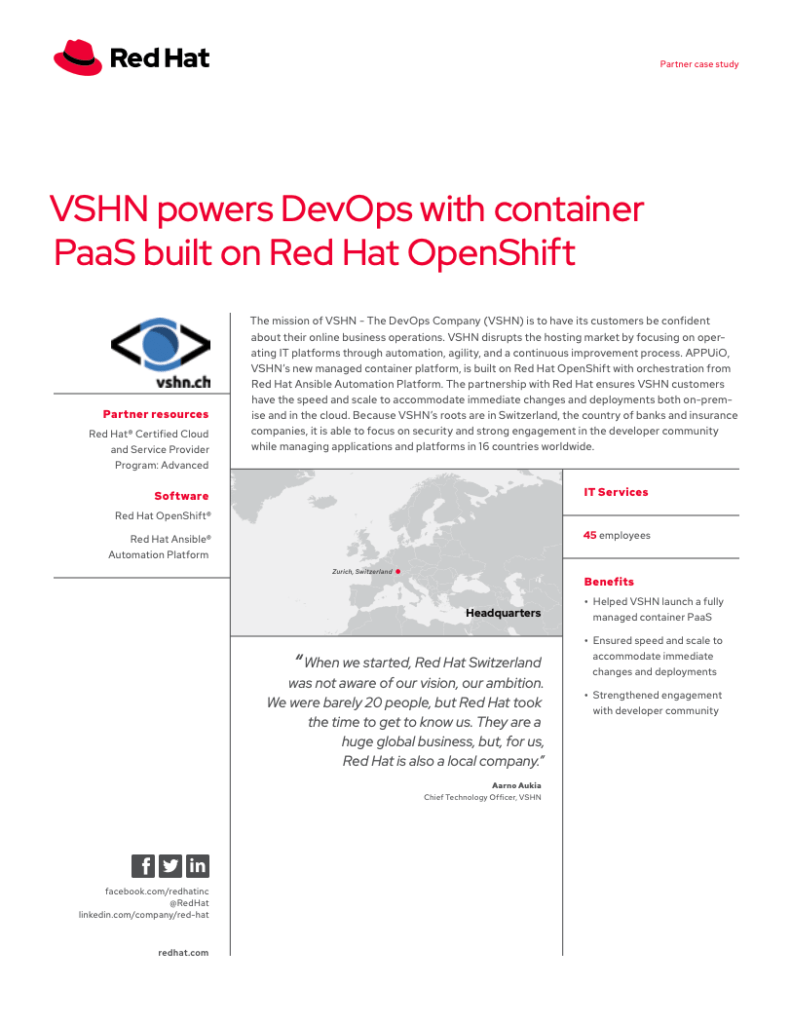
Red Hat Partner Case Study: VSHN powers DevOps with container PaaS built on OpenShift
6. Nov 2020
Red Hat partner case study with VSHN
VSHN disrupts the hosting market by focusing on operating IT platforms through automation, agility, and a continuous improvement process. The partnership with Red Hat ensures VSHN customers have the speed and scale to accommodate immediate changes and deployments both on-premise and in the cloud. We are very pleased about our partnership with Red Hat and in this engaging story we tell you about the history of VSHN and how Red Hat solutions helped us achieve our goals and that of our partners and customers.
VSHN powers DevOps with container PaaS built on Red Hat OpenShift
The mission of VSHN – The DevOps Company is to have its customers be confident about their online business operations. VSHN disrupts the hosting market by focusing on operating IT platforms through automation, agility, and a continuous improvement process. APPUiO, VSHN’s managed container platform, is built on Red Hat OpenShift with orchestration from Red Hat Ansible Automation Platform. The partnership with Red Hat ensures VSHN customers have the speed and scale to accommodate immediate changes and deployments both on-premise and in the cloud. Because VSHN’s roots are in Switzerland, the country of banks and insurance companies (check out our fintech success stories), it is able to focus on security and strong engagement in the developer community while managing applications and platforms in 16 countries worldwide.
“When we started, Red Hat Switzerland was not aware of our vision, our ambition. We were barely 20 people, but Red Hat took the time to get to know us. They are a huge global business, but, for us, Red Hat is also a local company. Red Hat and Red Hat OpenShift have been an important pillar for our success from the beginning. The Certified Cloud and Service Provider Program fits perfectly into our future growth strategy and innovations.” Aarno Aukia Chief Technology Officer, VSHN
Establishing a fully managed container Platform-as-a-Service
VSHN focuses on operating IT platforms through automation, agility, and a continuous improvement process. It wants to address the Ops in DevOps, letting software developers concentrate on their business. Aarno Aukia, Founder and Chief Technology Officer of VSHN, said the company aims to fill the gap between software developers and cloud service providers. “If software developers are architects, we see ourselves as civil engineers. We take care of the foundation, they’re free to be creative. It’s a collaborative relationship,” said Aukia. Aukia established a fully managed container Platform-as-a-Service (PaaS) for enterprise customers. The service needed to be robust, scalable, and secure. The platform must support software developers in making applications automatically testable and deployable, and be able to operate on any infrastructure. “Our goal is to supply the agile infrastructure developers need to scale their software quickly,” said Aukia.
Ensuring enterprise-grade support for critical container PaaS
VSHN is part of the Red Hat Certified Cloud and Service Provider (CCSP) Program, which helps enterprise IT organizations use cloud technologies to lower costs, improve operational flexibility, and stay ahead of the competition. It has used Red Hat OpenShift since 2015; Red Hat OpenShift unifies operations and delivery on-premise, in cloud, and in hybrid environments for enterprise supported Kubernetes. “We’re an open source company, our values are open, the way we operate is open,” said Aukia. “Red Hat shares those values, and can also ensure enterprise-level support worth paying for. The container PaaS is critical for our customers. It cannot go unsupported.” Red Hat OpenShift strengthens DevSecOps for different enterprise customers through rolebased access control and other security-by-default. In addition, VSHN uses Red Hat Ansible Automation Platform for orchestration and maintenance of its managed server products and to provide customization and engineering services.
Filling the gap between developer and infrastructure
Helped VSHN launch a fully managed container PaaS APPUiO is VSHN’s enterprise-focused container platform. The fully managed service, launched in 2016, is based on Red Hat OpenShift, and provides customers with the flexibility to be in cloudbased public, dedicated, private, or on-premise environments. The partnership with Red Hat ensures APPUiO users have the speed and scale to accommodate immediate changes and deployments and strengthens VSHN’s engagement among Switzerland’s developer community. The use of Red Hat OpenShift means VSHN can supply customers with a self-service container PaaS that can be activated and operational within minutes. Applications can be deployed and operated by developers and DevOps themselves, independent of other teams. The launch of APPUiO helped VSHN assist customers with the creation of both their platform and application, from planning via installation to operations. “Also, the size and status of Red Hat has a major impact when we target enterprise customers. Customers trust Red Hat. This has opened doors for us,” said Aukia. Ensured speed and scale to accommodate immediate changes and deployments Red Hat OpenShift improves customer time to market for new applications or software updates. In addition, it helps maximize service efficiency with ongoing upgrades and automation. Customers can automate the building, testing, and deployment of applications. VSHN is running 50 OpenShift clusters in 16 countries. To date, APPUiO has been used by banks, healthcare providers, and insurance companies. For instance, acrevis, a regional Swiss bank, is building its digital future on the platform. It claims publicly to now be faster to market with new digital services. “For us, the APPUiO container platform is a perfect solution, especially from the cost/benefit point of view,” said Christian Gentsch, Member of the Executive Board, acrevis. Strengthened engagement with developer community Community and open values are at the heart of VSHN. Aukia said the fact APPUiO is built entirely on open source components is key. There is a community chat for support and to encourage the exchange of ideas and improvements. “There is an assumption in the open source world that you will get your hands dirty,” Aukia explained. “But at an enterprise level, that comes with certain expectations.” The engagement with Red Hat ensures the support, roadmap, and foresight to keep customers on track. “We assume the same kind of openness by providing our documentation and code to the community,” Aukia added. “Together, open source software, open standards, and openly available documentation guarantee supplier independence to the highest possible extent and protect from vendor lock-in.”
Thinking globally, acting locally
The long-term challenge for VSHN is to remain relevant in that gap between developers and infrastructure. The engagement with Red Hat, and the global ambitions of VSHN’s Swiss-based enterprise customers, give cause for optimism. “When we started, Red Hat Switzerland was not aware of our vision, our ambition. We were barely 20 people, but Red Hat took the time to get to know us. They are a huge global business, but for us, Red Hat is also a local company,” Aukia said.
VSHN is Switzerland’s leading DevOps, Docker, Kubernetes, OpenShift, and 24/7 cloud operations partner. It focuses on operating IT platforms through automation, agility, and a continuous improvement process. Completely location-independent and without its own hardware, VSHN operates according to the DevOps principle, agilely and 24/7 on every infrastructure. VSHN is the first Swiss Kubernetes Certified Service Provider (KCSP) and the winner of the Swiss Digital Economy Award 2019.
About Red Hat
Red Hat is the world’s leading provider of enterprise open source software solutions, using a community-powered approach to deliver reliable and high-performing Linux, hybrid cloud, container, and Kubernetes technologies Red Hat helps customers integrate new and existing IT applications, develop cloud-native applications, standardize on our industry-leading operating system, and automate, secure, and manage complex environments. Award-winning support, training, and consulting services make Red Hat a trusted adviser to the Fortune 500. As a strategic partner to cloud providers, system integrators, application vendors, customers, and open source communities, Red Hat can help organizations prepare for the digital future.
Markus Speth
Marketing, Communications, People
Latest news
Events
General
Recap Cloud Native Computing Meetup September 2026
VSHN on YouTube and Adrian's first video #VSHN.timer
27. Oct 2020
Video is the new normal, or is it?
As visual species, we humans usually find videos more memorable and “easier to consume” than any other type of content. Be it to tell stories, for explanatory or cat videos or during the pandemic to give a more personal insight behind the scenes of VSHN.
Videos are on the advance and the popularity of YouTube, TikTok and Co. is growing without limits. For example, Cisco estimates that in 2021, 80% of all traffic will be video. And YouTube now has 2 billion users.
Did you know that VSHN has a YouTube channel?
Since we always want to learn and like to try something new, we plan to publish more videos about us and our work in the future.
Join us and subscribe to our YouTube channel and look forward to cool video content from the VSHNeers. 😊
Adrian in the first video VSHN.timer
Adrian has been publishing the VSHN.timer for quite some time now collecting exciting technical news and links, which are published in text form in the weekly VSHN.timer.
And now for the first time as video. What do you think about his first try? Watch below, we think it is awesome. 😊
We are happy to hear your feedback!
Your VSHNeers
Markus Speth
Marketing, Communications, People
Latest news
Events
General
Recap Cloud Native Computing Meetup September 2026
Project Syn is nominated for the DINAcon Award 2020
22. Oct 2020
DINAcon 2020
The DINAcon, conference for digital sustainability, takes place annually at the Welle7 Workspace in Bern. Inspiring keynote inputs and selected sessions will bring together Opinion Leaders from politics, business, the public sector and the digitalisation scene at the conference and discuss how digital transformation can be implemented with sustainable added value for society and the environment. DINAcon 2020 is organized by the Research Centre Digital Sustainability of the University of Bern and is supported by the location partner Welle7 Workspace and numerous partner organisations.
DINAcon Awards on Friday October 23, 2020
Every year, the DINAcon Awards are awarded to open projects by communities, companies, administrations, organisations and individuals at the DINAcon Conference. Participation is free of charge, projects from all over Europe are eligible. The winner of the DINAcon Business Award 2020 is automatically nominated for the “Digital Economy Awards” of swissICT. The organizers are very happy to present the DINAcon Awards to 6 great projects in this extraordinary year 2020. The award ceremony will take place on Friday, October 23rd from 3 pm virtually via BigBlueButton.
Project Syn is on the award shortlist
Our Project Syn is one of six projects shortlisted for the DINAcon Awards 2020 in the category Newcomer. Keep your fingers crossed and watch our Project Syn preview video with Tobias Brunner:
Free of charge as a participant in the virtual DINAcon 2020
Those who want to participate spontaneously can order a free ticket. Have fun at DINAcon and see you soon!
Markus Speth
Marketing, Communications, People
Latest news
Events
General
Recap Cloud Native Computing Meetup September 2026