Presse Tech

K8up für CNCF Projekt Onboarding akzeptiert

19. Nov. 2021

Update: k8up ist jetzt ganz offiziell ein CNCF Sandbox Projekt!

Wir freuen uns sehr, bekanntgeben zu können, dass K8up, der von VSHN entwickelte Kubernetes-Backup-Operator, in den CNCF Project Onboarding-Prozess aufgenommen wurde!

Wir werden nun mit der CNCF zusammenarbeiten, um den Onboarding-Prozess abzuschliessen und alle erforderlichen Informationen für die Übertragung der Projektverantwortung an die CNCF bereitzustellen.

Während dieser Phase werden wir bei VSHN unsere Arbeit fortsetzen und K8up mit neuen Funktionen und Möglichkeiten verbessern. Das GitHub-Projekt ist die Hauptstütze für diese Arbeit und du bist herzlich eingeladen, dir unseren Getting Started Guide anzusehen und mehr über K8up zu erfahren.

Vielen Dank an die CNCF für ihr Vertrauen in K8up! Wir wissen, dass dieses Projekt eine grossartige Ergänzung zur ständig wachsenden Welt der Cloud Native-Projekte sein wird, und wir freuen uns auf seine Zukunft!

Tobias Brunner

Tobias Brunner arbeitet seit über 20 Jahren in der Informatik und seit bald 15 Jahren im Internet Umfeld. Neue Technologien wollen ausprobiert und darüber berichtet werden.

Kontaktiere uns

Unser Expertenteam steht für dich bereit. Im Notfall auch 24/7.

Kontakt
Tech

Microservices oder nicht? Dein Team hat sich bereits entschieden

10. Nov. 2021

Lass uns das Thema der Microservices-Architektur ein wenig tangential angehen. Die meisten Diskussionen darüber drehen sich um technologische Aspekte: Welche Sprache man wählen sollte, wie man die meisten RESTful-Services erstellt, welches Service Mesh am leistungsfähigsten ist usw.

Bei VSHN haben wir jedoch schon vor langer Zeit herausgefunden, dass der wichtigste Erfolgsfaktor für Softwareprojekte die Menschen sind. Und die These dieses Artikels ist, dass die Wahl von Microservices als Architekturmuster mehr mit der Organisationsstruktur deines Unternehmens zu tun hat als mit den technologischen Zwängen und Funktionen des Endprodukts.

Oder anders ausgedrückt: Dein Team hat sich bereits für eine Architektur für ihre Software entschieden, auch wenn es sich dessen nicht ganz bewusst ist. Und siehe da: Microservices könnten das sein oder auch nicht.

Definition

Zunächst einmal müssen wir die Microservices-Architektur definieren. Was ist das?

„Microservices“ ist ein Architekturmuster, bei dem die Funktionalität des gesamten Systems in völlig unabhängige Komponenten zerlegt wird, die über das Netzwerk miteinander kommunizieren.

Das Gegenstück zur Microservices-Architektur ist der so genannte „Monolith“, der in den letzten 25 Jahren der häufigste Ansatz für Webapplikationen und -dienste war. In einem Monolithen sind alle Funktionen der Anwendung, von der Datenverwaltung bis zur Benutzeroberfläche, in einem einzigen Binary oder Paket enthalten.

Auf der gegenüberliegenden Seite der Strasse finden wir die Microservices-Architektur, bei der jeder Dienst für seine eigene Implementierung und Datenspeicherung verantwortlich ist.

Per Definition sind Microservices feingranular und haben einen einzigen Zweck. Sie weisen eine starke Kohäsion auf, d. h. die von ihnen eingekapselten Vorgänge sind in hohem Masse miteinander verbunden. Sie sind ein Beispiel für das „Single Responsibility Principle“. Sie werden auch separat bereitgestellt, mit deutlich abgegrenzten Kontexten, und sie erfordern DevOps-Ansätze für ihre Bereitstellung und Verwaltung, wie Automatisierung und CI/CD-Pipelines.

Sehr wichtig ist, dass die Microservices-Architektur eine „Share-Nothing-Architektur“ ist, bei der die einzelnen Dienste niemals gemeinsamen Code über Bibliotheken teilen, sondern die gesamte Interaktion und Kommunikation auf das sie verbindende Netzwerk beschränkt ist.

Und nicht zuletzt sollten Microservices (wie der Name schon sagt) so klein wie möglich sein, einen geringen Speicherbedarf haben und in Sekundenschnelle starten und stoppen können.

Angesichts all dieser Merkmale sind Microservices das mit Abstand komplexeste Architekturmuster, das je geschaffen wurde. Es ist schwer zu planen, kann die Komplexität von Projekten drastisch erhöhen und war für einige Teams erfahrungsgemäss nicht zu bewältigen.

Geschichte

Die Idee, dass sich „Komponenten gegenseitig Nachrichten schicken“, ist absolut nicht neu. Bereits 1966 prägte einer der grössten Informatiker aller Zeiten, Alan Kay, den Begriff „objektorientierte Programmierung“. Die Industrie hat seine ursprüngliche Definition, die wie folgt lautete, übernommen und verformt:

OOP bedeutet für mich nur Messaging, lokale Speicherung und Schutz und Verstecken von State-Process, und extreme Late-Binding aller Dinge.

Alan Kay, Quelle.

Dieser Text stammt aus dem Jahr 2003, der folgende aus dem Jahr 1998:

Die grosse Idee ist „Messaging“ – das ist es, worum es im Kern von Smalltalk/Squeak geht (…) Der Schlüssel zum Aufbau grossartiger und wachstumsfähiger Systeme liegt eher darin, zu entwerfen, wie die Module kommunizieren, als was ihre internen Eigenschaften und Verhaltensweisen sein sollten.

Alan Kay, Quelle.

Alan Kay entwickelte in den 1970er Jahren die Programmiersprache Smalltalk, die auf diesen Konzepten basiert. Und nach der Lektüre der obigen Texte wird klar, dass die Microservices-Architektur zu einem grossen Teil eine Umsetzung von Alan Kays Ideen von Messaging, Entkopplung und Abstraktion ist, die auf die Spitze getrieben wurde.

Um den heutigen Stand der Microservices zu erreichen, waren jedoch viele weitere Durchbrüche erforderlich. In den 2000er Jahren wurde mit dem Aufkommen von XML, dem SOAP-Protokoll und den damit zusammenhängenden Webdiensten der Begriff „serviceorientierte Architektur“ zu einem weit verbreiteten Grundnahrungsmittel in Architekturdiskussionen. Mit dem Aufkommen agiler Methoden wandte sich die Branche dem REST-Ansatz anstelle von SOAP zu. Im letzten Jahrzehnt ermöglichten das Aufkommen von DevOps und der Aufstieg der Containerisierung durch Docker und Kubernetes den Teams schliesslich die Bereitstellung von Tausenden von Containern als Microservice-Architektur, dank des gesamten Katalogs der Cloud-Native-Technologien.

Pro und Kontra

Wenn Microservice-Architekturen so komplex sind, warum sollten sie dann eingesetzt werden? Es stellt sich heraus, dass sie viele Vorteile bringen können:

  • Da jede Komponente vollständig von den anderen isoliert werden kann, können die Teams, sobald sie sich auf ihre Schnittstellen geeinigt haben, diese zu 100 % unabhängig von den anderen entwickeln, dokumentieren und gründlich testen. Auf diese Weise können die Teams parallel vorgehen und Funktionen implementieren, die zu 0 % miteinander kollidieren können.
  • Die Teams werden ausserdem ermutigt, die Programmiersprache zu wählen, die am besten zu der jeweiligen Aufgabe passt, die ihr Microservice erfüllen muss.
  • Da es sich per definitionem um „Mikro“-Dienste handelt, sind sie so konzipiert, dass sie schnell gestartet und wieder beendet werden können, so dass sie nur bei Bedarf eingreifen und das gesamte System effizienter und reaktionsfähiger machen.
  • Die Grösse von Microservices ermöglicht auch eine höhere Verfügbarkeit, da es möglich ist, viele von ihnen hinter einem Load Balancer zu haben; sollte eine Instanz eines Microservices ausfallen, kann sie schnell entlassen werden und eine neue an ihrer Stelle instanziiert werden, ohne dass die Verfügbarkeit verloren geht.
  • Systeme können schrittweise aktualisiert werden, wobei jedes Team Fehler behebt und Funktionen hinzufügt, ohne die anderen zu stören. Solange die Schnittstellen beachtet (und schliesslich versioniert) werden, gibt es keinen Grund, dass das System unter den Aktualisierungen leidet.

Es gibt jedoch viele Gründe, sich nicht für die Microservices-Architektur zu entscheiden; unter den wichtigsten sind:

  • Leistung: Ein mit Microservices aufgebautes System muss die Latenz zwischen diesen Diensten berücksichtigen; und in dieser Hinsicht sind monolithische Anwendungen schneller; ein Funktionsaufruf ist immer schneller als ein Netzwerkaufruf.
  • Reife des Teams: Microservices erfordern von den Teams ein gewisses Mass an Erfahrung und Fachwissen; bei Teams, die neu im Bereich Microservices sind, ist die Wahrscheinlichkeit eines Projektfehlschlags höher.
  • Kosten: Die Erstellung eines Microservices-Systems ist, wenn überhaupt, teurer, da jeder einzelne Dienst einen Overhead verursacht.
  • Machbarkeit: Manchmal ist es einfach nicht möglich, Microservices zu nutzen, zum Beispiel wenn es um Altsysteme geht.
  • Teamstruktur: Dies ist ein entscheidender Faktor, auf den wir später noch ausführlich eingehen werden.
  • Komplexität: Es ist nicht ungewöhnlich, dass Systeme aus Tausenden von gleichzeitigen Diensten bestehen, und dies führt zu Herausforderungen, auf die wir später noch eingehen werden.

Ich möchte nun auf die letzten beiden Punkte eingehen, die unserer Erfahrung nach die grössten Probleme bei Microservice-Implementierungen darstellen: Teamstruktur und die Wahrnehmung und Bewältigung von Komplexität.

Conway’s Law

Einer der entscheidenden Faktoren, der die Fähigkeit von Teams zur Implementierung von Microservices einschränkt, ist oft unsichtbar und wird übersehen: Ihre eigene Struktur. Auch dieses Phänomen ist nicht neu. Im Jahr 1968 schrieb Melvin A. Conway für die Zeitschrift Datamation einen Artikel mit dem Titel „How Do Committees Invent?“, in dem die folgende Idee hervorsticht:

Die Grundthese dieses Artikels ist, dass Organisationen, die Systeme entwerfen (…), gezwungen sind, Designs zu produzieren, die Kopien der Kommunikationsstrukturen dieser Organisationen sind.

Melvin Conway, Quelle.

Dafür gibt es umfangreiche Belege, sowohl anekdotische als auch empirische, die durch die Forschung belegt sind.

Die Konsequenz dieses Prinzips ist die folgende: Die Entscheidung zwischen einer monolithischen und einer Microservices-Architektur ist bereits im hierarchischen Diagramm einer jeden Organisation verankert.

Eine der Dienstleistungen, die wir bei VSHN anbieten, befasst sich genau mit diesem Thema. In unserem „DevOps-Enablement-Workshop“ bewerten wir den Grad der Agilität von Organisationen sowie das Ausmass und die Verbesserungen, die DevOps bringen könnte. Auf der Grundlage dieser Informationen führen wir ein Reverse-Engineering ihrer Struktur durch das Conway’sche Gesetz durch, um einen Ausgangspunkt für ihre digitale Transformation zu finden.

Komplex vs. Kompliziert

Ein weiterer wichtiger Punkt ist die Unterscheidung zwischen „komplex“ und „kompliziert“, da diese beiden Wörter in der Alltagssprache manchmal miteinander verwechselt werden können, und um die Sache noch schwieriger zu machen, kann das Wort „einfach“ als Antonym für beide verwendet werden.

„Komplex“ kommt aus dem Lateinischen complexus und bedeutet „aus ineinander verschlungenen Elementen bestehend“. Complexus ist wiederum von plectere („biegen, verflechten“) abgeleitet. Dieses Wort wird seit dem XVI. Jahrhundert verwendet, um etwas zu bezeichnen, das sich aus heterogenen Elementen zusammensetzt. Es hat dieselbe Wurzel (plectere) wie der medizinische Begriff „Plexus“, der „Geflecht“ bedeutet und seit dem 16. Jahrhundert als medizinischer Begriff für „Nerven- oder Blutgefässnetz“ verwendet wird.

(Quelle: Dictionnaire historique de la langue française von Alan Rey)

„Kompliziert“ hingegen hat einen ähnlichen Ursprung, aber eine andere Konstruktion: Es kommt vom lateinischen complicare, was wörtlich „zusammenfalten“ bedeutet. Im übertragenen Sinne wurde dies als Nähe zum Begriff der Peinlichkeit oder Unbeholfenheit verstanden. Das Wort setzt sich aus dem Wort plicare zusammen, das „falten“ bedeutet. Uhren, die gemeinhin als „Komplikationen“ bezeichnet werden (wie das Kaliber 89 von Patek Philippe, die Aeternitas Mega von Franck Muller und die „Référence 57260“ von Vacheron Constantin), sind per Definition komplizierte Maschinen.

Kurz gesagt, „komplex“ und „kompliziert“ stammen von leicht unterschiedlichen Wurzeln ab: Der lateinischen Wurzel plectere („verflechten“) für Ersteres und plicare („falten“) für Letzteres. Der Begriff „kompliziert“ vermittelt die Vorstellung eines Netzes von miteinander verflochtenen Objekten, deren Zustand und Verhalten sich durch die Interaktion mit anderen Objekten in diesem Netz ständig ändert. Das Wort kompliziert impliziert eine inhärente scheinbare „Unklarheit“ durch Faltung in sich selbst, die zu einem „sich entfaltenden“ Entdeckungsprozess einlädt.

Oder anders ausgedrückt: einzelne Microservices sollten nicht kompliziert sein, aber eine Microservice-Architektur ist per Definition komplex. Monolithen hingegen neigen dazu, mit der Zeit sehr kompliziert zu werden. Und natürlich sind beide nicht einfach.

Die Geschichte zeigt, dass Softwareentwickler ein leidenschaftliches Verhältnis zur Kompliziertheit haben; komplizierte Systeme sind grossartig, um auf Hacker News damit zu prahlen, während Maintainer auch privat über sie weinen.

Eine „Best Practice“ hat in diesem Zusammenhang eine und nur eine grundlegende Aufgabe: den Ingenieuren zu helfen, das Komplizierte in das Komplexe zu übersetzen. Die meisten softwarebezogenen Katastrophen werden durch eine einfache Tatsache verursacht: Aufgrund von Fristen, Organisation, Werkzeugen oder schlichtweg Unwissenheit neigen Softwareentwickler dazu, komplizierte statt komplexe Systeme zu bauen.

Dies ist ein weiterer Punkt, um den wir uns in unserem DevOps-Workshop kümmern, und zwar durch die Bewertung der aktuellen Ressourcen (nicht nur Quellcode, sondern auch aktuelle Datenbankschemata, Sicherheitsanforderungen, Netzwerktopologien, Bereitstellungsverfahren und -rhythmen usw.).

Migrieren oder umschreiben? Gleichgewicht

Die Kompliziertheit von Monolithen an sich ist nicht problematisch; sie führt zu eng gebundenen Systemen, die in der Regel sehr schnell sind, da, wie gesagt, ein Funktionsaufruf schneller ist als ein Netzaufruf. Schliesslich haben wir in der Vergangenheit sehr erfolgreich Monolithen gebaut. Aber die Erfahrung zeigt, dass sie in Bezug auf Verfügbarkeit und Skalierbarkeit Probleme bereiten. Microservices stellen einen diametral entgegengesetzten Ansatz dar, der eher auf Komplexität als auf Kompliziertheit beruht, der aber diese Probleme löst.

Es besteht also ein Spannungsverhältnis zwischen Komplexität und Kompliziertheit auf der einen und organisatorischen Zwängen auf der anderen Seite. Mit anderen Worten, es besteht ein Spannungsverhältnis zwischen monolithischen und Microservices-Systemen auf der einen Seite und mehr oder weniger hierarchischen Strukturen auf der anderen Seite. Ein Gleichgewicht zwischen diesen Kräften zu erreichen, ist also die technische Herausforderung, der sich Softwarearchitekten heutzutage stellen müssen.

Viele Teams stehen heute vor der Aufgabe, ihre Monolithen auf Microservice-basierte Architekturen zu migrieren, entweder auf Wunsch des Managements oder auf Grund von Kunden- oder Lieferantenanforderungen. Architekten können zum Glück einige Techniken anwenden, um ein Gleichgewicht zu finden:

  1. Beginne den Migrationspfad im Bewusstsein, dass oft nicht die gesamte Anwendung auf Microservices umgestellt werden muss. Einige Teile können und sollten monolithisch bleiben, und insbesondere bewährte ältere Systeme, auch wenn sie in COBOL oder älteren Technologien geschrieben wurden, können immer noch einen Wert darstellen und eine sehr wichtige Rolle für den Erfolg des Übergangs spielen.
  2. Identifiziere die Komponenten richtig, so dass sie im isolierten Zustand weder nur funktions-, noch nur daten-, noch nur anforderungsgesteuert sind, sondern von diesen drei Faktoren (Funktionalität, Daten und Anforderung) gleichzeitig gesteuert werden. Achte auf das Organigramm und verwende dieses als Grundlage für die Dekomposition in Microservices.
  3. Denke daran, dass die Netzwerkbandbreite nicht unbegrenzt ist. Einige Schnittstellen sollten „klobig“ sein, während andere „gesprächig“ sein sollten. Plane von Anfang an Latenzprobleme ein.
  4. Reduziere die Kommunikation zwischen den Dienststellen so weit wie möglich, was auf verschiedene Weise geschehen kann:
    1. Konsolidierung der Dienste
    2. Konsolidierung von Datendomänen (Kombination von Datenbankschemata oder Verwendung gemeinsamer Caches)
    3. Verwendung von Technologien wie GraphQL zur Verringerung der Netzwerkbandbreite
    4. Verwendung von Messaging-Warteschlangen, wie RabbitMQ.
  5. Einführung von Microservice-freundlichen Technologien wie Docker-Container, Kubernetes, Knative oder Red Hat OpenShift und Quarkus.
  6. Implementiere eine automatisierte Teststrategie für jeden einzelnen Microservice.
  7. Standardisiere Technologie-Stacks rund um Container und Kubernetes und schaffe eine gemeinsame Basis für ein echtes Microservice-Ökosystem in Unternehmen.
  8. Automatisiere die Arbeit so weit wie möglich, da sich der Aufwand für die Automatisierung (DevOps, CI/CD) über viele Dienste hinweg amortisieren kann und sich somit langfristig als Nettoinvestition erweist.

Wie bereits erwähnt, helfen wir Organisationen regelmässig bei ihrer digitalen Transformation in Richtung Microservices, Kubernetes, OpenShift, DevOps, CI/CD, GitLab und DevOps im Allgemeinen, um ihre Teams mit den Werkzeugen zu unterstützen, die sie in der Zukunft benötigen werden. In Anlehnung an das Konzept der Team-Topologien von Henny Portman kann VSHN sowohl als „Enabling Team“ (DevOps-Workshops, Beratung) als auch als „Platform Team“ (Kubernetes/OpenShift) unterstützen, um Microservices zu entwickeln und Stabilität und Sicherheit zu gewährleisten.

Schlussfolgerung

Microservice-Architekturen sind nicht nur ein Hype, sondern bringen auch grosse Vorteile mit sich, können aber auch eine grosse Herausforderung für Software-Teams darstellen.

Der beste Weg, diese Herausforderungen zu bewältigen, besteht darin, das Conway’sche Gesetz umzukehren und zunächst die menschliche Organisation deiner Teams zu analysieren. Mach sie unabhängig, agil und frei in der Wahl der besten Werkzeuge für ihre Arbeit. Ermutige sie, untereinander die Schnittstellen ihrer jeweiligen Komponenten auszuhandeln.

Lass uns komplexe, nicht komplizierte Systeme schaffen und betreiben. Wir können uns nicht von der Komplexität lösen; das ist unsere Aufgabe als Ingenieure. Aber wir können den komplizierten Teil loswerden.

Abschliessend möchte ich meinen ehemaligen Kollegen und lebenslangen Freund Adam Jones, einen unabhängigen IT-Berater aus Genf, zitieren: Um mit der Microservice-Architektur Erfolg zu haben, musst du Struktur in deine Aktivitäten einbetten und sie aus der Hierarchie entfernen. Es geht nicht darum, die Struktur verschwinden zu lassen, sondern sie dorthin zu verlagern, wo sie am meisten Nutzen bringt.


Aarno Aukia

Aarno ist Mitgründer der VSHN AG und als CTO für die technische Begeisterung zuständig.

Kontaktiere uns

Unser Expertenteam steht für dich bereit. Im Notfall auch 24/7.

Kontakt
Allgemein Tech

Die 5 hartnäckigsten Mythen über Container-Technologien

28. Sep. 2021

Gastbeitrag von Richard Zobrist, Head of Partners & Alliances Switzerland, Red Hat.

Open-Source-Container-Technologien sind eine wichtige Massnahme, um Daten zu schützen. Trotzdem halten manche Unternehmen Containerlösungen vermeintlich für zu unsicher, zu schwierig zu integrieren, zu langsam oder gänzlich unnötig. Höchste Zeit, mit diesen hartnäckigen Mythen aufzuräumen.

1. Zu wenig Sicherheit

Für Sicherheitsteams wird es immer schwieriger, mit den sich ändernden Risiken, Compliance-Anforderungen, Tools und Architekturänderungen Schritt zu halten, die durch neue Technologien wie Container, Kubernetes, softwaredefinierte Infrastruktur und Cloud-Technologien eingeführt werden.

Um langfristig erfolgreich zu sein, müssen Sicherheitsexperten ihre Einstellung zu Containern jedoch ändern: Sie sind keine Virtual Machines (VMs) oder Hosts und bringen veränderte Sicherheitsherausforderungen mit sich die mit herkömmlichen Tools nicht bewältigt werden können. Die Red Hat OpenShift Container Platform ermöglicht den Anwendern, Open-Source-Vorteile mit der Stabilität und Sicherheit eines verwalteten Produkts zu kombinieren. Zudem bietet Red Hat OpenShift langfristig konsistentere Sicherheit, integrierte Überwachung, zentralisierte Richtlinienverwaltung und Kompatibilität mit Kubernetes Workloads. Red Hat OpenShift kann die Sicherheit erhöhen durch schnellere Software-Updates, die Sicherheitslücken schliessen – und dies ohne dass Sie dabei aktiv beteiligt sein müssen.

2. Zu schwierig zu integrieren

Ein weiterer Mythos, der sich unbeirrt hält, ist die „schwierige Integration“ von Open-Source-Anwendungen. Die Erklärung hierfür sei, dass heutige IT-Landschaften oftmals wenige Schnittstellen anböten, an die Open-Source-Plattformen andocken könnten. In einer diesjährigen, von der Universität Bern publizierten “Open Source Studie Schweiz” wird jedoch als Hauptgrund für den Einsatz von offener Software gerade die offenen Standards, die Open Source zugrunde liegen, genannt. Dies zeigt, dass Interoperabilität heute zentral ist und monolithische IT-Systeme ausgedient haben. Von Business-Anwendungen werden offene Schnittstellen via Application Programming Interfaces erwartet, über die etwa Microservices-Daten ausgetauscht werden könnten.

3. Mangel an Know-how

Viele Unternehmen haben eine gemeinsame Sorge: Wie können sie von Open-Source-Technologien profitieren, auch wenn sie über keine eigenen Fachkräfte verfügen? Welche Lösungen gibt es konkret? Und welche Hürden gilt es zu überwinden? Um Ihre Anwendungen auf Red Hat OpenShift zu migrieren, benötigen Sie kein zusätzliches Personal. Sie können entweder direkt mit Red Hat zusammenarbeiten oder die Migration einem zertifizierten Partner – wie etwa VSHN – überlassen.
Red Hat OpenShift bietet Ihnen den zusätzlichen Vorteil, dass im Hintergrund eine tatkräftige und hilfsbereite Community bereitsteht, mit welcher Wissen und Erfahrungen ausgetauscht werden können. In der dynamischen IT-Welt ist dieser Zugang zu kompetenten Fachleuten einer der wichtigsten Gründe für den Einsatz von Open-Source-Software. Ausserdem schafft die Verbreitung von Open-Source-Know-how auch die Grundlage für professionellen Support und letztlich die Möglichkeit, erfahrene Open-Source-Fachleute auch direkt anstellen zu können. So wird Open Source zu einem Trumpf im Kampf um IT-Talente, denn die Technologie macht Unternehmen für sie attraktiv.

4. Alle Anwendungen müssen auf Open Source basieren

Immer mehr Unternehmen transformieren ihr Geschäft, indem sie DevOps-Prinzipien, Microservices, und Container-Technologien wie Kubernetes anwenden. Red Hat OpenShift wird dennoch häufig unterstellt, dass es zu wenige Schnittstellen zu anderen Systemen aufweise und nur dann erfolgreich sei, wenn alle Anwendungen auf Open-Source-Technologien basierten. Aus der “Open Source Studie Schweiz” geht hingegen hervor, dass ein wichtiger Grund für die Nutzung von Red Hat OpenShift ist die enorme Auswahl an frei verfügbaren Komponenten und Tools ist. In den letzten Jahren hat sich rund um OpenShift ein signifikantes Ökosystem gebildet, von welchem die Kunden auf einfachste Weise profitieren können.
Da sich IT-Entscheidungen oft an dem orientieren, was andere tun, multipliziert sich mit der steigenden Verbreitung von Open-Source-Software deren Popularität.

5. Unklares Geschäftsmodell der Anbieter

Um auch diesem Mythos ein Ende zu setzen, lohnt sich ein Blick zurück zu den Anfängen von Open-Source-Technologien. Ein Meilenstein in der Open-Source-Geschichte war die Publikation der ersten Version des Linux-Kernels durch den finnischen Informatiker Linus Torvalds. Mit der Erfindung von Linux gelang es Torvalds, das erste komplett freie Betriebssystems für Computer zu entwickeln und er legte damit den Grundstein nicht nur für eine grosse Entwickler-Community, sondern auch für zahlreiche Projekte und Distributionen, die auf dem Linux-Kernel aufbauen, etwa “Red Hat Enterprise Linux”. In der Folge nahmen die Verbreitung und der Bekanntheitsgrad von Linux und anderer freier Software in der Unternehmenswelt stetig zu, ob es sich nun um Software für Server, Büroprogramme für Desktop-PCs oder Virtualisierungs-Tools für Cloud-Plattformen handelt.

In der Zwischenzeit hat Open Source seinen Ruf als Innovationstreiber für die Softwareindustrie gefestigt. Die Trends, die nun unsere Arbeit immer mehr bestimmen, basieren alle auf Open Source. Hierzu zählen Red Hat Enterprise Linux, Cloud Computing, Edge-Technologie und Internet of Things (IoT), Container, Künstliche Intelligenz (KI) und Maschinelles Lernen (ML) sowie DevOps. Heute ist Red Hat der weltweit führende Anbieter von Enterprise-Open-Source-Lösungen. Das Unternehmen beschäftigt weltweit etwa 18’000 Mitarbeiter und verfügt über 105 Büros, die sich auf sämtlichen Kontinenten befinden.

Zusammenarbeit mit VSHN

Mit der Initiative „Leading with Containers“ unterstützt Red Hat sowohl seine eigenen Kunden wie auch seine Partner bei der Einführung von „Red Hat OpenShift“. Kunden, die über einen Partner – wie etwa VSHN – von Red Hats Container-Technologie profitieren wollen, erhalten die gleichen Vorteile wie Red Hats eigene Kundschaft. Denn VSHN ist seit über 3 Jahren ein anerkannter Advanced Partner von Red Hat, der sich auf den Bereich „Certified Cloud & Service Provider“ (CCSP) spezialisiert.

Richard Zobrist

Head of Partners & Alliances Schweiz und (interimistischer) Country Manager Österreich bei Red Hat

Kontaktiere uns

Unser Expertenteam steht für dich bereit. Im Notfall auch 24/7.

Kontakt
Tech

Happy 30th Birthday, Linux!

25. Aug. 2021

On the evening of August 25th, 1991, Linus Torvalds wrote a short message on the comp.os.minix Usenet newsgroup:

I’m doing a (free) operating system (just a hobby, won’t be big and professional like gnu) for 386(486) AT clones.

Fast-forward 30 years, and to make a long story short, well: Linux is now both big and professional. It’s nearly everywhere, hidden behind the shiny graphical user interface of your smartphone or tablet (well, except for iOS users), in your gaming box, in your car, and even on Mars.

I discovered Linux as a young boy still at school, in 1998. It was in a book store where I was attracted by a shiny package (I had no idea what Linux was) called „SuSE Linux 6.0“ (nowadays available for download from archive.org), and since then I couldn’t stop working with it.

Over time, I got more and more into Linux, and it became an important hobby, with all my PCs running Linux, and also on my home server under my desk at home. Many years later, in 2011, I could finally start working full-time as a Linux administrator. My desktop computer has been only powered by Linux since around 2004, and I’ve been a big fan of KDE ever since.

The author’s original SuSE Linux 6.0 CDs, originally released in December 1998.
More memorabilia from early Linux versions.

Today, the Linux Kernel is more present, yet less visible than ever. We interact with it on containers and in VMs on the cloud, and it gets more and more abstracted away, deep down in serverless architectures, making the Kernel even more invisible than ever before. Albeit out of sight of most users, Linux has become much more solid, mature, and pervasive, and does its great job behind the scenes without interruption.

Linux empowers VSHN at all levels; not only it is the dominating technology we use every day, empowering Kubernetes, containers, and cloud VMs, but it is also the operating system that the majority of VSHNeers (around 66%, according to an internal poll) use for their daily job, the remaining third using macOS or Windows.

Some numbers: of those two thirds of VSHNeers that use Linux every day in their laptops, 61% chose Ubuntu (or one of its various derivatives); 17% use Arch, 11% Fedora, and others use DebianMint, and other distributions. Some even contemplate switching to Qubes OS soon! As for desktop environments, around 35% use GNOME, 25% use KDE, 20% use i3, and 6% use Cinnamon.

Each one of us VSHNeers has a unique feeling about Linux; here are some thoughts about what Linux means to us:

Before using Linux, I was primarily focused on how to use and work with computer systems. With the switch to Linux I started to understand how they actually work.

What I really appreciate about Linux is that it’s (still relatively) lightweight, powerful, transparent and adaptable. I do heavyweight gaming and video livestreaming on the same OS that runs my file servers and backup systems (not all on the same machine, don’t worry). Even my car and my television run Linux! This universality combined with the permissive licenses means that whenever one industry improves Linux (the kernel), every other industry profits.

I originally just wanted to play Minecraft with my friends. Suddenly I had to learn how to host this on a Linux server, which then turned into a fascination on how things work on the backstage. It’s the urge to see how our modern society works!

Linux is the operating system of our software-driven world.

On to the next 30 years of Linux!

Tobias Brunner

Tobias Brunner arbeitet seit über 20 Jahren in der Informatik und seit bald 15 Jahren im Internet Umfeld. Neue Technologien wollen ausprobiert und darüber berichtet werden.

Kontaktiere uns

Unser Expertenteam steht für dich bereit. Im Notfall auch 24/7.

Kontakt
Presse Tech

VSHN Top Ten Open Source Contributor in Switzerland

4. Aug. 2021

Open Source is without any doubt one of the most important forces shaping the business of software in the 21st century. And Switzerland, after some hesitant first steps in the 2000’s, has now fully embraced it; many organizations are now contributing lots of code for the community, collaborating with one another, and helping shape an open future for our craft. And Open Source is undoubtedly a major factor contributing to Switzerland topping the UN innovation ranking for the past 10 years in a row.

For VSHN, Open Source is part of our culture. We release new projects and products continuously, and gladly collaborate with projects all over the country, providing pull requests, bugs reports, and feedback. We actively advocate for our customers to adopt Open Source as well; they can learn more about the Open Source advantage to their businesses in our website.

And our commitment pays off; we’ve been consistently figuring in the top ten of Swiss organizations contributing to Open Source. We are thrilled and proud to share the stage with such prestigious names as Camptocamp, CERN, Exoscale, Swisscom, the University of Bern, Zühlke and many others!

Our major contributions at this moment are:

  • Project Syn, our suite of tools to manage large numbers of Kubernetes clusters from a central location.
    • Commodore, one of the members of the Project Syn family, can be extended through components. The full component ecosystem is featured in our recently released Commodore Components Hub, including not only our own components, but also those created by third parties.
  • K8up, our Kubernetes backup operator, which recently released its version 1.0.
  • But there is more, so much more! Check out our GitHub profiles: VSHNAPPUiO, and Project Syn.

We are also contributing and sponsoring the Linux Foundation and Cloud Native Computing Foundation, CH Open, Parldigi, Opendata.ch and many more and we support the Swiss Open Source Study 2021.

On The Press

These contributions are making the headlines:

Markus Speth

Marketing, Communications, People

Kontaktiere uns

Unser Expertenteam steht für dich bereit. Im Notfall auch 24/7.

Kontakt
Project Syn Tech

The New Commodore Components Hub

28. Juli 2021

We’re very happy to announce a new member of the Project Syn family: the new Commodore Components Hub. This is the new central point of reference and information for all Commodore components available in GitHub.

Commodore Components Hub

Not only does the Commodore Component Hub list all existing components on GitHub, it also automatically imports and indexes the documentation of each and every one, written in Asciidoc and formatted as an Antora documentation site. This makes it very easy to find the perfect component that suits your needs.

The source code used to generate the Commodore Component Hub was born during our recent VSHN HackDay; it’s written in Python and 100% open source (of course!). Check it out in GitHub.

Get your Component on the Hub!

To add your own Commodore Component to the Hub, it’s very easy: just add the commodore-component tag to your project on GitHub, and voilà! The Commodore Component Hub is rebuilt every day at every hour from 6 AM to 7 PM (CET time).

We recommend that you write the documentation of your component with Asciidoc in the docs folder of your component. This will ensure that users will be able to find your component, and most important, also learn how to use it properly.

We look forward to featuring your Commodore Components on the Hub!

Tobias Brunner

Tobias Brunner arbeitet seit über 20 Jahren in der Informatik und seit bald 15 Jahren im Internet Umfeld. Neue Technologien wollen ausprobiert und darüber berichtet werden.

Kontaktiere uns

Unser Expertenteam steht für dich bereit. Im Notfall auch 24/7.

Kontakt
Tech

Benchmarking Kubernetes Storage Solutions

23. Juli 2021

One of the most difficult subjects in the world of Kubernetes is storage. In our day-to-day operations we’ve often had to choose the best storage solution for our customers, but in a changing landscape of requirements and technical offerings, such choice becomes a major task.

Faced to many options, we decided to benchmark storage solutions in real life conditions, to generate the data required for a proper decision. In this article we’re going to share with you our methodology, our results, and our final choice.

The chosen storage providers for this evaluation were:

All of these benchmarks (except Gluster) were run on an OpenShift 4.7 cluster on Exoscale VMs.

We benchmarked Ceph both with unencrypted and encrypted storage for the OSDs (object-storage daemons). We included Gluster in our evaluation for reference and comparison only, as that’s the solution we offered for storage on OpenShift Container Platform 3.x. We never intended to use Gluster as the storage engine for our new Kubernetes storage cluster product.

Methodology

We first created a custom Python script driving kubestr, which in turn orchestrates Fio. This script performed ten (10) iterations for each benchmark, each of which included the following operations in an isolated Fio run:

  • Read iops
  • Read bandwidth
  • Write iops, with different frequencies of calls to fsync:
    • no fsync calls during each benchmark iteration
    • an fsync call after each operation („fsync=1“)
    • an fsync call after every 32 operations („fsync=32“)
    • an fsync call after every 128 operations („fsync=128“)
  • Write bandwidth, with different frequencies of calls to fsync:
    • no fsync calls during each benchmark iteration
    • an fsync call after each operation („fsync=1“)
    • an fsync call after every 32 operations („fsync=32“)
    • an fsync call after every 128 operations („fsync=128“)

This is the Fio configuration used for benchmarking:

[global]
randrepeat=0
verify=0
ioengine=libaio
direct=1
gtod_reduce=1
[job]
name=JOB_NAME     (1)
bs=BLOCKSIZE      (2)
iodepth=64
size=2G
readwrite=OP      (3)
time_based
ramp_time=5s
runtime=30s
fsync=X           (4)
  1. We generate a descriptive fio job name based on the benchmark we’re executing. The job name is generated by taking the operation („read“ or „write“) and the measurement („bw“ or „iops“) and concatenating them as „OP_MEASUREMENT“, for example „read_iops“.
  2. The blocksize for each operation executed by fio. We use a blocksize of 4K (4kB) for IOPS benchmarks and 128K (128kB) for bandwidth benchmarks.
  3. The IO pattern which fio uses for the benchmark. randread for read benchmarks. randwrite for write benchmarks.
  4. The number of operations to batch between fsync calls. This parameter doesn’t have an influence on read benchmarks.

If writing to a file, issue an fsync(2) (or its equivalent) of the dirty data for every number of blocks given. For example, if you give 32 as a parameter, fio will sync the file after every 32 writes issued. If fio is using non-buffered I/O, we may not sync the file. The exception is the sg I/O engine, which synchronizes the disk cache anyway. Defaults to 0, which means fio does not periodically issue and wait for a sync to complete. Also see end_fsync and fsync_on_close.

Fio documentation

Results

The following graph, taken from the full dataset for our benchmark (available for download and study) shows the type of comparison performed across all considered solutions.

Figure 1. Read IOPS (higher is better)

The table below gives an overview over the data gathered during our evaluation (each column shows mean ± standard deviation):

Storage solutionread IOPSread bandwidth MB/swrite IOPS, no fsyncwrite bandwidth MB/s, no fsyncwrite IOPS, fsync=1write bandwidth MB/s, fsync=1
OCS/Rook.io Ceph RBD (unencrypted OSDs)42344.21 ± 885.521585 ± 32.6559549.14 ± 371.11503.208 ± 12.544305.18 ± 15.6535.591 ± 1.349
OCS/Rook.io CephFS (unencrypted OSDs)44465.21 ± 1657.911594 ± 82.5229978.00 ± 456.97512.788 ± 8.0498808.47 ± 357.87452.086 ± 10.154
OCS/Rook.io Ceph RBD (encrypted OSDs)36303.06 ± 2254.871425 ± 59.7206292.75 ± 424.91310.520 ± 63.047225.00 ± 12.1122.804 ± 1.031
OCS/Rook.io CephFS (encrypted OSDs)36343.35 ± 1234.931405 ± 92.8686020.49 ± 251.16278.486 ± 49.1015004.28 ± 152.01291.729 ± 17.367
Longhorn (unencrypted backing disk)11298.36 ± 664.99295.458 ± 25.458111.197 ± 10.3225975.43 ± 697.14391.57 ± 26.1129.993 ± 1.544
Gluster22957.87 ± 345.40976.511 ± 45.2682630.89 ± 69.21531.88 ± 48.22133.563 ± 11.45543.549 ± 1.656

Unencrypted Rook/OCS numbers are from OCS, encrypted Rook/OCS numbers from vanilla Rook.

Conclusion

After careful evaluation of the results shown above, we chose Rook to implement our APPUiO Managed Storage Cluster product. Rook allows us to have a single product for all the Kubernetes distributions we’re offering at VSHN.

We have released the scripts on GitHub for everyone to verify our results, and published even more data in our Products documentation. Feel free to check the data, run these tests in your own infrastructure, and of course, your pull requests are more than welcome.

Simon Gerber

Simon Gerber ist ein DevOps-Ingenieur bei VSHN.

Kontaktiere uns

Unser Expertenteam steht für dich bereit. Im Notfall auch 24/7.

Kontakt
Tech

Networking Security Part 3: Trust and Certificate Chains

16. Juni 2021

Welcome to the third and last installment of our „Networking Security“ blog post series. If you didn’t read the previous ones yet, go ahead and read the first two parts:

In this article we’ll talk about trust, and how it’s implemented thanks to certificate chains.

Chain of Trust

As explained in the previous posts, a server certificate can be signed by a CA certificate in order to confirm their identity. We trust that the CA has verified the contents of the server certificate before signing it, and hence we trust that the contents of the server certificate are valid.

Now, since a certificate that is used to sign other certificates, can in turn be signed by another certificate, we can build a whole „chain of trust“:

  • At the top, there is the Root Certificate (also called the Anchor). It is signed by itself (self-signed).
  • In between, there may be one or more Intermediate Certificates. They are signed by either other intermediates or the root certificate.
  • On the bottom is our server (or client) certificate, called the Leaf Certificate.

In order to verify trust of a leaf certificate, we follow the „certificate chain“ upwards until we reach a root certificate we already know and trust.

Root Certificates

In order to know which root certificates to trust, we must have a „trust store“ containing all the root certificates. This store is usually provided by the operating systems, but some clients (most notably web browsers) have their own „trust store“.

In order for a CA to have its root certificate accepted into the trust store of an operating system or browser, they must meet certain quality criterias. They must prove that they take CSR validation seriously and that they have measures put in place to keep their private key confidential.

Having their private key stolen by an attacker is the absolute worst-case scenario for any CA. It would mean that the attacker could create and sign ANY certificate using the CA’s cert! And since the CA’s certificate is trusted by all operating systems, clients connecting to the attacker would be none the wiser!

The only way to react to a compromised key is to rotate it, that is, to create a new one using a new private key. This however would mean that the certificate also has to be replaced in all trust stores. Since this can take a long time for some operating systems or clients, CA’s usually only use Intermediate Certificates to sign your certificates, and store the root key somewhere safe (and by safe I mean printed out on a piece of paper and stored in an actual safe.)

Intermediate Certificates

As explained, CA’s usually use an Intermediate Certificate to sign your CSR’s. An Intermediate Certificate, in turn, can be signed by either the Root Certificate or another Intermediate Certificate. This means that, in theory, there could be any number of intermediate certificates between your server (leaf) certificate and the Root. In practice, however, there is usually only one or two intermediates.

CA Bundles

In order to verify a certificate, a client must possess the certificate that was used to sign it. So in order to verify the whole chain, it must have each intermediate certificate as well as the root certificate. The root certificate we already have in our trust store. But what about the intermediates?

When a CA has signed your CSR and sends you back the certificate, they will also send you all the intermediate certificates between your server cert and the Root. This is called the „CA bundle“ or „CA chain“.

When we install our Server certificate in our web server, we also provide it the CA bundle. And when a client connects to the server, the server will send along the bundle with the certificate. This is safe because as long as one of the certificates in the chain is signed by a trusted root certificate, we know that we can trust the whole chain.

Note that the root certificate itself must NOT be part of the chain. It MUST come from the client’s trust store! Unfortunately some CA’s have the bad habit to include their root in the CA bundle, so make sure to remove it before configuring your webserver.

If you check your website against SSL Labs‘ SSL Server Test, it will warn you if either intermediates are missing or the root („anchor“) is included.

Closing Words

Congratulations, you’ve made it! You should now have some basic understanding about TLS/SSL certificates, what they do, and how they work!

Thanks to various browser vendors‘ efforts, HTTPS has become the norm when surfing the web in recent years. And now that you’re armed with knowledge, there is no excuse anymore to serve your websites unencrypted!

Aarno Aukia

Aarno ist Mitgründer der VSHN AG und als CTO für die technische Begeisterung zuständig.

Kontaktiere uns

Unser Expertenteam steht für dich bereit. Im Notfall auch 24/7.

Kontakt
Tech

Networking Security Part 2: Verifying and Connecting

28. Mai 2021

Welcome to the second article of a series of three, about the subject of security in networking applications, TLS, certificates, keys, and more.

In the first part, we learnt about TLS/SSL, certificates, CAs and Keys. If you haven’t read it yet, please do so now.

Now that we know all about the pieces of the puzzle, how do they all fit together? Let’s have a closer look!

Issuing Certificates

To begin with, we need to obtain a certificate. The process works something like this:

First, we need a public/private key pair. With it, we can now create a new CSR (short for „Certificate Signing Request“). The CSR contains all the details we want to include in the certificate (the „Subject“) as well as the public key. We then send the CSR to the CA (the „Certificate Authority“).

The CA then verifies the contents of our CSR, and signs it with their own certificate and private key. This results in a new certificate with the details from our CSR, its „Issuer“ field set to the „Subject“ of the CA’s certificate, and our public key embedded. The CA then sends the new certificate back to us.

And that’s it! We now have a certificate that is signed by the CA, and we have the accompanying private key. We can now install the certificate in our web server.

Establishing Connections

The whole purpose of certificates and keys is to create secure channels through which devices can exchange information, without the risk of snooping by third parties. In other words, security experts call this „being able to send secrets on a postcard“, and all things considered, the analogy is quite appropriate.

So, how do we establish a secure connection with SSL? The following things are required:

  1. A (web) server with:
    • A CA certificate;
    • A server certificate;
    • And a server certificate key (with its corresponding passphrase).
  2. And a client (usually a web browser) with a list of trusted CA certificates.

With all this in place, we can establish a trusted, secure connection between both:

  1. The client opens a TLS connection to the server.
  2. The server responds with its certificate.
  3. The client verifies that the server certificate was indeed signed by a trusted CA.
  4. The client verifies that the server certificate’s CN attribute (part of the „Subject“, remember?) matches the requested URL.
  5. The client verifies that the server certificate is not expired.
  6. The client can optionally check that the server’s certificate has not been revoked, either by using a CRL (a „Certificate Revocation List“), or a mechanism like OCSP (an „Online Certificate Status Protocol“).

After these steps, the client has established an encrypted connection, and verified that the server it is connected to is indeed the one it claims to be.

The client and the server can now exchange data securely with one another, without the risk of a third party being able to read their interactions, or even worse, manipulating them!

Client Certificates

There is however another use case for certificates, and that is Client Authentication. Remember how in the example above the server’s certificate was used to verify its identity? This works the other way around too!

If we have a client certificate that is signed by a CA known to the server, we can establish a mutually trusted, secured connection.

To achieve this, we need the following things:

  1. A server with:
    • A CA certificate;
    • A server certificate;
    • And a server certificate key (with its corresponding passphrase).
  2. A client with:
    • A CA certificate;
    • A client certificate;
    • And a client certificate key (again, with its corresponding passphrase).

Once all the things are in place, a mutually trusted, secured connection can be established:

  1. The client opens a TLS connection to the server, sending its certificate.
  2. The server responds with its own certificate.
  3. The client verifies that the server certificate was indeed signed by a trusted root.
  4. The client verifies that the server certificate’s CN attribute matches the requested URL.
  5. The client verifies that the server certificate is not expired.
  6. The client can optionally ensure the server’s certificate was not revoked.
  7. The server verifies that the client certificate was indeed signed by a trusted root (our CA certificate in this case).
  8. The server verifies that the client certificate is not expired.
  9. The server can optionally ensure the client’s certificate was not revoked.

After these steps, both client and server have established an encrypted connection, one in which both parties are who they claim they are. The server can now read the client’s certificate details (mostly the Subject) to identify the client.

And just like previously, our connection is now fully encrypted and all communications flowing through it are confidential.

Coming Up

In the last part of this series, we are going to talk about some technical details about chains, roots, and intermediates. Stay tuned!

Aarno Aukia

Aarno ist Mitgründer der VSHN AG und als CTO für die technische Begeisterung zuständig.

Kontaktiere uns

Unser Expertenteam steht für dich bereit. Im Notfall auch 24/7.

Kontakt
Tech

Self-Service Provisioning with the Crossplane Service Broker

6. Mai 2021

Tobias Brunner’s lightning talk at Crossplane Community Day Europe 2021.

Watch the recording

The Crossplane Service Broker exposes Crossplane primitives via the Open Service Broker API. Tobias will introduce the concepts behind the Crossplane Service Broker and demonstrate to the audience how it all works together. By leveraging the Open Service Broker API while coupling it with the powerful concept of Crossplane Compositions it’s very easy to enable users of a platform which exposes Open Service Broker API integration (like Kubernetes Service Catalog or Cloudfoundry) to provision services fully automated. In a demonstration a real use case will be shown how a Redis service can be provisioned using the Open Service Broker API, leveraging the Crossplane Compositions and the Helm provider.

Slides: https://speakerdeck.com/tobru/self-service-provisioning-with-the-crossplane-service-broker

Note: This talk was held at the Crossplane Community Day Europe 2021

Also see: Crossplane – The Control-Plane of the future

Markus Speth

Marketing, Communications, People

Kontaktiere uns

Unser Expertenteam steht für dich bereit. Im Notfall auch 24/7.

Kontakt
Allgemein Tech

Crossplane – The Control-Plane of the future

29. Apr. 2021

VSHN has been a fan of Crossplane since its very early days in 2019. Since then the project has matured a lot and is now used in production by VSHN and many others. In mid 2020 Crossplane became a CNCF Sandbox project and lately applied to be promoted to be a CNCF Incubation project. It’s time for an introduction to Crossplane, why it matters to VSHN and talk about our production usage.

This blog article is also available as a video talk (with corresponding slides).

Use Case: Self-Service Marketplace with Crossplane Service Broker

The very first use case we were able to fulfill by using Crossplane is a project for a VSHN customer who provides a self-service marketplace to their internal customers (developer and service teams). This marketplace is available in their internal Cloudfoundry environment, presented as a one-click service provisioning web-interface. Via this interface, the end-user can order a MariaDB Galera Cluster or a Redis Cluster with different characteristics (e.g. available storage or memory), called Service Plans, with one click. This infrastructure runs in an on-premise datacenter which doesn’t provide any of the well-known hyperscaler services and APIs. We were able to use the Crossplane Helm Provider to deploy services which are specified by Crossplane Composite Resources and Compositions.

In the world of Cloudfoundry the Open Service Broker API is used to provision and manage services. To have a native integration in to the marketplace we developed a Crossplane Service Broker which maps the concepts of the Open Service Broker API specification to the concepts of Crossplane. As they match very well, the integration and translation between these two APIs is very easy.

The Crossplane Service Broker is Open Source and available under https://github.com/vshn/crossplane-service-broker.

This concept lays the foundation for many upcoming new services of VSHN, under the name „Application Catalog“. Watch out this space for more articles about this topic!

What is Crossplane?

In short:

Crossplane is an open source Kubernetes add-on that enables platform teams to assemble infrastructure from multiple vendors, and expose higher level self-service APIs for application teams to consume, without having to write any code. 

(Source: crossplane.io)

To achieve this promise, Crossplane brings three main features with it:

  • Providers: These are the pluggable building blocks to provision and manage infrastructure. Each provider enables the use of an upstream or third-party API, for example of a cloud provider, and manages the abstraction to it by bringing Kubernetes custom resources (CRDs) with it. These custom resources are called „managed resources“ in the Crossplane world and resemble the upstream API as closely as possible. As each upstream provider has its own opinionated API, Crossplane aligns these interface by providing its own opinionated structure, the Crossplane Resource Model, abbreviated XRM. This allows for example to have a unified API for things like status conditions and references.
    Crossplane itself brings already a lot of providers out-of-the-box and under the crossplane-contrib GitHub organization a lot of third-party providers are being developed.
  • Compositions: This is a Crossplane specific construct which enables the possibility to define new custom APIs – called „composite resources“ (XR) – which provide a pre-configured set of managed resources. By predefining a set of managed resources – called „composition“ –  the end-user of the platform (e.g. the developer) is being enabled to get infrastructure in an actually usable self-service way. The user doesn’t have to care about the inner details of for example an AWS RDS instance which most of the time needs a lot of configuration and other objects (VPC, networking, firewalling, access control). This work is done by the platform team.
  • Packages: Sharing opinionated infrastructures is done by packaging up all the resources (XRD, Provider, Compositions) in to a package and re-distributing it as a standard OCI image.

The Crossplane developer Nic Cope has written a very good overview in Crossplane vs Cloud Provider Infrastructure Addons and the Crossplane documentation gives another good introduction.

The project overview slides Crossplane – CNCF Project Overview walks the reader through the project (As of March 2021).

Why do we care?

The three core features described above in itself are already very cool, but we feel that there is much more behind it.

As Crossplane leverages the Kubernetes API and concepts, it enables a lot of possibilities:

  • Usage of a well-known API. There is no need to learn a completely new API.
  • This allows to re-use tooling like GitOps to declaratively manage infrastructure.
  • The infrastructure is defined in the same language (Kubernetes API style) as the application deployment is described. No need to learn a new domain-specific language.
  • With that there can be one place which describes everything needed to run an application, including all the infrastructure needs (databaes, caches, indexes, queues, …).
  • As Crossplane is a Kubernetes operator, it has reconciliation built into its heart and therefore all the time actively makes sure that the infrastructure adheres to the defined state. Manual changes to the infrastructure will be rolled-back immediately. No configuration drift is possible this way.
  • Battle-tested Kubernetes RBAC rules help to control access to infrastructure provisioning and management.

Kubernetes is much more than „just“ container orchestration. It’s the platform aspect that counts, the well-defined API and the concepts of the control-loop. Crossplane brings this to the next level, making Kubernetes more independent of containers than ever before.

VSHN lately updated its company beliefs in which we set out to bet on Kubernetes as the technical foundation for everything we do in the future. With Crossplane we can now even provision all the infrastructure we need straight out of Kubernetes, no need to use another, disconnected tool anymore.

One API to rule them all:

Core Kubernetes APIs to orchestrate application containers
Crossplane APIs to orchestrate infrastructure

Comparison to other Infrastructure as Code tools

The above description might already shed some light where the differences to other Infrastructure as code tools like Terraform, Pulumi or Ansible are.

Why not Terraform?

When directly comparing Crossplane with Terraform the most important aspect is that Terraform is a command-line (CLI) tool acting on control-planes, where Crossplane is a control-plane itself which is active all the time.

To configure infrastructure with Terraform, the user has to declare the intended architecture in the domain specific HashiCorp Configuration Language (HCL). After that the CLI has to be invoked manually which starts Terraform to plan and actually apply the configuration. After that the current state is stored in a state file to represent the current infrastructure. When something changes in the infrastructure without telling Terraform about it, the stored state differs from the actual state and on the next CLI invocation no-one knows what happens. Also, when only wanting to change something on one of the probably many provisioned services, Terraform always configures all services which could take a long time and affect other services as well, unintended. Automating Terraform is very hard because of these and many other issues. Many more aspects are discussed in Crossplane vs Terraform.

That doesn’t mean Terraform is bad, it’s just a completely different approach to manage infrastructure.

Why not cloud specific Kubernetes operators?

Many, if not all, of the big cloud providers (Hyperscaler) are providing a native Kubernetes operator to manage their cloud of out Kubernetes: Google Cloud has their Config Connector, Azure the Service Operator and AWS the Controllers for Kubernetes. All these operators are specific to the cloud they are engineered for and are providing low-level access to their services. While it’s perfectly fine to use them, Crossplane provides an abstraction layer where the same APIs can be used cross-cloud and presents the platform user the same API, independent on which cloud the cluster is running on and how all the services are named. By leveraging the Composition feature of Crossplane the user doesn’t have to care what all is needed to properly provision a service: For example a production-grade AWS RDS instance has hundreds of configuration values and needs networking, security group, API connection secret, user, schema and grants. This all can be easily abstracted by Crossplane Compositions. An in-depth discussion can be found in Crossplane vs Cloud Provider Infrastructure Addons.

Keeping up with infrastructure providers

Cloud providers are constantly adding and changing services. The Crossplane providers somehow have to keep up with that. As it’s nearly impossible and also impractical to manually keep up with the changes, the Crossplane developers have engineered tools to generate Crossplane providers out of already existing and well maintained SDKs.

Examples:

Crossplane Terminology

To better understand Crossplane, a few Crossplane specific terms will need an explanation:

  • Providers: Extends Crossplane to enable infrastructure resource provisioning. In order to provision a resource, a Custom Resource Definition (CRD) needs to be registered in the Kubernetes cluster and its controller should be watching the Custom Resources those CRDs define.
  • Managed Resources: The Crossplane representation of the cloud provider resources and they are considered primitive low level custom resources that can be used directly to provision external cloud resources for an application or as part of an infrastructure composition.
  • Crossplane Resource Model (XRM): Standardization between all providers, defining for example the status properties and resource references.
  • Composite Resource (XR): A special kind of custom resource that is composed of other resources. Its schema is user-defined.
  • Composite Resource Definition (XRD): Defines a new kind of composite resource, and optionally the claim it offers.
  • Composite Resource Claim (XRC): Declares that an application requires a particular kind of infrastructure, as well as specifying how to configure it.
  • Composition: Specifies how Crossplane should reconcile a composite infrastructure resource – i.e. what infrastructure resources it should compose. It can be used to build a catalog of custom resources and classes of configuration that fit the needs and opinions of an organization.

Video introduction

Tobias Brunner

Tobias Brunner arbeitet seit über 20 Jahren in der Informatik und seit bald 15 Jahren im Internet Umfeld. Neue Technologien wollen ausprobiert und darüber berichtet werden.

Kontaktiere uns

Unser Expertenteam steht für dich bereit. Im Notfall auch 24/7.

Kontakt
Allgemein Tech

Download the „DevOps in Switzerland 2021“ Report

9. Apr. 2021

We are thrilled to announce the second edition of our „DevOps in Switzerland“ report!

From autumn 2020 until early this year we conducted a study to learn how Swiss companies implement and apply DevOps principles.

We compiled the results into a 30-page PDF file (only available in English), and just like in the previous edition, we provided a short summary of our findings in the first pages.

You can download the report directly from our website. Enjoy reading and we look forward to your feedback!

Aarno Aukia

Aarno ist Mitgründer der VSHN AG und als CTO für die technische Begeisterung zuständig.

Kontaktiere uns

Unser Expertenteam steht für dich bereit. Im Notfall auch 24/7.

Kontakt
Tech

Networking Security Part 1: What is TLS?

6. Apr. 2021

Welcome to this first article of a series of three, about the subject of security in networking applications, TLS, certificates, keys, and more.

We have noticed that many of our customers struggle to understand how TLS certificates work on a conceptual level. For example, how does „signing“ work? What does it even mean? What are a „chain“, an „intermediate“ or a „root“? Why do intermediates belong to a chain, but not the root? What is a CSR? How do CSR, Key, and certificate work together? And so on.

This series is an attempt to explain these critical concepts to our customers, starting this first part with the basic vocabulary and knowledge to get started.

HTTPS – TLS – SSL

Let’s talk about what we want to achieve first. When you visit a website via plain old HTTP, an attacker could intercept your request and grab any private information like usernames and password. Additionally, there is no way for you to verify that you indeed connected to the server you intended. An attacker could have modified the DNS response (which is also unencrypted) to send your browser to their server instead. See Man-in-the-middle attack on Wikipedia for more examples.

So in order to verify the identity of the server we connected to, and to make sure nobody except the server and our browser can read the data we exchange, websites these days use TLS („Transport Layer Security“, or its predecessor SSL „Secure Sockets Layer“) to both authenticate the server and encrypt the traffic.

From a technical perspective, TLS sits between TCP and HTTP on the protocol stack, and while it’s mostly known for being the S (for Secure) part in HTTPS, it’s noteworthy that it can be used for other protocols as well. Some examples:

  • Email protocols: IMAPS, POP3S, SMPTS, …​
  • Database connections: MySQL, PostgreSQL, MongoDB, etcd, …​
  • Data transfer: FTPS
  • Telephony: SIPS
  • Chat: XMPPS, IRCS, …​

The last thing to note here is that there are different versions of TLS (and SSL), and some of them are not considered secure anymore!

From oldest to newest, at the time of writing (March 2021):

  • SSLv1: Insecure, not supported anymore
  • SSLv2: Insecure, not supported anymore
  • SSLv3: Insecure, not supported anymore
  • TLS 1.0: Insecure, deprecated
  • TLS 1.1: Insecure, deprecated
  • TLS 1.2: OK
  • TLS 1.3: OK

Keep this in mind when planning your environment! You wouldn’t want to protect your brand new microservice with outdated security protocols!

By the way, if you want to check which TLS versions a website supports, use SSL Labs‘ SSL Server Test. It’s a great debugging tool and will show you a lot of information about the topics of this Blog post series!

Certificates

The next thing we should have a look at are Certificates, or more specifically X.509 v3 public key certificates.

A Certificate is a cryptographically signed piece of information, of which the most important part is the Subject, which identifies who this certificate belongs to, as well as the Issuer. Other attributes include details about when the certificate is about to expire as well as a lot of technical information about the key and signature algorithms used, and so on.

The Subject and Issuer of a certificate are characterized by a set of attributes:

  • CN – Common Name
  • C – Country
  • ST – State
  • L – Location (City)
  • O – Organisation
  • OU – Organisational Unit

Together, those attributes form a Distinguished Name (DN). Most attributes are optional, except for the Common Name. In the case of Server Certificates, the CN must match the address used to connect, for example www.vshn.ch.

The Certificate also contains a Public Key (embedded in the certificate) and its matching Private Key.

The last important feature of X.509 certificates is that they are signed by other certificates (or itself). Once a certificate is signed, its contents cannot be changed anymore.

Signing CAs

The Internet is a big place, so how do we know whom to trust? To solve this issue, the concept of Certificate Authorities came up.

A Certificate Authority (commonly referred to as CA) is a central trusted source of certificates. They have a CA Certificate (also known as the „root“ certificate) that is well known and trusted. This certificate is only used to sign other certificates. By signing another certificate, the CA confirms „yes, I trust this certificate and the information in it is correct.“

A related concept is a Certificate revocation list, also known as „CRL“, which is a list of digital certificates that have been revoked by the CA before their scheduled expiration date, and should therefore no longer be trusted.

Now that we have explained what a certificate is, let’s talk about keys.

Keys

Each certificate has its own key. The key makes certificates actually useful; without them, they would not work.

Each key consists of two parts: a public key and a private key. While the public key is embedded as part of the certificate itself, the private key is stored in a different file altogether.

In order to sign another certificate, you need the Private key of the signing certificate (but not of the certificate you want to sign).

When you open a connection to a server, the server also needs the private key of the server certificate in order to authenticate itself and establish encrypted communication.

This whole concept is called Public-key cryptography.

Confidentiality

A very important thing to understand is that the key is the only confidential piece in the puzzle; needless to say, it is the most important piece! So please, keep this always in mind: do not ever exchange keys over unsecured channels, under any circumstances!

On the other hand, the certificate itself is not confidential. The CA certificate in particular must be provided to all clients and servers, in order to verify other certificates.

How can a client ask a CA to sign a certificate? Through a CSR (also known as Certificate Signing Request) which, as the name implies, performs exactly this task.

Coming Up

Speaking about verification and issuing new certificates, we are going to talk about these subjects in detail, respectively in the second and third parts of this series. Stay tuned!

Aarno Aukia

Aarno ist Mitgründer der VSHN AG und als CTO für die technische Begeisterung zuständig.

Kontaktiere uns

Unser Expertenteam steht für dich bereit. Im Notfall auch 24/7.

Kontakt
Presse Project Syn Tech

K8up Version 1.0 Released

16. März 2021

We are thrilled to announce the general availability of K8up version 1.0!

New K8up Logo
New K8up Logo

K8up (pronounced /keɪtæpp/ or simply „ketchup“) is a Kubernetes Operator distributed via a Helm chart, compatible with OpenShift and plain Kubernetes. It allows cluster operators to backup PVCs; to perform on-demand backups; or to schedule regular backups. K8up is written in Go and is an Open Source project hosted at GitHub.

This new version is a full rewrite of the operator, based on the Operator SDK. This provided us with a more stable code base, with extended testing, paving the way for future improvements and new features.

Speaking about which; some of the new features in version 1.0 are:

  • Support for Kubernetes 1.20.
  • K8up status printed when using kubectl get or oc get.
  • Run multiple replicas of K8up for high availability.
  • Specify Pod resources (CPU, memory, etc.) from different levels.
  • New random schedules (e.g. @daily-random) to help distribute the load on the cluster.
  • New end-to-end and integration tests.
  • Docker image mirroring in Docker Hub and Quay.
  • More and better documentation, including a new logo!

Current K8up users: please check the upgrade guide with all the information you need to start using the latest and greatest version of K8up.

Would you like to know more or to contribute to the project? Check the K8up GitHub project and backup your clusters!

Aarno Aukia

Aarno ist Mitgründer der VSHN AG und als CTO für die technische Begeisterung zuständig.

Kontaktiere uns

Unser Expertenteam steht für dich bereit. Im Notfall auch 24/7.

Kontakt
Tech

Diagrams with Draw.io

6. Jan. 2021

I think it can be said that at VSHN we have a certain obsession with documentation. This goes beyond the requirements set by our customers, or by those imposed by certifications such as the ISO 27001 or ISAE-3402. We have found that as a team we can work better when we can refer to written documentation at all times.

In the past few years we have standardized our documentation toolkit: we have adopted Asciidoctor as the lingua franca for our documentation. We have put in production various documentation websites based on Antora: our Handbook, our Knowledge Base, and the Project Syn documentation are some examples.

That works great for text. But what about diagrams? Our documentation has lots of them, and although embedding PNG files works fine, it does not “scale” very well.

For that reason we have set up an instance of Kroki in production (in APPUiO, of course!), to enable the generation of SVG diagrams based on various formats: PlantUML for UML diagrams, Nwdiag for network diagrams, and Ditaa for simple box-and-arrow kind of diagrams, all produced and shown in a crisp and neat SVG format. We love Kroki! It is such an awesome idea, that it has even been integrated to GitLab as a supported diagramming tool. How cool is that? In general, the Asciidoctor ecosystem has very good integration of diagrams into workflows, and this extends to Antora as well.

I am not going to dive into the benefits of vector vs. raster images; I think the readers of this article are well aware of the bonuses the former has over the latter. SVG diagrams look great in both online and print, but they can be a bit complicated to draw by hand (duh!).

But here’s a confession: I’m not a big fan of editing text-based diagrams either. But that’s just a personal choice. And the truth is, many other non-technical VSHNeers find the whole “diagrams as text” thing a bit arcane.

So that means that we needed a more accessible tool for them. The ideal diagram drawing tool for VSHN must have the following requirements:

  • Cross-platform: Most of us at VSHN use Linux, but a sizable number also use Macs and Windows laptops.
  • Accessible to non-technical VSHNeers: Not everyone at VSHN is a DevOps engineer.
  • Simple to use: If possible, using a point-and-click interface; for example, in our Confluence wiki we have enabled the Gliffy extension, which allows non-technical users to create stunning diagrams.

So we started our search. Leaving aside tools like Inkscape, that are too generic, like Asciiflow, that are too limited, or like Dia, that are too platform-specific, it took us a while to find a tool that would fit our requirements. But we found it!

Please welcome Diagrams.net (previously also known as Draw.io). It is a web application geared specifically to the generation of diagrams, very easy to use and ticking all the boxes that we needed.

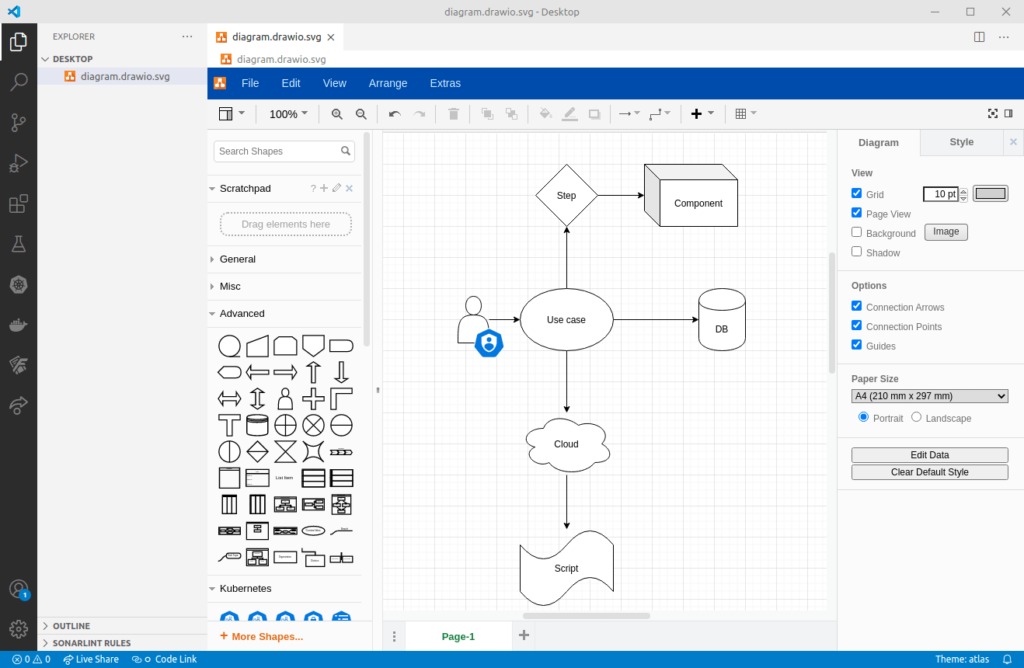
And even better, there is a Visual Studio Code extension that allows to edit diagrams locally, directly on your laptop, in Linux, Mac and Windows.

How do we integrate this with Antora? Very simple. In the assets/images folder of our documentation components, create your diagrams using the *.drawio.svg extension. These are automatically associated by Visual Studio Code with the extension, and provides a live editor with all the bells and whistles you might expect.

And then, well, just image::diagram.drawio.svg[] in your documents, git commit and push.

This approach is definitely more accessible to non-technical VSHNeers, making it super easy to edit diagrams online, or locally in Visual Studio Code.

To finish, here’s a Pro Tip™®©: switch the Draw.io extension to the “Atlas” theme, since some lines in the extension lack contrast, and aren’t easily seen when using a dark theme. You can change the Draw.io extension theme with the selector at the bottom right of the screen.

PS: there is an open issue in Kroki to add support for Draw.io diagrams. Can’t wait to see it in action!

Aarno Aukia

Aarno ist Mitgründer der VSHN AG und als CTO für die technische Begeisterung zuständig.

Kontaktiere uns

Unser Expertenteam steht für dich bereit. Im Notfall auch 24/7.

Kontakt
Tech

About Our ISO 27001 Certification And ISAE 3402 Type 1 Report

11. Nov. 2020
One of our core value propositions consists in making sure that our infrastructure responds to the highest levels of security, confidentiality, and availability.
It is with this goal in mind that we passed our first ISO 27001 certification in 2017, and this year we added an ISAE 3402 audit, initially requested by one of our customers in the financial sector.

ISO 27001

ISO 27001 is a worldwide applied standard for the certification of an information security management system (ISMS). Its aim is to protect information based on an analysis of business risks regarding confidentiality, integrity and availability.
The certification is valid for three years. Every year there is a monitoring audit done by the certification authority. This year the three year period for the first certificate ended. In spite of the ongoing worldwide pandemic we were able to renew this certification earlier this year with excellent results.
The audit required for the renewal not only didn’t raise any concerns, but rather praised positively our KPIs for ISMS, our thorough integration of information security into every single step of our operations, and the overall commitment of management to the whole process.
Our certification is valid for the next three years, and you can download it for review.

ISAE 3402

Service providers are recommended to use a recognized auditing company on their own behalf, which annually reports in a standardized form on the functioning of their internal controls.
This is done in order not to have to repeatedly expose its confidential internal processes, procedures and methods.
The most important international standard for companies in the financial sector in Switzerland is ISAE 3402.
The International Standard on Assurance Engagements (ISAE) 3402 is an internationally accepted audit standard issued and maintained by the International Auditing and Assurance Standards Board (IAASB). The ISAE 3402 is divided into two categories: ISAE 3402 Type I only assesses the suitability or design of controls, i.e. the control design and implementation. While the ISAE 3402 Type II additionally also evaluates the effectiveness of the controls during the test period, i.e. their definition and concrete implementation.
The ISAE 3402 Assurance Report examines the definition and implementation of control objectives as well as the existence and effectiveness of controls. The basic prerequisite for a successful audit is a complete and up-to-date documentation of the company organization, the IT organization and ICS-related issues. This includes an assessment of the existence and effectiveness of the internal control system, including the IT organization and IT security.
ISAE 3402 reports provide substantial added value to FINMA regulated firms, which must ensure conformity to circulars regarding outsourcing, such as Rundschreiben 2008/21 and Rundschreiben 2018/3.
On June 2020 our ISAE 3402 Report Type 1 got audited by ERM Solution AG. We are currently planning the establishment of our Type 2 report by January next year. This report ensures and supports the legal audits of our financial customers.
If your company requires a yearly ISAE 3402 report for audit or revision, please contact our sales and marketing team.

More Information

If you would like to know more about the differences between ISO 27001 and ISAE 3402, please check this link.
We remain at your service for any enquiry. Contact us if you need more information.

Aarno Aukia

Aarno ist Mitgründer der VSHN AG und als CTO für die technische Begeisterung zuständig.

Kontaktiere uns

Unser Expertenteam steht für dich bereit. Im Notfall auch 24/7.

Kontakt
Tech

Bewertung der Auswirkungen neuer Docker-Pull-Rate-Limits in APPUiO

3. Nov. 2020

Docker Inc., das Unternehmen, welches hinter Docker Hub steht, hat vor kurzem eine Beschränkungen der Image-Pull-Rate für Benutzer von Docker Hub angekündigt. Diese Änderung betrifft alle Cloud Native Installationen, die so konfiguriert sind, dass sie Container Images verbrauchen, welche in Docker Hub gespeichert sind, einer der populärsten Container Registries. Diese Massnahme hat direkte Auswirkungen auf den Einsatz vieler Kundenanwendungen, die derzeit auf APPUiO Public und privaten Clustern laufen.

Wir verfolgen die Situation aufmerksam. Nach den jüngsten Ankündigungen beginnt der Docker Hub langsam damit, eine Begrenzung der Abrufrate auf 100 Abrufe pro 6 Stunden für anonyme (nicht authentifizierte) IP-Adressen und 200 Abrufe pro 6 Stunden für authentifizierte kostenlose Benutzer durchzusetzen. Dies bedeutet, dass ein gesamter Kubernetes- oder OpenShift-Cluster ohne authentifizierung für alle seine Benutzer nur 100 Container Images in 6 Stunden von Docker Hub abrufen kann. Während Wartungsperioden werden üblicherweise die meisten Container Images eines Clusters abgerufen. Eine Reduzierung der Limite für die Abrufrate kann aus diesem Grund zu Ausfallzeiten führen.

Diese Situation sollte das heutige Wartungsfenster nicht beeinträchtigen. Obwohl die Beschränkung der Abrufrate am Montag, dem 2. Oktober 2020 angekündigt wurde, zeigt eine Analyse der „Responses“ von Docker Hub, dass die neuen Begrenzungen noch nicht angewendet wurden. Diese werden nur während eines 3-Stunden-Fensters von 18:00 bis 21:00 Uhr (MEZ) morgen durchgesetzt . Leider wissen wir zu diesem Zeitpunkt noch nicht, wann die neuen Pull-Rate-Limits vollständig durchgesetzt werden.

Bemerkenswert ist auch, dass diese Einschränkungen weder für die interne OpenShift-Registry gelten die in APPUiO Public oder Private enthalten ist und die völlig unabhängig vom Docker Hub ist, noch für Docker-Benutzer mit Pro- oder Team-Konten. Authentifizierte Benutzer mit Pro- oder Team-Konten können unbegrenzt Daten von und zum Docker Hub übertragen.

VSHN evaluiert derzeit Massnahmen, um Ausfallzeiten zu verhindern und die Auswirkungen dieser Situation für unsere Kunden zu reduzieren. Die derzeit geeignetste Lösung besteht in der Umstellung auf die oben genannten Pro- oder Team-Docker-Kontoarten. Noch einfacher ist die Verwendung eines authentifizierten Benutzerkontos als Pull Secret anstelle eines anonymen Kontos, das die Pull-Rate-Grenze verdoppelt und das Risiko von Ausfallzeiten erheblich verringern könnte. Eine andere Möglichkeit besteht darin, Container Images in ein anderes öffentliches Register zu migrieren, wie z.B. Red Hat Quay. Eine andere Möglichkeit ist die Verwendung eines privaten Registers, wie AWS ECR, GitLab Container Registry, Harbor oder andere ähnliche Technologien. Insbesondere hat AWS kürzlich die zukünftige Verfügbarkeit („innerhalb von Wochen“) eines kostenlosen öffentlichen Registers angekündigt.

Bei Fragen dürfen Sie uns gerne kontaktieren.

Gabriel Mainberger

Gabriel Mainberger ist ein DevOps-Ingenieur bei VSHN.

Kontaktiere uns

Unser Expertenteam steht für dich bereit. Im Notfall auch 24/7.

Kontakt
Allgemein Tech

How to migrate OpenShift 3 to OpenShift 4

9. Okt. 2020

Migrating OpenShift Container Platform (OCP) 3 to 4: learn about possible migration paths and why you should make the move to the new version of OpenShift.

Recap: what is OpenShift?

Red Hat OpenShift is a hybrid cloud, enterprise Kubernetes application platform for developers and business applications.
OpenShift provides a secure and stable platform for container-based deployments without the need for big IT investments. This means that much needed legacy applications can be used alongside new cloud native and container-based ones.
Red Hat OpenShift is a Kubernetes distribution. An extensive article with more details about Kubernetes and how Kubernetes compares to OpenShift can be found here.
OpenShift consists of platform, application, and developer services. It is used to manage workloads, build cloud-native apps, and to boost the productivity of developers.

(image: © Red Hat https://www.openshift.com/learn/what-is-openshift)

What’s new in OpenShift 4?

OpenShift 4 was introduced at the Red Hat Summit in May 2019. In this major release, Red Hat redefines Kubernetes for the enterprise through full stack automation. OpenShift 4 includes new technologies and functionality that results in self-managing, flexible, and automated clusters.
New key elements of OpenShift 4 include:

  • Immutable Red Hat Enterprise Linux CoreOS;
  • Operator framework;
  • OpenShift service mesh; and
  • Knative framework.

OpenShift 4 is Kubernetes at its core and in this release, Red Hat has completely re-architected how OpenShift is installed, upgraded and managed, introducing innovations such as Kubernetes Operators. Operators automate life cycle management of containerized applications with Kubernetes, and drives installation and upgrades of OpenShift and all of its services. This includes Kubernetes core services, along with Prometheus, Grafana, Elasticsearch, software-configured networking, storage, registry and other components of the OpenShift Kubernetes platform. OpenShift 4 is an Operator-driven platform that delivers full-stack automation from top to bottom.
OpenShift 4 also offers multiple cluster management across multiple clouds, and enables hybrid cloud services with Operators & OperatorHub. OpenShift 4 is designed to deliver a unified experience across hybrid cloud by driving automated installation and updates across Kubernetes deployments everywhere, all powered by Kubernetes Operators. OpenShift 4 is still built on top of Red Hat Enterprise Linux, and delivered in a new immutable form as Red Hat Enterprise Linux CoreOS.
OpenShift 4 also brings a number of new developer services and capabilities needed to build cloud-native applications, to deploy them consistently across any supported on-premises, private, or public cloud infrastructure.
Red Hat OpenShift 4 is Kubernetes for the Enterprise, designed to power businesses‘ digital transformation, and to unite development teams on a single platform.

What are the advantages of migrating to OpenShift 4

OpenShift 3 will only be supported until 2021, so besides the need to migrate to the new version, we also think that OpenShift 4 brings many advantages for both operators and users.
The level of maturity of operators leaves little to be desired. For the operation of a cluster, updates are much faster and at the same time, easier to handle and more stable. This also simplifies operations, as operators can react to changes and correct errors if needed. Operators are a new concept also for the operation of applications for users of OpenShift.
The switch from Docker to Buildah for container builds now allows to build container images in a more secure way. This is a welcome innovation for all multitenant clusters, such as public platform providers and corporate clusters with multiple users. With the introduction of the OpenShift Service Mesh, developers in particular will gain new insights and new possibilities to visualize, secure and optimize the communication of their applications.
OpenShift 4 represents a significant change in the way that OpenShift Container Platform clusters are deployed, managed, and developed upon. OpenShift 4 includes new technologies and functionality, for both developers and cluster administrators. Operators, Serverless, Service Mesh, and Red Hat Enterprise Linux CoreOS (RHCOS), are all new to OpenShift 4. They are redefining what’s possible with the next generation of Kubernetes platforms. This technology shift enables clusters to self-manage functions previously performed by administrators, and empower developers to innovate on a consistent and stable platform that is simple to install and scale.
The advantages of OpenShift 4 include:

  • Operators: implement and automate common Day-1 (installation, configuration, etc) and Day-2 (re-configuration, update, backup, failover, restore, etc.) activities in a piece of software running inside your OpenShift cluster, by integrating natively with Kubernetes concepts and APIs.
  • Red Hat Serverless: enables an application to consume only the compute resources necessary, scaling up or down automatically depending on usage. This removes the overhead of server provisioning and maintenance from the developer, letting them focus on application development instead.
  • Red Hat Service Mesh: controls how different parts of an application share data with one another through a built-in dedicated infrastructure layer. This visible infrastructure layer can track different parts of an app and their interactions, to optimize communications and to avoid downtime as it grows.
  • Red Hat Enterprise Linux CoreOS: combines the ease of over-the-air updates from Container Linux with the Red Hat Enterprise Linux kernel, to deliver a more secure, easily managed container host.

OpenShift’s goal is to help developers to innovate more rapidly, to address the needs of the business quicker. Cloud native application development brings new challenges. As developers adopt microservice architectures, managing the communication between each service, securing those services and getting better service to service traceability to debug issues is an absolute necessity. These are the challenges that the Istio open source project seeks to address.
The OpenShift 4 Service Mesh takes Istio and combines it with other key projects, like Jaeger for tracing and Kiali for visualization, to provide better manageability and traceability to microservices deployments. Developers can focus on building the business logic, letting the service mesh manage how each microservice communicates based on policies they define. They can also leverage the tracing and visualization capabilities to debug issues when they occur.
Development approaches haven’t stopped evolving, and serverless is yet another way developers are looking to build applications, by leveraging function as a service based offerings. The Serverless model enables scaling down to zero, so as to only consume compute resources when functions execute. This can be an effective way to control operational costs, particularly in the public cloud. FaaS offerings were first pioneered by public cloud providers like AWS, but have the potential to lock your applications into a single cloud environment. This is why Red Hat is working to bring these capabilities to a hybrid cloud environment via Knative.
Red Hat is an active member of the Knative open source project, collaborating with the Kubernetes community to drive upstream development that enables hybrid serverless capabilities. Using the Knative framework enabled in OpenShift, users can extend Kubernetes to build, deploy and manage serverless applications, supporting containerized and serverless deployments from a single Kubernetes control plane.

Who is OpenShift 4 for?

Almost a year after the initial release of OpenShift 4, we believe that OpenShift Container Platform 4 is ready for productive workloads.
If you are currently running OpenShift 3, you have to evaluate and plan migrating to OpenShift 4.
What are your options?

  • Do you want to run and operate OpenShift yourself?
    • This way you „keep full control“ and you decide on every detail with all the implications
    • Do you have enough staff with the needed know-how to run OpenShift operations yourself 24/7? This might mean that you have to re-train your staff and also re-engineer all operations tools.
      • You might need to hire new people or train your existing staff.
      • External consultants might be needed for specific tasks such as the setup or migration part.
  • Or do you want to work with a partner who takes care of your OpenShift installation and ensure 24/7 operations?
    • Work with a hyperscaler like AWS/Azure/Google Cloud etc.:
      • You are super flexible, you can spin up your own cluster and the additional tools you need and you can do everything yourself „at a fingertip“
      • But you are also bound to one platform and you have to ensure the actual 24/7 management and operations
    • Work with a specialized partner like VSHN / APPUiO:
      • You can be sure that you have the latest OpenShift know-how and enough people who take care of your operations, both on premises or in any cloud of your choice.
      • A certified, Swiss based Red Hat partner who knows how to run OpenShift even in the most sensitive areas and industries such as banking & finance with a focus on the business-relevant application, not the „generic platform“
      • You get Managed OpenShift, 24/7 operations, additional Managed Services for a recurring monthly fee, at the end you save time & money so that your people can focus on developing your product and / or services.

At the end, it’s not a question of if, but when to migrate to OpenShift 4.

How to migrate from OpenShift 3 to OpenShift 4

There is no planned update path from OpenShift 3 to 4. Red Hat provides migration tools, however, that can migrate not only the Kubernetes resources, but also the data from persistent volumes, where S3 Storage is used as a cache. The migration tool supports migrations from version 3 to 4 as well as migrations between different OpenShift 4 clusters.
According to the website openshift.com, the migration process from OpenShift 3 to 4 can be completed in 5 steps:

  1. Spin up a new cluster running OpenShift 4.
  2. Configure the new OpenShift 4 cluster.
  3. Create a migration plan which includes how to handle data from the applications that are being migrated.
  4. Run migration plan.
  5. Move your DNS or Load-balancer configuration to your new cluster.

To successfully transition from OpenShift Container Platform 3 to OpenShift Container Platform 4, it is important that you review the following information:

  • Planning your transition: Learn about the differences between OpenShift Container Platform versions 3 and 4. Prior to transitioning, be sure that you have reviewed and prepared for storage, networking, logging, security, and monitoring considerations.
  • Performing your migration: Learn about and use the tools to perform your migration:
    • Control Plane Migration Assistance Tool (CPMA): the Control Plane Migration Assistance tool helps you configure the new cluster OpenShift 4 cluster that will be the destination for the applications that are being migrated from your existing OpenShift 3 cluster. This tool reduces the possibility for human error in the configuration process, matching when possible the existing settings in the source cluster. It also allows you to review the resources that will be applied to the new cluster.
    • Cluster Application Migration Tool (CAM): the Cluster Application Migration tool (CAM) migrates stateful and stateless applications from the source cluster on OpenShift 3 to a destination cluster running the latest OpenShift. It also can migrate applications between OpenShift 4 clusters. It is installed on your destination cluster via an Operator. Through the rich user interface take advantage of the simplified, customizable workflows. Decide which applications to start with and which migration approach best fits each application and your needs.

If you need detailed instructions about your OpenShift migration, head over to this page to learn more about the migration process and how to utilize the migration tooling. And of course, if you need help with your migration, we will be very happy to help you.

VSHN and APPUiO

VSHN is a Red Hat Advanced CCSP partner and we offer Managed OpenShift since 2016 through our brand APPUiO, both in the cloud of your choice or on premises. In 2020, we are operating OpenShift clusters for 350 customers and partners in 16 clouds around the globe.
If you want to learn how we helped acrevis Bank in Switzerland with the move and how we operate OpenShift for them, check out our Success Story.

APPUiO OpenShift 4 Fact Sheet

Our APPUiO OpenShift Fact Sheet explains the benefits of OpenShift 4 in an easy to read 2-pager.

Download the Fact Sheet below.

OpenShift 4 Tech Labs

Join our free OpenShift 4 Tech Labs.
Need help migrating and operating OpenShift 4? Contact us, we are here to help.

Markus Speth

Marketing, Communications, People

Kontaktiere uns

Unser Expertenteam steht für dich bereit. Im Notfall auch 24/7.

Kontakt
Project Syn Tech

Second Beta Release of Project Syn Tools

23. Juli 2020

Without further ado, we’re announcing the release 0.2 of the Project Syn tools.
Since the first public release mid-March this year (read more about it in First Pre-Release of Project Syn Tools) we used the tools on a daily basis, in particular for the development of our new product „VSHN Syn Support“. And of course we have incorporated all of that experience in the source code. The main features are now in place, and are getting better and better on a daily basis.

New Features and Improvements

When reading the announcement of a new version, engineers are always interested in new features and improvements. So these are the most important new additions since 0.1:

  • Everything required for setting up a new cluster (GitOps repository, cluster config file in Tenant configuration, Vault secrets, and more) is now fully automated. One API call to register a new cluster and you’re done.
  • In parallel to the creation of clusters, we have also automated all steps required to decommission them (Repo deletion, Vault secret cleanup, and more). Just delete it and everything is gone (of course, there are preventive measures in place to not make this an Uh-oh moment).
  • Commodore got a lot of improvements: for local development, and for developing new components with a comprehensive cookiecutter template.

Document All The Things

Besides implementing new features and fixing bugs we put a lot of effort into the documentation. The main documentation page https://syn.tools/ got a completely new structure and a huge amount of new content. We’re in the process of adding new pages frequently, so make sure to check it out every so often.
Before 0.2 it was hard to get started with Project Syn and to understand what it was all about. To solve that issue we wrote the following introductions:

Our next goal is to document the concepts behind configuration management with Commodore in detail.

Commodore Components on GitHub

An important building block of Project Syn are Commodore Components. Over the past months we’ve written and open sourced more than 10 Commodore Components on GitHub. They offer the flexibility to install and configure Kubernetes system services, adapted to their respective distribution and infrastructure.
These Commodore Components can be found by searching for the „commodore-component“ topic on GitHub.
We are writing and refining more and more Components every day. We are going to publish some guidelines about how to write Commodore Components (one specifically for OpenShift 4 Components is already available) and eventually enforce them via CI jobs and policies.
An upcoming Component Writing Tutorial will help beginners to start writing own Components or contribute to existing ones.

The Road to 1.0 and Contributions

What we learnt while working on Project Syn over the last few months gave us a very clear picture of what we want to achieve in version 1.0. The roadmap contains the most important topics:

  • Documentation! We have to and will put a lot of effort into documentation, be it tutorials, how-to guides, or explanations.
  • Full Commodore automation to automate and decentralize the cluster catalog compilation process.
  • Developer experience improvements for simplifying the development of Commodore Components even further.
  • Engineering of a new tool helping users to launch managed services on any Kubernetes cluster.
  • Cluster provisioning automation integration, to leverage third party tools for automatically bootstrapping Kubernetes clusters.

This is not all; check the more detailed roadmap on the Project Syn page for more. The GitHub project will grow with issues over the next few weeks.
If you think that this sounds interesting and you would like to contribute, we now have an initial Contribution Guide available and are very open to suggestions and pull requests. Just get in contact with us if you’re interested.

Our Product: VSHN Syn Support

Besides the Open Source project we were also working on defining what added value you can get from VSHN. We call this product „VSHN Syn Support.“ If you’re interested in getting commercial support from VSHN for Project Syn on a Managed Kubernetes Cluster based on OpenShift 4 or Rancher, get in touch with us. More information about VSHN Syn Support can be found here.

Tobias Brunner

Tobias Brunner arbeitet seit über 20 Jahren in der Informatik und seit bald 15 Jahren im Internet Umfeld. Neue Technologien wollen ausprobiert und darüber berichtet werden.

Kontaktiere uns

Unser Expertenteam steht für dich bereit. Im Notfall auch 24/7.

Kontakt
Tech

How we manage 100+ Web Application Firewalls

26. Juni 2020

This is about how we manage large numbers of ModSecurity WAF deployments, including CRS and custom rules.

ModSecurity CRS Berne Meetup

At VSHN we’re not only 100% committed to Free and Open Source software, we also collaborate actively with the communities of the software we use, deploy and enhance. This June, we had the pleasure to join the OWASP ModSecurity Core Rule Set Berne Meetup group online who had asked us back in November at yet another Meetup to showcase the way we use ModSecurity and the Core Rule Set (CRS).

(mehr …)

Aarno Aukia

Aarno ist Mitgründer der VSHN AG und als CTO für die technische Begeisterung zuständig.

Kontaktiere uns

Unser Expertenteam steht für dich bereit. Im Notfall auch 24/7.

Kontakt