General Press

VSHN – the DevOps Company is official hosting partner of Spryker Systems

29. Aug 2018

VSHN AG and Spryker Systems GmbH agree on partnership

VSHN AG from Zurich and Spryker Systems GmbH from Berlin / Hamburg agree on a strategic cooperation to serve future e-commerce customers jointly with Spryker Commerce OS, the unique e-commerce operating system and VSHN as hosting partner for the 24/7 operation and support of the platform.

In a world of increasing device diversity and increasing complexity of customer behavior, Spryker enables companies to reach their customers across all current and future digital points of contact: online store, mobile apps, IoT scenarios, blockchain technology or bot and voice integrations. Spryker makes it possible.
With VSHN, Spryker Systems has chosen the leading Swiss partner for DevOps, container technologies such as Docker, Kubernetes, OpenShift and 24/7 Cloud Operations. VSHN helps software developers run their applications agile and 24/7 on any infrastructure while relieving the burden on IT operations.
The scope of services offered to Spryker by VSHN includes, among other things, Managed Servers, Managed Cloud and Managed Container Platforms including 24/7 Operations & Support, Service Management, Maintenance, Incident Management, DevOps Processes, Infrastructure-as-Code, Container Management and advanced consulting services such as conception, development of infrastructure & CI/CD processes, DevOps support and application performance management.

Patrick Kleine-Albers, Director Industry Partnerships, Spryker Systems GmbH: “With VSHN – the DevOps Company, we have won another partner who will provide our customers with professional and modern hosting solutions, container technologies and Platform-as-a-Service (PaaS) concepts and VSHN fits ideally into our agile development philosophy.”

Aarno Aukia, CTO, VSHN AG: “We are very pleased to be Spryker’s official hosting partner in the future and to be able to assist customers in operating their online shops and other e-commerce solutions based on the innovative Spryker Commerce OS. Through our close collaboration, we want to deliver the highest level of quality and support for our customers and help them implement their digital business processes through our highly secure and scalable hosting platform.”
VSHN and Spryker are already working together successfully in their first joint customer projects and the partnership will be further expanded in the long term. 

About Spryker

Spryker Systems develops the Spryker Commerce OS – a unique e-commerce operating system for the post-desktop and post-shop era
The rapidly growing number of user devices results in an increasing complexity of the customer journey. Spryker Commerce OS enables companies to develop highly individualised digital business models for B2C and B2B that reach customers through all digital touch points. Within short time frames, Spryker Commerce OS allows companies to implement new customer interfaces via frontend applications, such as the desktop shop, mobile apps, IoT scenarios, blockchain technologies or bot and voice integrations. This enables businesses to realise customer-centric sources of revenue without long lead times. Brands and manufacturers including Tom Tailor, Hilti or A.T.U are using Spryker Commerce OS. The Spryker Systems team is based in Berlin and Hamburg.
You can find more information about Spryker Commerce OS on the official website of Spryker Systems GmbH and on Twitter

About VSHN – The DevOps Company

VSHN AG is the leading Swiss partner for DevOpsDocker, Kubernetes, OpenShift and 24/7 Cloud Operations. VSHN helps software developers run their applications agile and 24/7 on any infrastructure while relieving the burden on IT operations.
Since 2014, we are serving more than 900 servers in 20 different clouds as well as on-premises at customer locations with a total of more than 62’000 services for 300 different customers and partners. We are ISO 27001 certified and work to the strict FINMA guidelines to ensure the security and confidentiality of customer information at all times.
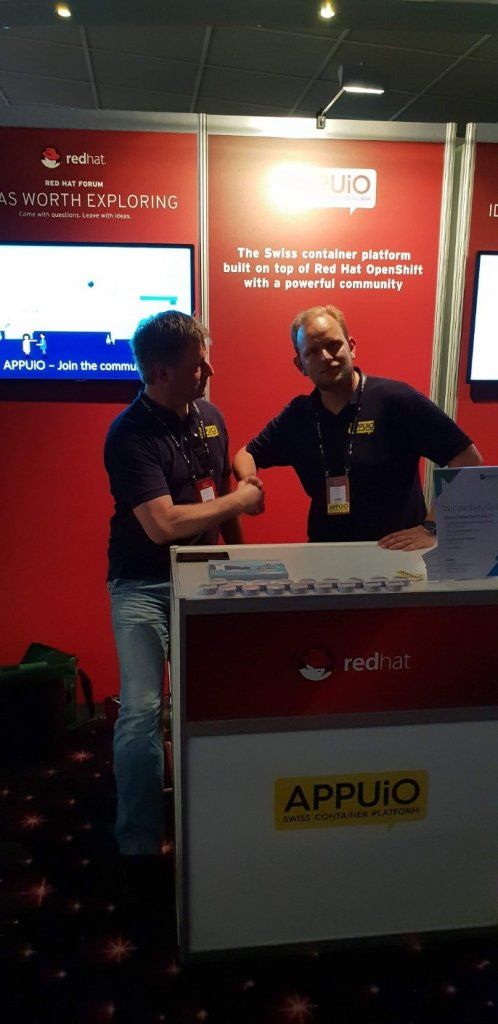
With APPUiO.ch, we have created a Red Hat OpenShift based Swiss container platform, where we can offer Managed Services as a PaaS solution (Platform-as-a-Service) on any infrastructure: public, dedicated, private and on-premises.
At VSHN, we believe in openness and transparency, so we let you decide where to store your data (we call this multi-cloud strategy). Either locally in your own data center (on-premise) or at a cloud provider location of your choice. Take a look at our services and learn more about our services and how we can possibly support you. Follow us on Twitter and don’t miss any news.

Markus Speth

Marketing, Communications, People

Contact us

Our team of experts is available for you. In case of emergency also 24/7.

Contact us
General

EU GDPR and US CLOUD Act

2. Aug 2018

EU GDPR and Swiss companies

It’s been already 2 months since the EU General Data Protection Regulation (GDPR) became enforceable on May 25th 2018 to protect data and privacy for all individuals living in the European Union and the new Swiss Data Protection Act is currently in the making.
But even if GDPR concerns EU and not Swiss law, it doesn’t mean that it’s not affecting Swiss companies. Swiss companies have to comply with GDPR if they are processing personal data of people located in the EU and the purpose of the processing lies in either offering goods or services to people or tracking user behavior, which is true for many Swiss companies.
Swiss companies affected by the new EU regulation have to inform and obtain the consent of the person whose data is processed, guarantee ‘Privacy by Design’ and ‘Privacy by Default’, report violations of data protection to the supervisory authority and much more.
You can learn more about GDPR for Swiss companies on kmu.admin.ch.

US Cloud Act

In stark contrast, the US Clarifying Lawful Overseas Use of Data Act (CLOUD Act) which was signed by the Trump administration in March 2018 and goes back to the Microsoft vs. United States case, allows federal law enforcement to compel U.S.-based companies via warrant or subpoena to provide requested data stored on servers regardless of whether the data is stored in the U.S. or on foreign soil.
That means that even if you choose an EU or Swiss server location but the service or cloud provider is an US company, they can be forced to hand over your customer data to the authorities.
But that would probably mean that you violate the GDPR regulation at the same time. So to sum up, this is quite an unsatisfactory situation for everyone and the US and EU should work on finding a solution to this issue.
Apple, Google and Facebook welcome the CLOUD Act while several civil rights groups including the Electronic Frontier Foundation (EFF) critize the bill. 

What does that mean for your company?

The long-term effects of these colliding regulations still have to be seen and the new Swiss Data Protection Act won’t come into effect until 2019. But that shouldn’t hold you back from thinking about your strategy.
In the end it depends on your specific business requirements and where you need to store your data. The issue demonstrates that it is a topic worth thinking about, both in a detailed and also a long-term perspective.
Our friend Mathias Brenner, CTO of Sherpany, wrote an excellent article about the CLOUD Act which goes into more detail and also talks about the recent acquisition of German Cloud Provider Brainloop by a US company and the resulting implications for their customers. 

How can VSHN help you?

We at VSHN – the DevOps company – believe in openness and transparency and therefore let you decide, where you want to store your data (we call that Multi-Cloud-Strategy). Either on-premises in your own data centers or at a Cloud Provider location of your choice. Head over to our services and find out more about what we do and how we can support you.
VSHN AG (pronounced ˈvɪʒn like “vision”) is Switzerland’s leading DevOpsDocker, Kubernetes, Openshift and 24/7 cloud operations partner. Since 2014 we support >300 customers & partners operating >900 servers in 20+ different clouds and on-premises with >62000 combined monitored services. We are ISO 27001 certified and work in accordance with the strict FINMA guidelines to ensure the security and confidentiality of customer data at all times.


Markus Speth

Marketing, Communications, People

Contact us

Our team of experts is available for you. In case of emergency also 24/7.

Contact us
General Internal Press

VSHN in der Presse im 2017

1. Feb 2018

Der Jahreswechsel ist ein guter Moment, um auf das vergangene Jahr zurück zu blicken: VSHN ist im 2017 mehrere Male positiv in der Presse aufgefallen:
Ende Juni 2017 sind wir in der ISG Provider Lens Switzerland 2017 Studie der Experton Group namentlich als “neue Anbieter in die Analyse aufgenommen worden, die im Markt an Bedeutung gewonnen haben”. Diese Studie wurde ebenfalls von InsideChannels.ch und IT-daily.net zitiert und verbreitet.
Mitte August 2017 hat unser Cloud-Partner Exoscale.ch einen langen Artikel zu OpenShift und VSHN veröffentlicht.
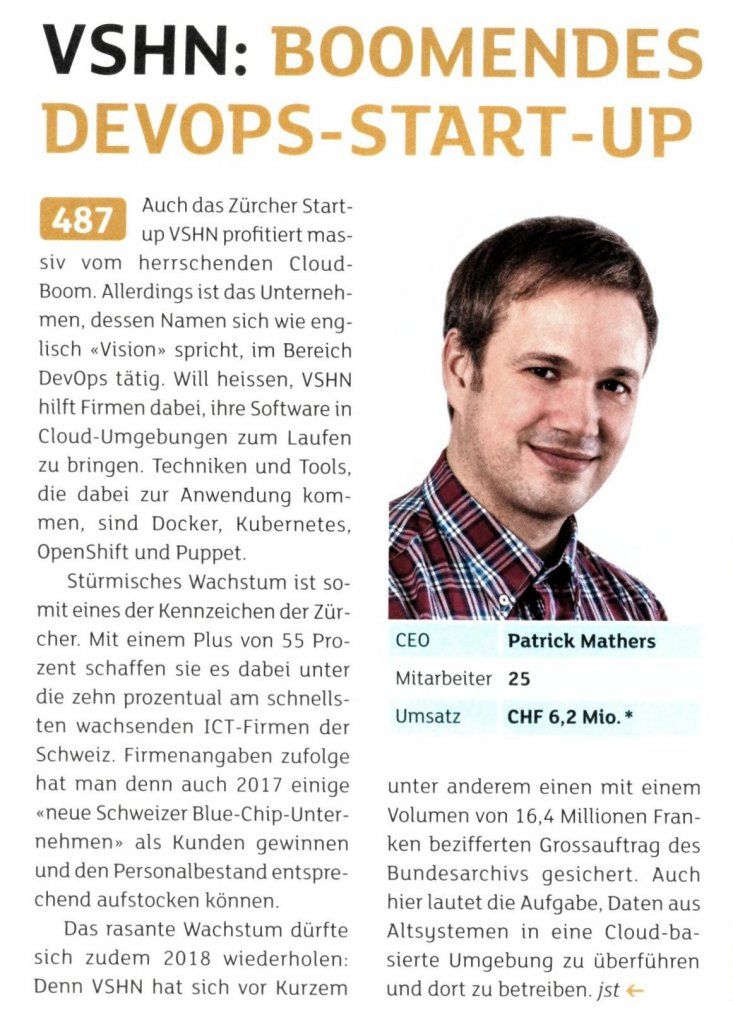
Ende August veröffentlichte Computerworld.ch das Ranking der stärksten ICT-Firmen der Schweiz, die VSHN ist von Platz 551 (2016) auf Platz 513 (2017) aufgestiegen. Gemäss Computerworld sind wir das am drittmeisten nach Prozentpunkten wachsende Unternehmen der Schweiz hinter zwei durch Fusionen und Übernahmen stark gewachsenen Firmen.

Im September 2017 wurde VSHN auch im Jahresbericht der Zürcher Hochschule für Angewandte Wissenschaften ZHAW als Forschungspartner erwähnt.
Im November 2017 wurden wir für einem Bericht der 10vor10-Nachrichtensendung des Schweizer Fernsehens zum Thema Beschäftigung von Flüchtlingen interviewt. 

Aarno Aukia

Aarno is Co-Founder of VSHN AG and provides technical enthusiasm as a Service as CTO.

Contact us

Our team of experts is available for you. In case of emergency also 24/7.

Contact us
General Internal

3 years of VSHN: new website on-line

30. Oct 2017

We’re happy to publish our new website just in time for the third anniversary since the founding of VSHN.ch. In addition to more elaborate pages about our technologies and products we now also have a less technical area – our solutions. Here we try to explain the benefits of our solutions for a business executive: to get back time, to reduce cost and to increase security.
To get to know what and who is behind all of this you can have a look at the team of VSHNeers. Our blog is sill filled with fresh topics about technology, events and stories from behind the scenes (VSHNinternal) and now also supports posts in multiple languages – you can change between the german and english version of this post in the menu above. New is the separate page jobs.
Of course we included a few easter eggs in our new site – write us when you find them and we’ll send you a small surprise!
Being agile, this website is a “minimal viable product – MVP” for us: we are going live as soon as we have approximately the same contents as on the old site. Now we have a good basis to continuously improve our site and expand the contents.
For that we are dependent on your feedback: what do you think should be the next thing to be improved? Please share your opinion with us using the form below:

Aarno Aukia

Aarno is Co-Founder of VSHN AG and provides technical enthusiasm as a Service as CTO.

Contact us

Our team of experts is available for you. In case of emergency also 24/7.

Contact us
General Tech

What is DevOps – what does VSHN do?

16. Feb 2016

DevOps is a common term, but unfortunately as vague as “Cloud”: everyone knows that they want or need it and yet it is not something you can simply order and get delivered.
By DevOps we mean the interdisciplinary cooperation between developers and operators of software in order to deploy the applications quickly and systematically.

Similar to agile software development (e.g. Scrum) – where the “product owner” specifies the next development steps together with the software developers and takes over finished work – this promotes communication between the parties involved and reduces misunderstandings and thus expensive errors.
The promotion of cooperation between developers and operators contrasts with the previous practice of strictly separating these teams – whether for reasons of separation of powers (no access by developers to production data) or because developers and operators had to fulfill different requirement profiles (programming skills, on-call service).
In the meantime, however, a number of findings and proven methods from software development have also arrived in the operating processes:

  1. Infrastructure as Code: the description and configuration of infrastructure components using scripts to quickly and reliably automate recurring tasks (e.g. installation of a server or installation/upgrade of an application). Depending on the application and environment, there are different tools – Docker, Ansible, Puppet, SaltStack, etc. – which already have their own frameworks and ecosystems with ready-made building blocks for standard components.
  2. Test systems: if the setup of a server is completely automated, this minimizes the effort to create one or more test servers. If developers can use a test server that is the same as a production server, they can find errors before they occur in production.
  3. Versioning: if the infrastructure or at least parts of it are mapped in code, it can be managed with well-known code versioning tools (Git, SVN, etc.). This makes it possible to track changes to the infrastructure (“Who changed what when?”, “Why does it suddenly no longer work even though the software hasn’t been changed?”) and to roll back changes completely in case an error should occur.
  4. Continuous integration of the infrastructure code: just as the actual application is compiled automatically with each change and tested functionally both component by component and as a whole, the requirements for the infrastructure can also be verified with automated tests. The effects are minimized by detecting an error as early as possible. For example, publishing changes can be blocked if errors occur during testing.

Conversely, experience gained during operation also flows into modern software architectures:

  1. Packaging and version management: to ensure that all persons involved speak of the same version of the software throughout the entire quality assurance process from test / development server, acceptance by the product owner, possible external testing / validation (beta, user, UX tests), integration with external interfaces (backends, APIs) to production, the software is stored in a versioned package. The type of packaging can be determined by the development environment (e.g. JAR for Java, WAR for Tomcat) or operating environment (e.g. DEB/RPM for Linux, MSI for Windows), or it can also be independent in the case of Docker. This ensures that the software can be installed and updated completely (with all required libraries) and automates these steps as far as possible.
  2. Service Oriented Architectures (SOA) and Microservices: as soon as an application becomes so extensive and/or complex in development that more than a handful of teams take care of it, it is easier to divide the teams into smaller sub-projects (“microservices”) and explicitly define the interfaces between them than to coordinate all teams with each other in the same “project” regarding technology, development progress and internal responsibilities. This not only allows the teams to develop in a decoupled way, but also allows them to choose more suitable technologies for their purpose – provided that the interface to other teams does not change. Ideally, most components / services would be fault-tolerant with each other, i.e. if a sub-component with limited functionality fails, they would continue to function, making the overall project more robust.
  3. Configuration Management: most applications have interfaces to other applications – for example to a database or other APIs / services – and write log files. During development, quality assurance testing and production, different endpoints (addresses, credentials, etc.) are used. This allows the isolation of test and production data, so a test of a new version cannot accidentally delete the production customer data. This is why the access data is not managed directly in the code, but in configuration files, which in turn can be generated automatically for each environment or read from environment variables. A modern definition for this is, for example, the twelve-factor method (http://12factor.net/de/).
  4. Scalability: applications and services that have clearly defined interfaces can easily be scaled horizontally, i.e. distributed across different servers. This enables the company to offer the service multiple times, redundantly and thus highly available and to react to different loads by adding or removing servers. Even these steps can be automated: It is possible to automatically obtain or release more server resources based on the current load and, depending on the billing model of the individual resources, to produce costs only if the service is also used effectively.

What does the fusion of development methods and operating processes bring in concrete terms?

  1. The automation of the infrastructure (see “Infrastructure as Code” above) makes the infrastructure faster, more reliable and prevents inconsistencies due to (missing) manual steps on different systems. It enables developers and product owners to effectively test their results under the same conditions as production.
  2. Automating the software lifecycle from development to production makes the whole process faster, more reliable, and can best be done by the product owner himself after the release of the latest version. Thus, after the developers, the operators also give the business the reins for the application into their own hands and are available for further developments. The product owner can thus determine both the scope and the frequency of the deployments. The more frequently a product is rolled out, which means that the scope of the respective changes is smaller, the smaller is the risk of undesirable side effects and errors. If errors nevertheless occur, the product owner himself can reverse the last change and call on the developers to remedy the situation without penalizing the company.
  3. Both together prevent IT from blocking the critical path of the project as an end in itself and enable the developers and the business to “self-service”. Of course, this also means a cultural change within a company: if a deployment fails or problems occur in production, then developers and business people have to solve the problem together and make sure that it does not happen again (e.g. by means of automatic testing). It doesn’t matter why or because of whom the problem occurred: no “culprit” has to be found, but the whole process has to be continuously improved.

We at VSHN do nothing all day long but automate different development processes, different technologies, different backends (databases, cache servers, proxies, WAFs, etc.) and operate them according to the requirements of our customers and / or development partners on any infrastructure – be it public clouds such as Amazon, Azure, Cloudscale.ch, Cloudsigma, Exoscale.ch, Safe Swiss Cloud, Swisscom Cloud or private, i.e. company-internal infrastructures on a VMware or Hyper-V basis.
We advise our customers on the location of data storage (CH, EU, international), will soon be ISO27001-certified ourselves and, together with our partners, can offer hosting in accordance with the FINMA standard.
Our core values are trustworthiness and availability of professional competence. Trustworthiness and security through transparency: transparent communication of processes, transparent order definitions and billing models. We work agilely with our clients and communicate regularly. We are available 24×7 around the clock and proactively take care of “our” applications.
We are VSHNeers.

Markus Speth

Marketing, Communications, People

Contact us

Our team of experts is available for you. In case of emergency also 24/7.

Contact us